Motorcycle Theory Test UK: Format, Pass Mark & How to Pass
The motorcycle theory test is the written exam every learner rider must pass before the practical motorcycle test — and yes, you need it even if you already hold a full car licence. It works like the car theory test (50 multiple-choice questions plus hazard perception), but the questions are written for riders, from the book Riding — The Essential Skills. This guide covers who must take it, the format, the pass mark, and how to pass first time.
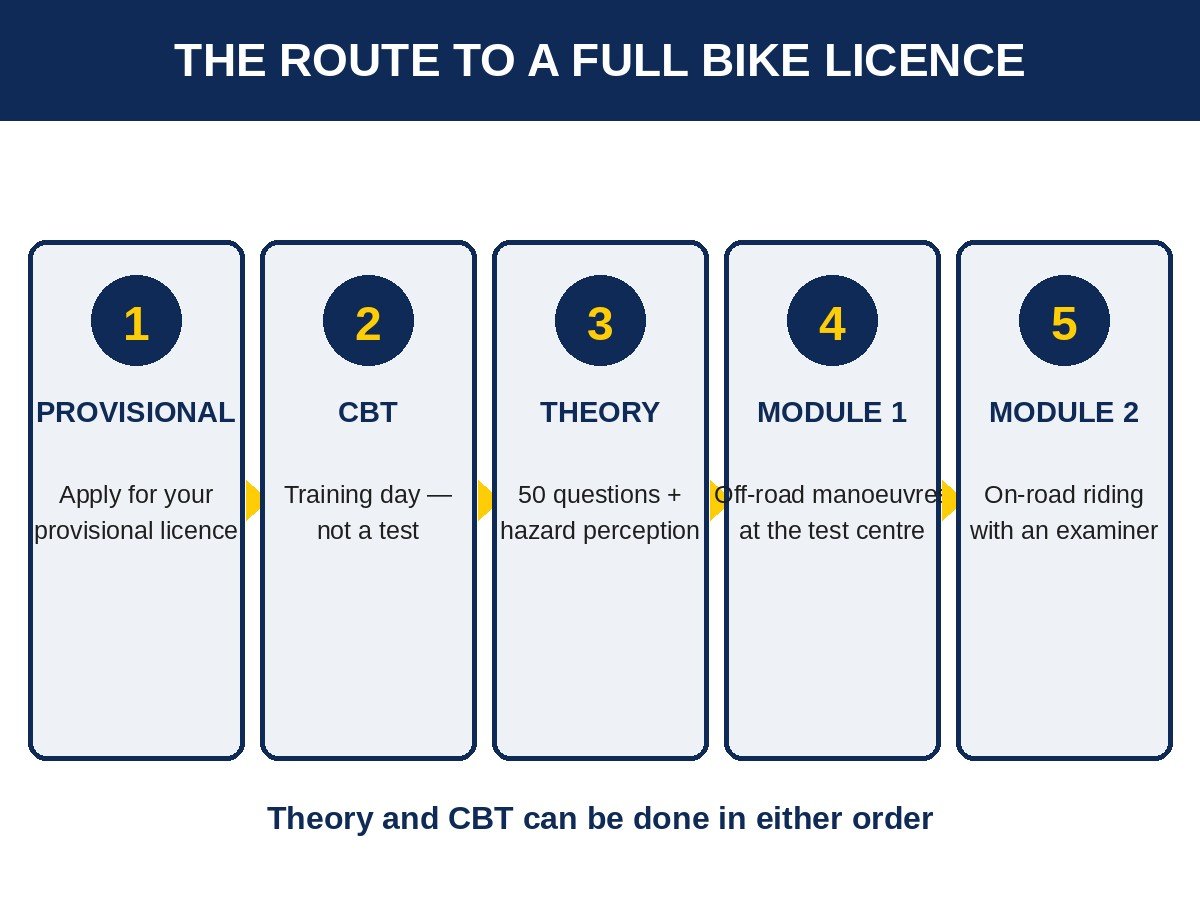
The motorbike theory test sits in the middle of the licence journey: you need a provisional licence with motorcycle entitlement to book it, and you cannot take practical Modules 1 and 2 until you have passed it.
Motorcycle Theory Test at a Glance
| Section | What happens | Key number |
|---|---|---|
| Multiple choice | 50 rider-specific questions in 57 minutes | Pass mark: 43 out of 50 |
| Hazard perception | 14 video clips; click as each hazard develops | Pass mark: 44 out of 75 |
| Pass certificate | Use the certificate number to book practical Modules 1 and 2 | Valid for 2 years |
What Is the Motorcycle Theory Test?
It is a two-part computer test taken at a DVSA test centre. The first part is 50 multiple-choice questions about riding safely and legally. The second part is hazard perception: 14 video clips where you click when you see a hazard developing. You book and take both parts as one test, and you must pass both to pass overall.
Who Must Take the Motorcycle Theory Test?
Almost every learner rider. The rules that catch people out:
- Car licence holders must take it. A full car licence (and even a passed car theory test) does not count. GOV.UK is explicit: you have to pass a motorcycle theory test before taking the motorcycle test.
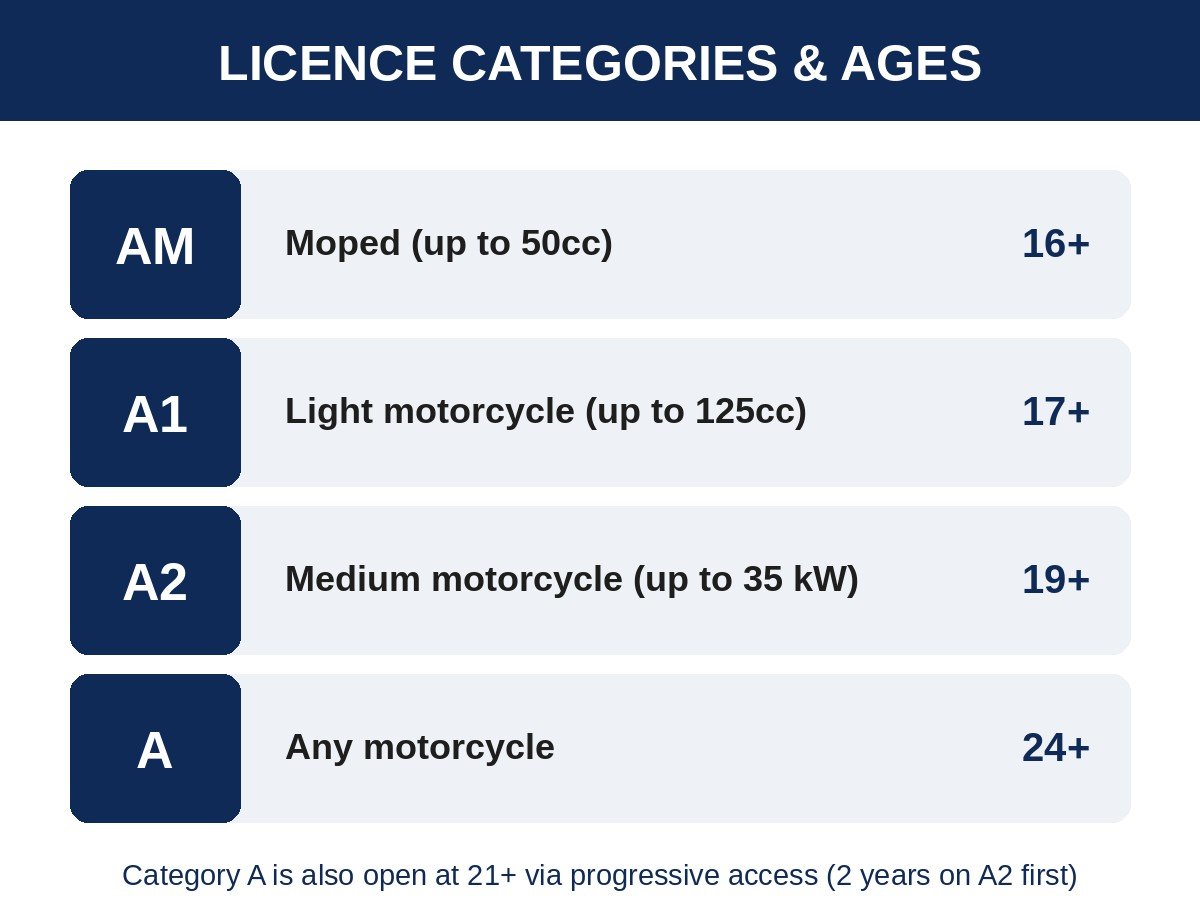
- Ages: from your 16th birthday for a moped (up to 50cc), and from your 17th birthday for a motorcycle.
- The one exemption: if you passed a moped test after 1 July 1996, you do not need the theory test for a category A1 test, or when upgrading under the progressive access rules.
Motorcycle Theory Test Format
- Multiple choice: 50 questions, 57 minutes. You can flag questions and come back to them, and you may take a break of up to 3 minutes before part two.
- Case study (changing soon): until 28 October 2026, some questions come as a case study — a short real-life story with 5 questions on it. From 29 October 2026, three questions are instead based on a short silent video of a riding situation, matching the car test.
- Hazard perception: 14 clips, one of them with 2 developing hazards. Each hazard scores up to 5 points for spotting it early. Clicking constantly or in a pattern scores zero for that clip.
The Pass Mark
You need 43 out of 50 on the questions and 44 out of 75 on hazard perception — the same marks as the car test, explained in our theory test pass mark guide. You get the result at the test centre straight away.
Pass, and your pass certificate number lasts 2 years. You must pass both practical modules inside those 2 years or you take the theory test again. Fail either part and you fail the whole test: wait at least 3 working days, rebook, and retake both parts.
How the Questions Differ From the Car Test
The Highway Code and traffic-sign questions overlap with the car test, but a large share of the motorcycle paper is rider-specific, drawn from Riding — The Essential Skills. Expect topics like:
- Riding in wind, rain and poor weather, and how a bike behaves differently from a car.
- Carrying a pillion passenger and luggage, and how weight changes handling and braking.
- Filtering through traffic, road positioning and observation routines.
- Protective clothing and helmets — what the law requires and what keeps you alive.
- Motorcycle controls, basic machine checks and security.
This is why car drivers cannot rely on their car knowledge alone. Use our mock theory test approach — timed practice, topic by topic — with motorcycle questions from the official DVSA kit or the Theory Test for Motorcyclists book.
CBT and the Theory Test: Which Comes First?
Either order is allowed. Compulsory Basic Training (CBT) is a training day, not a test, and you need it (or a full licence) before riding on public roads on L plates. Many riders do CBT first to start riding a 125, then take the theory test while gaining road experience. Others pass the theory test first so nothing delays their Module 1 and 2 bookings. Your theory certificate’s 2-year clock starts on the day you pass, so do not take it years before you plan to finish.
How to Revise and Pass First Time
- Study the three set books: The Highway Code, Know Your Traffic Signs, and Riding — The Essential Skills. Every question comes from these.
- Take timed motorcycle mocks until you score 47+ three times in a row — the same readiness rule as the car test.
- Learn signs separately: 128 official traffic-sign flashcards exist because signs are the most common weak topic.
- Practise hazard clips properly: click once, early, when a hazard starts to develop — never in a rhythm.
- Bring the right ID: your photocard licence. No licence on the day means a cancelled test and no refund.
After You Pass: Modules 1 and 2
With a theory pass in hand you can book the practical motorcycle test: Module 1 (off-road manoeuvres at a test centre) and Module 2 (on-road riding). Pass both within your theory certificate’s 2 years and you get the full licence for the category you tested on. If the certificate expires first, the theory test must be passed again before any more practical bookings.
Official source: GOV.UK motorcycle theory test guidance.
Conclusion
The motorcycle theory test is the same shape as the car test — 50 questions, 43 to pass, 44 out of 75 for hazard perception — but with rider questions that catch out even experienced car drivers. Remember the three things learners get wrong most: car licences do not exempt you, the certificate only lasts 2 years, and CBT can be done before or after. Revise from the three set books, practise with timed mocks, and the test itself holds no surprises.