HGV Theory Test: CPC Part 1 Explained (Format & Pass Marks)
The HGV theory test is Part 1 of the Driver CPC — the qualification you need alongside your lorry licence to drive professionally. It is much bigger than the car theory test: 100 multiple-choice questions instead of 50, a higher pass mark of 85, and a separate hazard perception test with 19 clips. This guide explains the format, both pass marks, the case studies test that follows, and how to pass first time. The same test structure applies to bus and coach (PCV) drivers, with questions for their vehicle type.
Before you can book it, you need a full car licence and provisional entitlement for the lorry or bus category on your provisional licence — for lorries that starts with a medical. You must also be at least 18 for most lorry categories.
Driver CPC Theory Tests at a Glance
| Test | Format | Pass mark |
|---|---|---|
| Part 1a — multiple choice | 100 questions in 1 hour 55 minutes | 85 out of 100 |
| Part 1b — hazard perception | 19 video clips with 20 developing hazards | 67 out of 100 |
| Part 2 — case studies | 7 professional-driving case studies, scored out of 50 | 40 out of 50 |
What Is the HGV Theory Test?
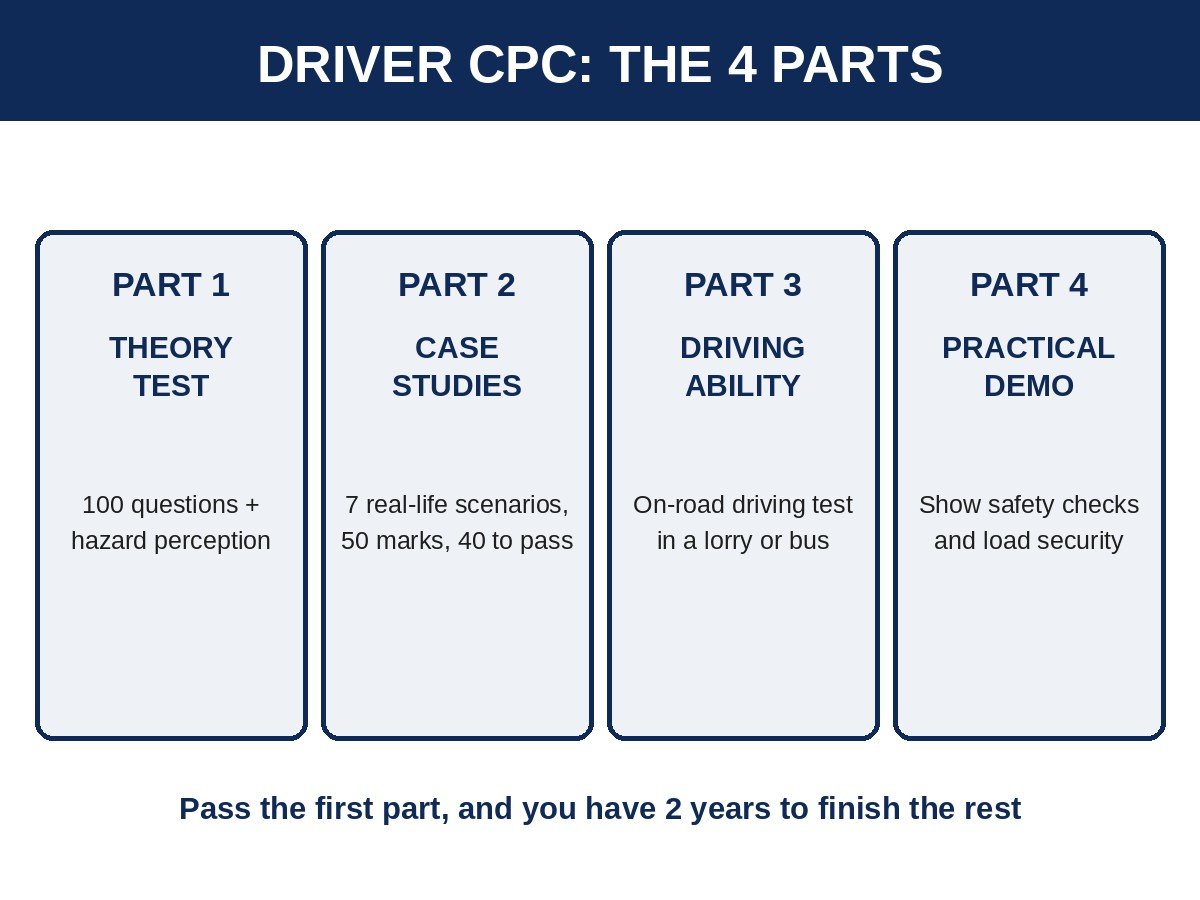
It is the theory stage of the Driver Certificate of Professional Competence (Driver CPC), taken at a DVSA test centre on a computer. Passing it does not give you a licence on its own — it is step one of four parts that together qualify you to drive a lorry, bus or coach for a living. Parts 1 and 2 are knowledge tests; Parts 3 and 4 are practical.
HGV Theory Test Format: Parts 1a and 1b
Unlike the car test, the two halves of Part 1 are booked as separate tests. You can sit them on the same day or on different days, and each is marked on its own:
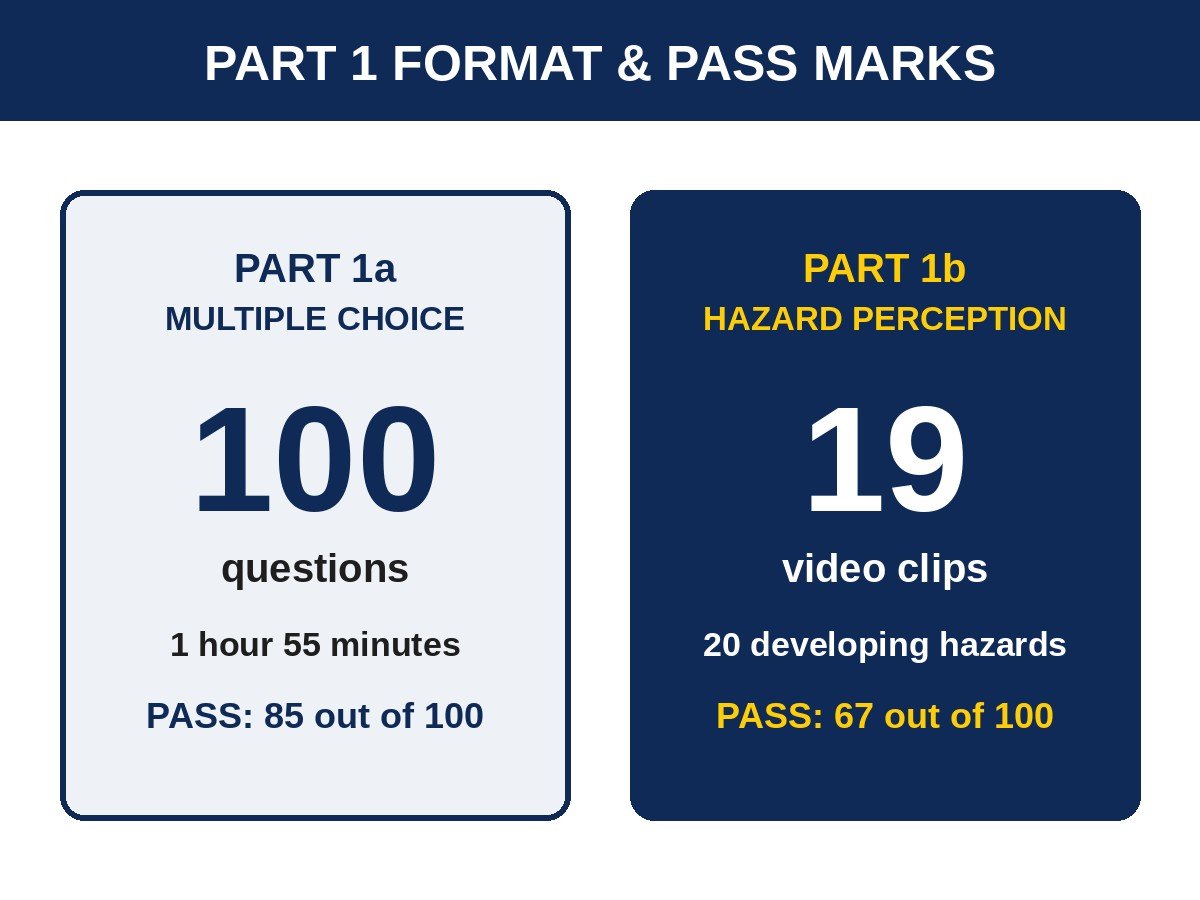
- Part 1a — multiple choice: 100 questions in 1 hour and 55 minutes. Some questions have more than one correct answer. You can flag questions and return to them. Pass mark: 85 out of 100.
- Part 1b — hazard perception: 19 video clips of everyday road scenes, with 20 developing hazards in total (one clip has two). Each hazard is worth up to 5 points for spotting it early. Pass mark: 67 out of 100. Clicking continuously or in a pattern scores zero for that clip.
The Pass Marks and Your Results
You get a result letter at the test centre for each part as you take it. Pass one part and fail the other, and you only retake the part you failed — but you must wait at least 3 working days before retaking it. When you have passed both parts, your certificate is posted to you, and you can book Part 3.
One clock matters: from the day you pass the first part of the Driver CPC, you have 2 years to complete the remaining parts. Miss that window and the passes expire — you start again.
Part 2: The Case Studies Test
Part 2 is the second knowledge test, and many learners group it with the theory test. It presents 7 case studies — short stories based on situations from a professional driver’s working life — with multiple-choice questions on each. The test is scored out of 50 and the pass mark is 40. Parts 1 and 2 can be taken in any order, but most drivers finish Part 1 first.
How the HGV Questions Differ From the Car Test
The Highway Code foundation is the same, but an 85-out-of-100 pass mark on 100 questions leaves far less room for guessing, and a large share of the paper is professional and vehicle-specific:
- Drivers’ hours, rest periods and tachographs.
- Load security, weight limits, and height and width restrictions.
- Speed limits for large vehicles, which are lower than for cars.
- Braking systems, vehicle checks and defect reporting.
- Fuel-efficient and safe driving with a high, heavy vehicle.
Revision works the same way as for cars — our mock theory test method of timed practice and topic tracking — but use the official DVSA material for drivers of large vehicles so the questions match your test.
How to Revise and Pass First Time
- Use the official large-vehicle book: every Part 1a question comes from the DVSA’s theory test material for lorry and bus drivers, built on The Highway Code and Know Your Traffic Signs.
- Practise at full length: a 100-question paper is an endurance test. Do complete timed mocks, not just short quizzes.
- Aim for 92+ in practice: with an 85 pass mark, a practice average in the low 90s leaves a safe margin for a hard paper.
- Learn hazard timing separately: 19 clips and a 67 pass mark reward early spotting, exactly as in the car test — but there are more hazards to find.
- Plan bookings sensibly: take 1a and 1b close together while the revision is fresh, and keep the 2-year completion window in mind before you start.
After You Qualify: Keeping Your Driver CPC
Passing all four parts earns your Driver Qualification Card (DQC). To keep driving professionally you must complete 35 hours of periodic Driver CPC training every 5 years. Driving professionally without a valid CPC — or without carrying your card — can lead to a fine of up to £1,000.
Official source: GOV.UK guidance on becoming a lorry or bus driver.
Conclusion
The HGV theory test is the car test’s bigger, stricter sibling: 100 questions with 85 to pass, 19 hazard clips with 67 to pass, booked as two separate tests inside the four-part Driver CPC. The traps are taking it lightly because you passed the car test years ago, and ignoring the 2-year clock for finishing the other parts. Revise from the official large-vehicle material, practise at full length, and Part 1 becomes a formality. Working through the other theory tests too? See our guides to the motorcycle theory test and the car test pass marks.