Driving Licence Codes Explained: What the Numbers Mean (2026)
Turn your photocard over and you will find small numbers printed in column 12, against each licence category. These are driving licence codes — conditions set by DVLA that you must meet every time you drive. Some are harmless (115 simply records that you are an organ donor), but others are legal requirements: code 01 means you must wear your glasses or contact lenses, and driving without them is an offence. This guide explains every UK code, where it comes from, and what to do if one is wrong.
You can also see your codes online through the driving licence check code service, which shows the same record an employer or hire company would see.
What Are Driving Licence Codes?
Driving licence codes are the numbers printed in column 12 on the back of your photocard licence, next to the vehicle categories you hold. GOV.UK defines them simply: they tell you what conditions you must meet to drive. A code can apply to one category only, or to all of them. Most drivers have no codes at all — a blank column 12 is normal. Codes appear only when DVLA has a reason to attach a condition or a note to your licence.
The Most Common Driving Licence Codes
| Code | What it means |
|---|---|
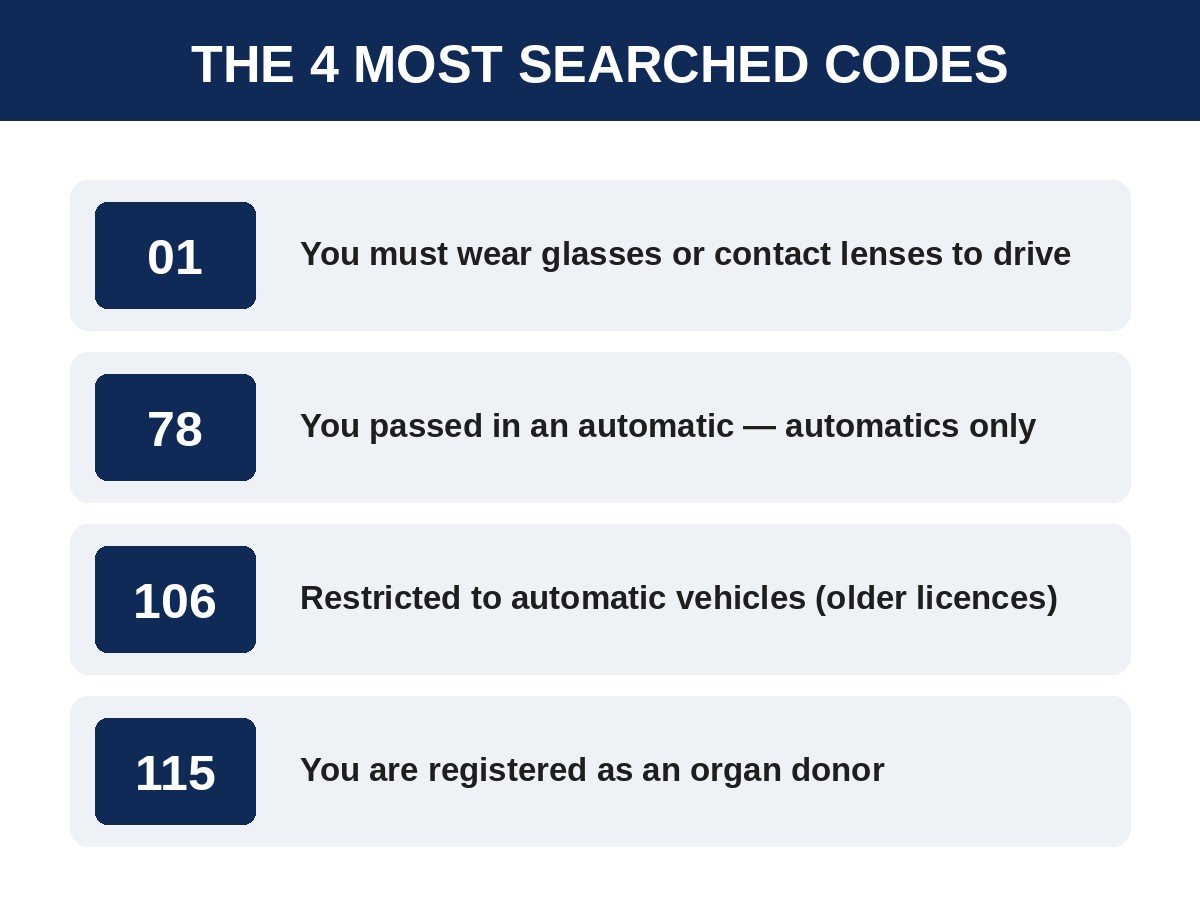
| 01 | Eyesight correction — you must wear glasses or contact lenses when driving. |
| 02 | Hearing or communication aid required. |
| 70 | Exchange of licence (your licence was exchanged from another country). |
| 71 | Duplicate of licence (a replacement for a lost or stolen one). |
| 78 | Restricted to vehicles with automatic transmission — you passed your test in an automatic. |
| 79 | Restricted to vehicles matching the specifications in brackets on your licence. |
| 96 | You may drive a car and trailer where the trailer is at least 750kg and the combination is between 3,500kg and 4,250kg. |
| 97 | Not allowed to drive category C1 vehicles that must have a tachograph fitted. |
| 101 | Not for hire or reward — you may not drive that vehicle to make a profit. |
| 102 | Drawbar trailers only. |
| 106 | Restricted to vehicles with automatic transmission (found on older licences). |
| 108 | Subject to minimum age requirements. |
| 111 | Limited to 16 passenger seats. |
| 115 | Organ donor. |
| 118 | Start date shown is for the earliest entitlement. |
| 122 | Valid on successful completion of the Basic Moped Training Course (CBT). |
Medical and Vehicle Adaptation Codes (10–44)
These codes appear when a driver needs the vehicle adapted, or must use an aid, to drive safely. They usually follow a medical notification or a driving assessment:
- 10 — modified transmission. 15 — modified clutch. 20 — modified braking systems. 25 — modified accelerator systems.
- 30 — combined braking and accelerator systems (licences issued before 28 November 2016). 31 — pedal adaptations and pedal safeguards. 32 — combined service brake and accelerator systems. 33 — combined service brake, accelerator and steering systems.
- 35 — modified control layouts. 40 — modified steering. 42 — modified rear-view mirror(s). 43 — modified driving seats.
- 44 — modifications to motorbikes, with sub-codes 44 (1) to 44 (12) covering adapted brakes, accelerator, transmission, mirrors, controls, seat height, foot rest and hand grip. 45 — motorbikes only with sidecar. 46 — tricycles only (licences issued before 29 June 2014).
Restriction and Information Codes (79–125)
- 79 (2) — restricted to category AM 3-wheel or light quadricycle vehicles. 79 (3) — restricted to tricycles.
- 103 — subject to a certificate of competence. 105 — vehicle not more than 5.5 metres long. 107 — not more than 8,250kg.
- 110 — limited to transporting persons with restricted mobility. 113 — limited to 16 passenger seats except for automatics. 114 — with any special controls required for safe driving.
- 119 — weight limit for the vehicle does not apply. 121 — restricted to conditions in the Secretary of State’s notice. 125 — tricycles only (licences issued before 29 June 2014).
How to Get a Code Removed or Changed
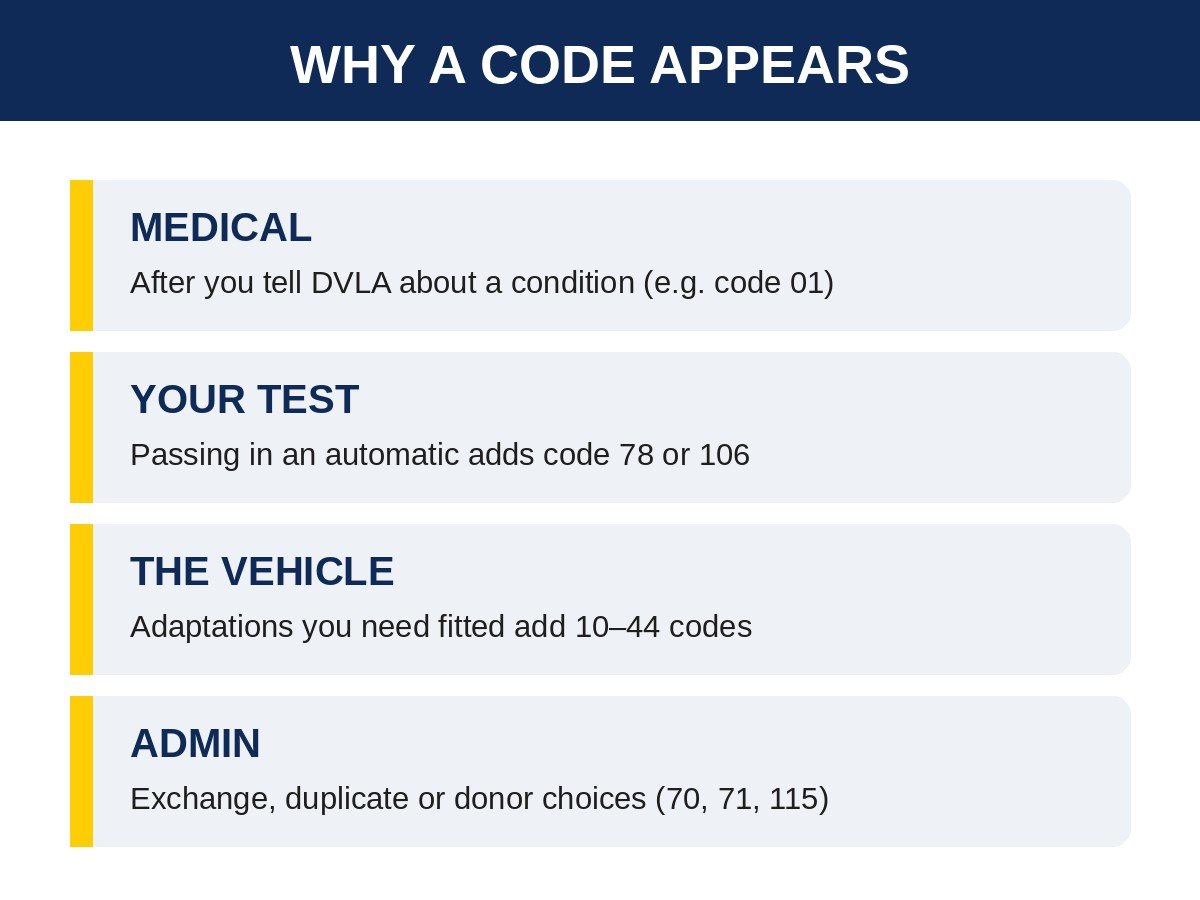
Codes are not all permanent. A code added after a medical condition can be reviewed when your condition changes — the process runs through DVLA’s medical team, the same route covered in our guide to DVLA medical conditions. Code 01 is the best example: if your eyesight is corrected by laser surgery so you meet the standard unaided, you can ask DVLA to remove it with evidence from your optician or doctor. Our eyesight requirements guide explains the standard you must meet.
- Code 78/106 (automatic only): removed by passing a practical test in a manual car — pass, and the restriction disappears.
- Wrong code on your licence: contact DVLA with evidence; mistakes are corrected and a new licence issued.
- Adaptation codes (10–44): reviewed after a new driving assessment if your needs change.
What Happens If You Drive Against a Code?
Driving in breach of a code is driving otherwise than in accordance with your licence — the same offence as driving without the right licence at all. You can be fined, given penalty points, and in serious cases disqualified. Your insurance can also be invalidated, because you told the insurer you were licensed for a vehicle you were not entitled to drive in that condition. The most common everyday example is code 01: driving without the glasses or lenses your licence requires.
Official source: GOV.UK driving licence codes.
Conclusion
Driving licence codes look like fine print, but they are legal conditions. Check column 12 on the back of your licence today: know what each number means, follow any that apply to you, and challenge a code that is wrong or out of date through DVLA. The list above is the full official set — if a code is not here, it is not a current UK code.