Can I Drive a Lorry on a Car Licence? (UK Rules)
Can I drive a lorry on a car licence in the UK? For most drivers, mostly no. A standard Category B car licence only covers lorries up to 3,500kg MAM (maximum authorised mass) — that means small vans and light lorries, not the big vehicles you see on motorways. Anything heavier needs extra entitlement: C1 for 3,500–7,500kg, C for rigid lorries over 3,500kg, and CE for articulated lorries. And if you want to drive lorries as a job, you also need Driver CPC. There is one big exception — drivers who passed their test before 1997 — explained below. (Note: GOV.UK calls these vehicles HGVs or large goods vehicles; ‘lorry’ is the everyday word for the same thing.)
Lorry Categories at a Glance
| Category | Vehicles and weight | Trailer rule |
|---|---|---|
| B | Up to 3,500kg MAM, or 4,250kg for zero-emission vehicles | Standard car towing limits apply |
| C1 | 3,500kg to 7,500kg MAM | Trailer up to 750kg |
| C1E | C1 vehicle with a heavier trailer | Combined maximum 12,000kg |
| C | Rigid lorries over 3,500kg MAM | Trailer up to 750kg |
| CE | Category C vehicle, including articulated lorries | Trailer over 750kg |
What Your Car Licence (Category B) Actually Covers
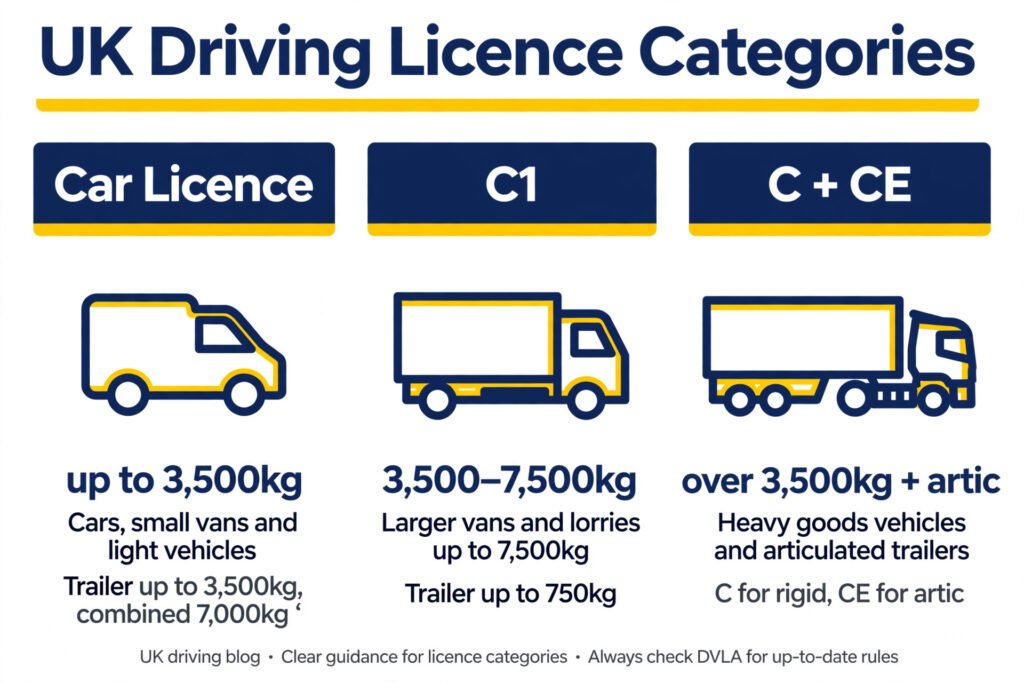
A Category B licence — the standard car licence most people hold — covers vehicles with up to 8 passenger seats and a MAM of up to 3,500kg. That includes cars, small vans, and light lorries up to 3,500kg. There is one wrinkle: for electric or hydrogen (zero-emission) vehicles, the limit rises to 4,250kg. You can also tow a trailer up to 3,500kg MAM, with a combined vehicle-plus-trailer maximum of 7,000kg. So yes, you can drive a 3.5-tonne lorry on a car licence — that is the ceiling, not the starting point. Anything with a MAM above 3,500kg (or 4,250kg zero-emission) is outside Category B. If you are unsure what your own licence covers, check the categories printed on it — our guide to your DVLA licence record explains how. Category limits work the same way across licence types — see our guide to driving a manual with an automatic licence for how entitlement limits apply in practice.
The Lorry Categories: C1, C1E, C and CE Explained
Here is the full ladder, from smallest to biggest. C1 covers vehicles from 3,500kg to 7,500kg MAM, with a trailer up to 750kg — this is the 7.5-tonne lorry category. C1E is a C1 vehicle with a trailer over 750kg, up to a combined maximum of 12,000kg. C covers vehicles over 3,500kg with a trailer up to 750kg — the full rigid lorry category. CE is a C vehicle with a trailer over 750kg — this is the articulated lorry (artic) category, also known as Class 1. That last point trips people up: C1 is not ‘Class 1’. Class 1 means C+E. If someone offers you ‘Class 1 training’, they mean articulated lorries, not the 7.5-tonne C1 category.
Passed Your Test Before 1997? Grandfather Rights
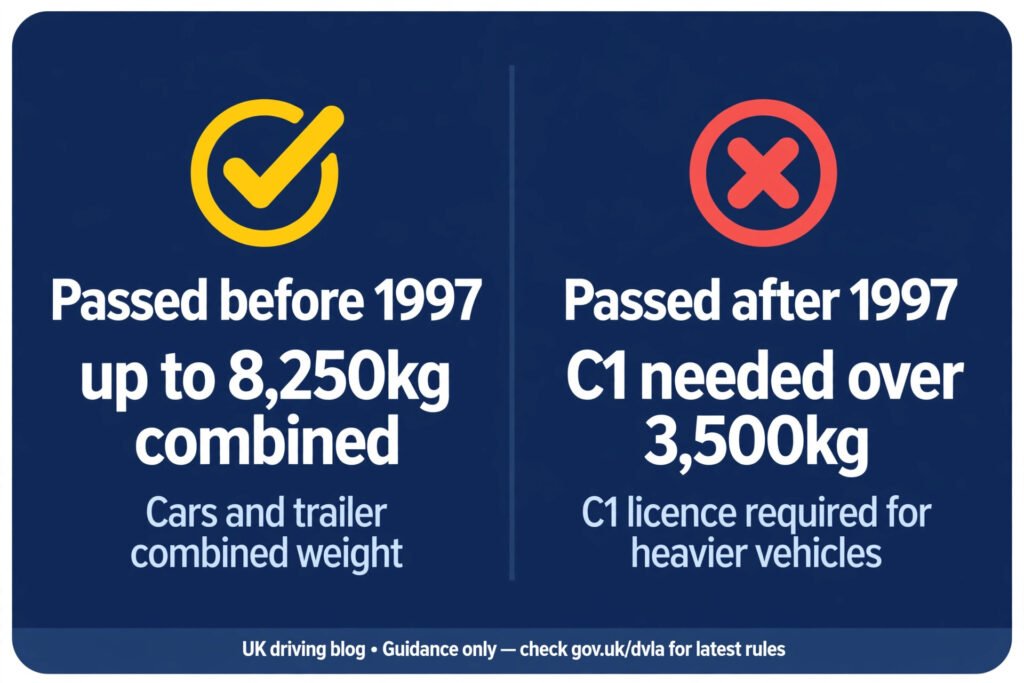
This is the exception that confuses everyone. If you passed your car test before 1 January 1997, your Category B licence carries grandfather rights: it covers a vehicle-plus-trailer combination up to 8,250kg MAM. That is why an older driver can legally drive a 7.5-tonne lorry on a car licence while a driver who passed in 1998 cannot. If you passed on or after 1 January 1997, you do not have these rights — you need C1 for anything over 3,500kg. The date on your licence is what matters, so check it before assuming. Drivers with licences from abroad should also confirm their entitlements — see our guide to checking what your licence covers.
Do You Need Driver CPC Too? (Licence vs. Professional Qualification)
Holding the right licence category and being qualified to drive lorries for work are two different things. Driver CPC (Certificate of Professional Competence) is a separate professional qualification for lorry, bus and coach drivers. If you drive a lorry professionally, you need Driver CPC on top of your C1/C/CE entitlement — the licence alone is not enough. The upkeep is ongoing: 35 hours of Driver CPC training every 5 years to stay qualified, and driving professionally without Driver CPC can mean a fine of up to £1,000. There is one carve-out: drivers who already held a vocational lorry licence before 10 September 2009 did not need the initial Driver CPC qualification (they still need the periodic training). So when someone asks ‘can I drive a lorry?’, there are really two questions: does my licence allow it, and am I professionally qualified?
How to Get a Lorry Licence (Steps)
If you need lorry entitlement, the route is straightforward. First, hold a full car licence and be over 18. Next, apply for a provisional HGV/bus licence. Then pass the Driver CPC tests. After that, keep up the 35 hours of Driver CPC training every 5 years. Lorry licences renew every 5 years, and every year from age 65. When you are ready to book the tests, our guide to booking a driving test covers the booking process. One honest caution: legal entitlement is not the same as readiness. A 7.5-tonne vehicle handles very differently from a car — heavier, longer stopping distances, wider turning circle. Get proper training and practice before you take a big vehicle out, even if your licence technically allows it.
Penalties for Driving a Lorry Without the Right Entitlement
Driving a lorry you are not entitled to drive is an offence. It can mean a fine, points on your licence, and prosecution in serious cases — and your insurance may not cover you either, which turns a bad day into a very expensive one. The same points system that applies to car drivers applies here; our guide to penalty points on your licence explains how points add up. The message is simple: check your entitlement before you drive, not after.
Official source: GOV.UK guidance on becoming a lorry or bus driver.
Before You Drive a Lorry: Quick Checklist
- Check the vehicle’s MAM on its VIN plate or V5C and match it to your licence category: B, C1, C or CE.
- If you passed before 1 January 1997, confirm any grandfather rights actually shown on your licence before relying on them.
- If you drive lorries for a job, make sure your Driver CPC is valid.
- Check the trailer weight and the combined vehicle-and-trailer MAM before setting off.
- If the category or CPC you need is missing, do not drive the lorry until the entitlement is sorted.
Conclusion
So, can you drive a lorry on a car licence in the UK? A 3.5-tonne lorry, yes. Anything bigger, no — unless you passed before 1997 and hold grandfather rights. For 7.5-tonne lorries you need C1, for rigid lorries over 3,500kg you need C, and for articulated lorries you need CE (Class 1). And if you are driving lorries for work, Driver CPC sits on top of all of it. Check the categories on your licence, get the right entitlement, and keep your CPC training current.
2 Comments