Can I Drive a Bus on a Car Licence UK?
The answer is no. A standard car (category B) licence does not cover a full-size bus. Once a vehicle carries 17 or more passenger seats, you need category D on your licence — and if you’re being paid to drive it, you’ll need Driver CPC on top. The 9–16 seat range sits in minibus territory (category D1), which is a different licence conversation entirely.
Picture this: your local cricket club needs a driver for the team coach to an away match. You’ve held a full car licence for ten years, so you put your hand up. Then somebody asks the question that freezes your arm mid-air — can I drive a bus on a car licence UK?
This page puts it all in one place: the exact seat boundary, what category D really covers, why pre-1997 “grandfather rights” don’t help you here, the route to getting D, when Driver CPC is and isn’t required, and what happens if you get it wrong.
Can I Drive a Bus on a Car Licence UK?
No. A normal car licence (category B) lets you drive vehicles with up to 8 passenger seats and a maximum authorised mass of 3,500kg (4,250kg for zero-emission vehicles). A full-size bus or coach is far beyond both limits.
To drive a bus with 17 or more passenger seats in Great Britain, you need category D on your licence — no amount of car-driving experience converts into a bus entitlement. And if you’re being paid to drive it, you’ll need Driver CPC on top.
The only grey areas are the narrow exemptions covered further down this page (charity driving, historic vehicles, certain non-commercial uses). If you’re looking at an ordinary bus, coach, or double-decker, assume D is mandatory.
Bus vs Minibus: the Seat Boundary That Decides Your Licence
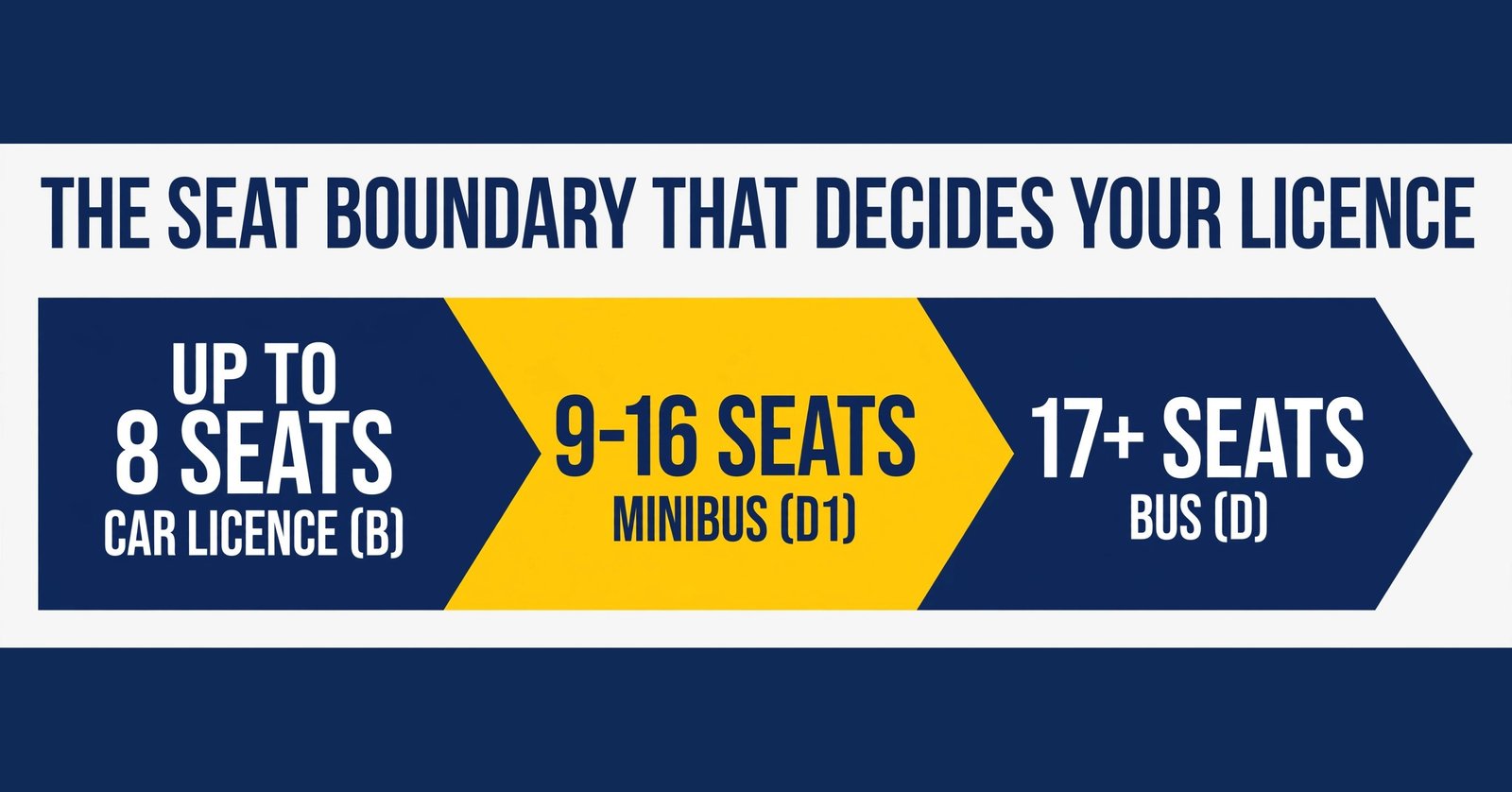
Everything about bus licensing turns on one number: how many passenger seats the vehicle has. GOV.UK’s categories split like this:
- Up to 8 passenger seats — a standard car licence (category B) covers you. This is your car, your people carrier, your campervan.
- 9–16 passenger seats — minibus territory. You need category D1. Minibuses have their own rules (including an 8-metre maximum length), and they sit in a separate article of their own.
- 17+ passenger seats — full bus territory. You need category D.
GOV.UK’s own wording for category D is “any bus with more than 8 passenger seats”, which on paper overlaps the D1 minibus range of 9–16. That phrasing confuses people, so here’s the practical split the industry actually uses: 9–16 seats is treated as a minibus (D1); 17 seats and above is treated as a bus (D). Don’t quote “17+” as GOV.UK’s definition of D — it’s the minibus/bus dividing line, not a GOV.UK quotation.
One more detail people get wrong: the seat counts refer to passenger seats, not counting the driver’s seat. And if you’re ever unsure which side of the line your vehicle falls on, count the seats before you count on your licence.
What Category D Actually Covers
Category D is the full bus entitlement. According to GOV.UK’s driving licence categories page, it covers:
- D — any bus with more than 8 passenger seats, plus a trailer of up to 750kg MAM.
- DE — D-category vehicles towing a trailer over 750kg MAM. So a coach pulling a large luggage trailer moves you from D into DE.
- D1 — minibuses: no more than 16 passenger seats, a maximum length of 8 metres, and a trailer of up to 750kg.
- D1E — D1 vehicles towing a trailer over 750kg, with a combined MAM of no more than 12,000kg.
For most readers, the practical version is simple: an ordinary single-decker, double-decker, or coach needs D. A coach with a heavy luggage trailer needs DE. If the vehicle is 16 seats or fewer, you’re in minibus (D1) territory instead — that’s a different licence and a different set of rules.
Two official links worth bookmarking sit on GOV.UK’s driving licence categories page. One note for Northern Ireland readers: driving licence categories differ there, so check nidirect for the NI equivalents.
Why Pre-1997 “Grandfather Rights” Don’t Cover Buses
There’s a persistent myth that passing your test before 1 January 1997 — the old “grandfather rights” — lets you drive a bus. It doesn’t.
Here’s what a pre-1997 category B licence genuinely gives you:
- A vehicle-plus-trailer combination of up to 8,250kg MAM (much more generous than the post-1997 7,000kg combined limit).
- A minibus with a trailer over 750kg MAM.
- D1 entitlement with restriction code 101 — meaning not for hire or reward, and effectively for voluntary driving.
What it does not give you is category D. The extra weight allowance and the minibus allowance never turned into a full bus entitlement, then or now. So if you passed before 1997, you can drive a minibus under the D1(101) conditions — but a 17+ seat bus still needs you to go and get category D properly. Grandfather rights are generous, but a bus is a bus.
How to Get a Category D Licence
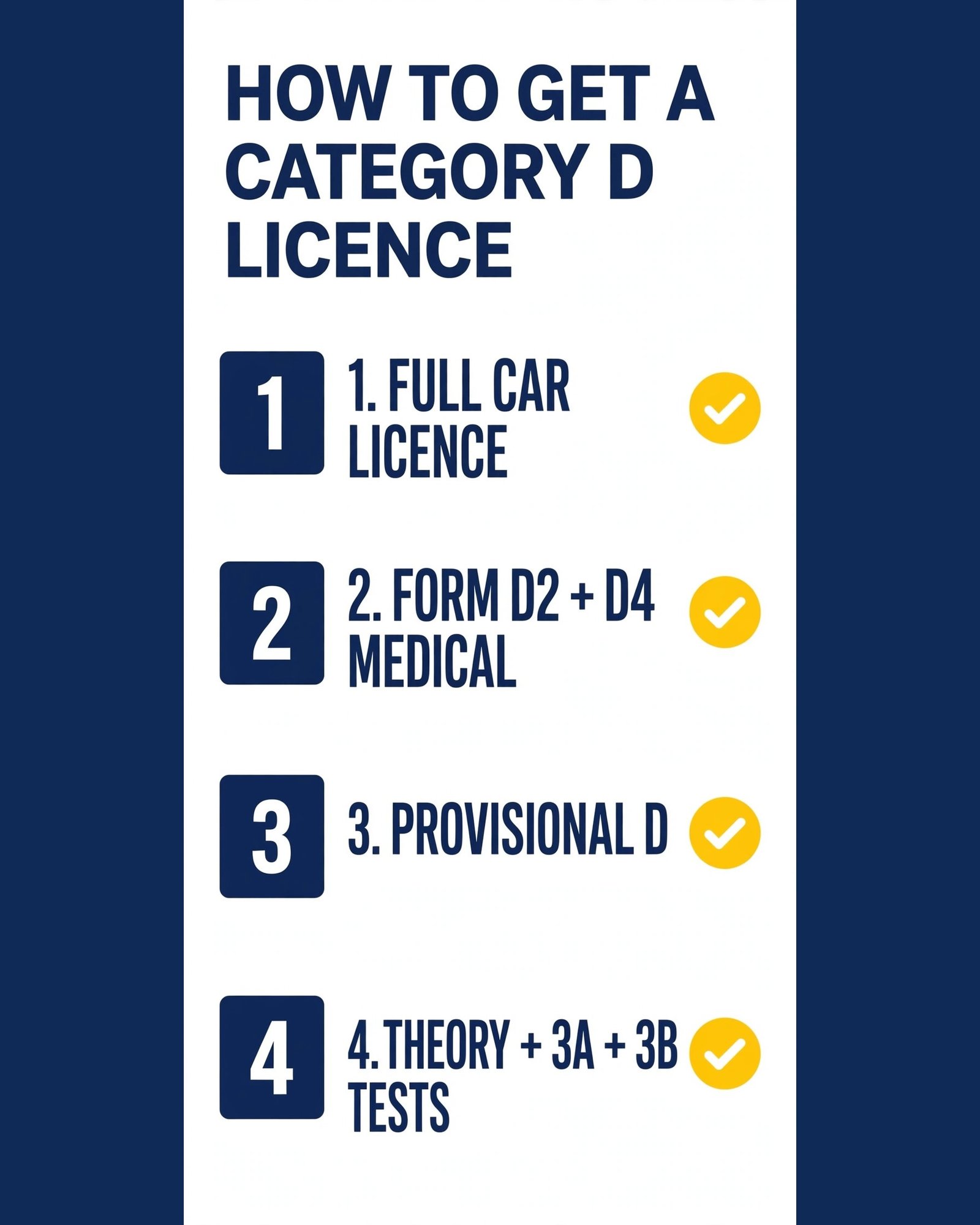
Getting category D is a defined, official route — no course provider can sell you a shortcut past it. Here are the steps, straight from GOV.UK’s page on adding higher categories to your licence:
- Hold a full car (category B) licence. You can’t start the bus route from a provisional car licence — the full B is your foundation.
- Apply for provisional entitlement for category D. You do this with form D2 (order it from DVLA or a post office). You’ll also need a D4 medical form, completed by a doctor, if it’s required. There’s no application fee for the provisional entitlement itself, and your new licence typically arrives within 3 weeks of DVLA receiving the application — longer if your health or personal details need checking.
- Pass the driving test for the category. With provisional D in hand, you train and then take the PCV test: part 1 (theory), part 3a (off-road exercises), and part 3b (on-road driving).
Three useful facts about this route:
- You do not need to pass a lower-category test first. There’s no requirement to get C1 (or any lorry category) before D.
- Applying for provisional D also gives you provisional entitlement for a whole family of categories in one go: C1, C1+E, C, C+E, D1, D1+E, D, and D+E. (The lorry categories are covered in our lorry article if you’re curious how those compare.)
- The upgrade only flows one way between lorries and buses: lorry entitlements can upgrade bus entitlements, but bus entitlements cannot upgrade lorry entitlements.
Once you’re driving professionally, remember that category D alone isn’t the end of the story — Driver CPC is the next section. And if you take a job where an employer wants to see your record, you’ll want a DVLA check code ready — it takes minutes to generate and is valid for 21 days.
Do You Need Driver CPC to Drive a Bus?
If you’re driving a bus for a living — paid work, hire or reward — the answer is yes. Professional bus driving needs full Driver CPC: the initial qualification plus 35 hours of periodic training every 5 years. Treat CPC as mandatory for any working bus driver.
But full Driver CPC is not needed in every situation. GOV.UK lists exemptions on its driver-CPC page, and they’re worth knowing because they’re narrower than people assume. You don’t need full CPC when:
- You’re carrying passengers non-commercially (no payment, no business purpose).
- Driving makes up less than 30% of your rolling monthly working time, where you’re carrying materials or equipment for your own job.
- You’re giving or receiving driving lessons.
- You’re driving to or from a pre-booked official vehicle testing appointment.
- You’re driving within 62 miles (100km) of your base, the vehicle carries no passengers or goods, and bus/coach driving is not your main job.
- You’re maintaining public order in a local-authority vehicle, or on rescue missions / in states of emergency.
- You work in agriculture, horticulture, forestry, farming, or fisheries and driving is less than 30% of your working time.
Certain vehicles are also exempt regardless of use: those limited to a 28mph top speed, and vehicles used or controlled by the armed forces, police, fire and rescue service, emergency ambulance service, or prison service. (The emergency-ambulance CPC exemption is also why ambulance licensing works the way it does — covered in our ambulance article.)
Important: even in these exempt situations, the licence route doesn’t change. You still need provisional entitlement and you still pass part 1 (theory), part 3a (off-road exercises), and part 3b (on-road driving). The exemption removes the CPC requirement, not the driving test.
Also note the renewal rhythm for bus/HGV licences: renewal is every 5 years from age 45, and every year from age 65.
Driving a Bus for a Charity or School: What Changes
This is where the exemptions above actually matter in real life. If you’re driving a bus for a charity, community group, or school on a voluntary, non-commercial basis — nobody’s paying you and nobody’s paying for the ride — the non-commercial carriage exemption means you may not need full Driver CPC.
But “charity” is not a magic word for the licence itself. You still need the right category on your licence for the vehicle you’re driving: D for a 17+ seat bus, D1 for a 9–16 seat minibus. And not-for-profit organisations may operate under a permit scheme — check the current GOV.UK permit rules before assuming anything, because this is one area where the details change and getting it wrong is expensive.
If it’s a school minibus rather than a full bus, different rules apply again — our minibus article walks through the D1 side of the story.
What Happens If You Drive a Bus on the Wrong Licence
Driving a bus on a car licence isn’t a technicality — it’s treated as driving without the proper entitlement. The consequences are the serious end of motoring offences: a fine, penalty points on your licence, and possible disqualification. No fine figure is quoted here because the exact penalty depends on the court and the circumstances.
Two consequences bite harder than the courtroom ones:
- Your insurance is invalid. An insurer covering a car driver has not covered a bus driver. If anything goes wrong — even something that isn’t your fault — you’re personally exposed, and the financial fallout can dwarf any fine.
- Your job prospects end. Any employer hiring bus drivers checks licences (usually with a DVLA check code). A conviction for driving without entitlement makes you unemployable in the industry.
The honest summary: getting caught without category D costs far more than getting category D.
Conclusion
So can I drive a bus on a car licence UK? No — a car licence covers up to 8 passenger seats, and a full-size bus starts where that ends. The practical map is simple: up to 8 seats = car licence; 9–16 seats = minibus, category D1; 17+ seats = bus, category D. Pre-1997 rights give you D1, not D. Getting D means the D2 form (plus a D4 medical if required), provisional entitlement, and the part 1 / 3a / 3b tests — and if you’re driving professionally, full Driver CPC goes with it.
If a bus is in your future, start the D2 application now. It’s the one part of the process that costs nothing and takes weeks.