Can I Drive an Ambulance on a Car Licence UK?
Can I drive an ambulance on a car licence in the UK? It depends on weight. A standard full car licence (Category B) does not cover a typical frontline ambulance, because once loaded it usually goes over 3,500kg MAM — and that pushes it into C1 territory (3,500–7,500kg). But a smaller patient-transport vehicle at or under 3,500kg MAM can be driven on a car licence. So the real question is not “ambulance or not?” — it is “what does this vehicle weigh on paper?” In this guide you will learn the weight test, where to find a vehicle’s MAM, the pre-1997 and post-1997 rules, how to get C1, and why ambulance drivers are exempt from full Driver CPC.
Can I Drive an Ambulance on a Car Licence in the UK?
Short answer: it depends on the vehicle’s MAM (Maximum Authorised Mass). MAM is the heaviest the vehicle is allowed to weigh when fully loaded — passengers, crew, equipment, fuel and all.
| 3,500kg or under | Category B (standard car licence) covers it |
| Over 3,500kg up to 7,500kg | Category C1 |
| Over 7,500kg | Category C |
A typical frontline ambulance falls in the middle row: it typically exceeds 3,500kg once loaded, so most frontline ambulance driving needs C1. A smaller patient-transport vehicle at or under 3,500kg MAM can be driven on a car licence. Two more rules apply whatever the weight: you must hold a full licence — a provisional licence does not cover an ambulance — and you must check the MAM on the specific vehicle, not guess from its size. Driving a vehicle your licence does not cover can mean points on your licence. The categories below come from GOV.UK’s driving licence categories page.
What Counts: MAM vs Empty Weight
This is where people get caught out. The weight that matters is not what the vehicle weighs empty. It is the MAM — the maximum it is allowed to weigh fully loaded. An ambulance that weighs 3,200kg empty can easily pass 3,500kg once you add the crew, a patient, a stretcher and the medical kit. That is why the check is always MAM, never kerb weight.
Where to find MAM:
- The vehicle’s V5C registration certificate (log book).
- The VIN plate — usually on the door frame or under the bonnet — which lists the plated weights.
- If the two disagree, go by the plated MAM on the VIN plate and ask the fleet manager or employer to confirm.

If You Passed Your Test Before 1 January 1997
If you passed your car test before 1 January 1997, your Category B entitlement is far more generous than a modern car licence. It usually lets you drive a vehicle + trailer combination up to 8,250kg MAM. That may already cover a frontline ambulance, depending on the vehicle’s MAM — check the entitlements printed on your licence to confirm. This is the one group of car-licence holders who may already be covered for ambulance driving without adding C1. But do not assume: confirm your entitlements before you drive, because licence records can carry restrictions.
If You Passed Your Test After 1 January 1997
If you passed on or after 1 January 1997, Category B covers vehicles with up to 8 passenger seats and a MAM of 3,500kg — or 4,250kg for electric or hydrogen (zero-emission) vehicles only. There is one narrow extra: 750kg extra MAM is allowed only for extra equipment for disabled passengers. That extra does not turn a frontline ambulance into a car-licence vehicle.
Towing on a post-1997 B licence: a trailer up to 3,500kg MAM, with the vehicle + trailer combined MAM not exceeding 7,000kg. A typical frontline ambulance, typically over 3,500kg MAM when loaded, sits outside this — so you need C1.
Frontline Ambulance vs Patient Transport
Not every ambulance is the same vehicle. A frontline (emergency) ambulance carries a full crew, a patient, a stretcher and a large kit load — and typically exceeds 3,500kg MAM once loaded, so it needs C1. A patient transport service (PTS) vehicle is often a smaller van or adapted car used for non-emergency journeys (for example, taking patients to routine appointments). If that vehicle is at or under 3,500kg MAM, a standard car licence covers it.
That is why competitors who flatly say “you need C1 for an ambulance” are only half right — and why the ones who say “a car licence is enough” are wrong for frontline work. The answer is the weight test, vehicle by vehicle. If you are joining a service, ask the fleet team for the MAM of the exact vehicles you will drive before your first shift.
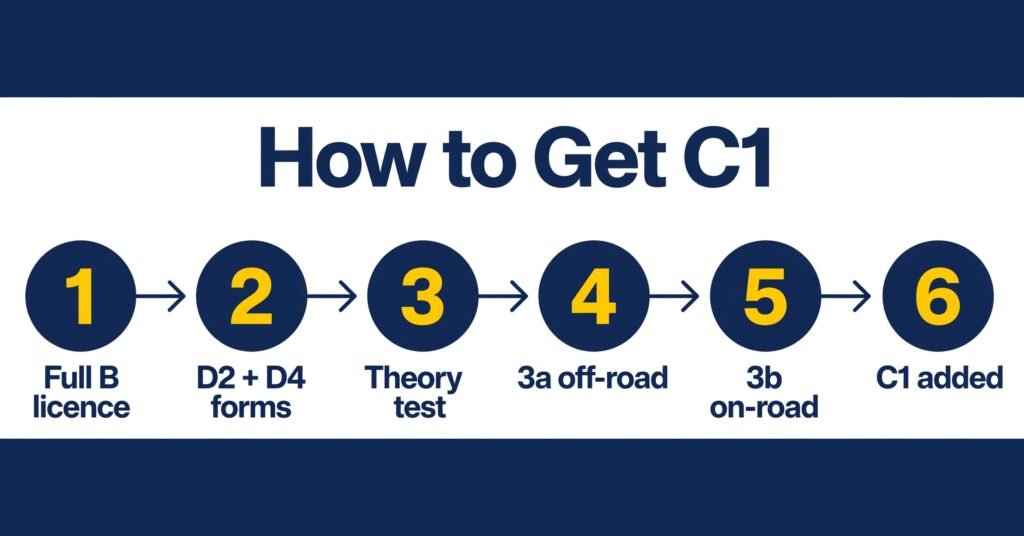
How to Get C1 Entitlement
If the ambulance you will drive is over 3,500kg MAM, you need to add C1 to your licence. The route, from GOV.UK’s adding higher categories page, is:
- Pass your car (B) test — you must already hold a full car licence.
- Apply for provisional entitlement for C1 using form D2. Form D4 must be filled in by a doctor (check form D2 for whether D4 is needed for you). There is no application fee. Send the forms and your photocard to DVLA — your new licence usually arrives within 3 weeks (longer if health or personal details need checking).
- Pass the tests for the new category — the theory and practical tests for C1. You do not need to pass a lower-category test first (for example, no need to pass C1 before C1E).
- Do not drive the ambulance while you wait — a provisional entitlement is not a full entitlement. Do not drive the ambulance while your C1 is still being added.
The professional HGV route is 18+, and HGV/bus licences renew every 5 years from age 45 and every year from 65. Licence renewal rules change as you get older.
Do Ambulance Drivers Need Driver CPC?
Here is the good news, and the big difference from lorry driving. You do not need the full Driver CPC qualification if the vehicle is being used or controlled by the emergency ambulance service — the same exemption covers the armed forces, police, fire and rescue service, and the prison service. The exemption also covers rescue missions and states of emergency. The source is GOV.UK’s when you don’t need Driver CPC page.
That means paramedics and ambulance crew need the C1 category on their licence, but not the full CPC. If CPC is not needed, the route is still: apply for a provisional HGV/bus licence, then pass part 1 (theory), part 3a (off-road exercises) and part 3b (on-road driving). Do not confuse the two: C1 is the licence category; CPC is a separate professional qualification. Lorry drivers, by comparison, usually DO need full Driver CPC for professional driving.
Private, Voluntary and Community Ambulances
Careful here — the CPC exemption wording is “used or controlled by … emergency ambulance service”. That covers NHS and contracted emergency ambulance work. It does not automatically cover every vehicle with an ambulance badge:
- Private medical transport (for example, a private company moving patients for a fee) may still need CPC, because the exemption is tied to the emergency ambulance service, not to the vehicle type. Check before you drive — ask the employer or check with DVSA.
- Voluntary / community first-responder vehicles vary: some run under an emergency service umbrella, some do not. Again, check the arrangement, not the paint job.
- If you are unsure, the safe move is to ask the organisation in writing which exemption (if any) covers your driving, rather than assuming you are exempt.
What Else Employers Will Check
Beyond the licence category, expect an employer to check:
- Your full licence and its entitlements — check what is printed on your licence before you apply, so there are no surprises.
- A DVLA check code — employers and hire companies use a check code to view your driving record online. Generate one when asked; it is free and valid for 21 days.
- Medical fitness — ambulance employers will have their own medical checks on top of the D4.
- Blue-light training — your trust will also train you for blue-light (emergency-response) driving. That is employer / NHS-trust training, not a DVLA licence requirement — it does not add a licence category.
Conclusion
Can you drive an ambulance on a car licence in the UK? It depends on weight. If the vehicle’s MAM is 3,500kg or under — as with many patient-transport vehicles — a standard car licence covers it. If it is over 3,500kg — as with most frontline ambulances — you need C1. Check the MAM on the V5C or VIN plate, check your own entitlements, and if you need C1, apply with D2/D4 (no fee) and pass the C1 tests. And remember: ambulance drivers need the C1 category but not the full Driver CPC when driving for the emergency ambulance service. One last note: GOV.UK’s licence categories apply in Great Britain — if you are in Northern Ireland, check nidirect instead, as the categories differ there.

2 Comments