Renew Your Driving Licence at 70: The Free Renewal Process Explained
Last reviewed: September 2026. Rules are taken from GOV.UK.
Turning 70 does not end your ability to drive, but it does end your existing licence. Renewing at 70 costs nothing and does not involve a driving test, yet DVLA figures suggest a meaningful number of older drivers let their licence lapse simply because they missed the paperwork.
This guide covers exactly what happens at 70, how the renewal works online and by post, what you must declare, and what changes every three years after that. Every rule is matched against GOV.UK as of September 2026.
Why Does Your Driving Licence Expire at 70?
A standard UK photocard licence normally lasts 10 years, but your entitlement to drive expires on your 70th birthday regardless of when your card was last renewed. After that, you must renew every 3 years.
This is not a retest of your driving skill. It is a self-declaration process, designed to catch age-related changes in health or eyesight that can develop gradually enough to go unnoticed day to day. There is no upper age limit for driving in the UK, and renewing at 70 does not automatically restrict what you can drive.
How is renewing at 70 different from a standard 10-year renewal?
| Standard renewal (under 70) | Renewal at 70 and over | |
|---|---|---|
| Frequency | Every 10 years | Every 3 years |
| Cost | £14 online, £17 by post | Free |
| Trigger | Photocard expiry date | Your 70th birthday, then every 3 years |
| Test required | No | No |
| Declaration required | Basic identity and photo update | Full health and eyesight declaration |
The core process, applying online or by post, is similar. What changes is the frequency, the cost, and the depth of the health declaration you complete each time.
Do you have to retake your driving test at 70?
No. You do not retake the theory or practical test. You complete a health declaration instead, confirming you still meet the medical and eyesight standards for driving. If you have a relevant health condition, DVLA may ask for more detail or a medical assessment, but this is the exception, not the default.
How Do You Renew Your Driving Licence at 70?
When does DVLA contact you?
DVLA automatically sends a reminder letter and a D46P application form 90 days before your 70th birthday, then again roughly every three years afterward when the next renewal is due. You do not need to request this yourself the first time.
What if you never receive the D46P form?
If nothing arrives, you can still renew. Your options are:
- download or order a D1 form (“Application for a driving licence”) from GOV.UK
- pick up a D1 form at most Post Office branches
- renew directly online, without needing the physical form at all
Do not wait indefinitely for a letter that has gone missing in the post. GOV.UK’s online service works whether or not you have the D46P in hand, and starting online avoids any further delay while a replacement paper form is requested and sent out.
How to Renew Online
Renewing your driving licence at 70 online is free, and is the fastest of the three methods.
What do you need to renew online?
- Your addresses for the last 3 years
- Your National Insurance number
- A valid UK passport number, if you also want to update your photo
- An email address, to sign in or register for GOV.UK services
How do you apply step by step?
- Go to the GOV.UK page “Renew your driving licence if you’re 70 or over” and select “Renew online”.
- Sign in, or create sign-in details if this is your first time using DVLA’s online services.
- Prove your identity if asked, usually with photo ID.
- Complete the health and eyesight declaration.
- Confirm or update your photo, if you have a valid passport to use.
- Submit the application. No payment is needed at any point.
How long does the online renewal take?
Your licence should arrive within about 1 week. This assumes no further identity or medical checks are needed.
How to Renew by Post
What do you need to apply by post?
- The D46P form DVLA sent you, or a D1 form if you do not have it
- A new passport-style photo, if you previously held a photocard, or a current passport-style photo if you still hold an old paper licence
- Proof of identity, if DVLA cannot verify it another way
How long does a postal renewal take?
Around 3 weeks. It can take longer if DVLA needs to check your medical or personal details further.
Can everyone renew online?
Not quite. If you hold C1 (medium-sized vehicles) or D1 (minibus) entitlement, you must renew by post. These categories cannot currently be renewed through the online service.
What Do You Need to Declare When Renewing at 70?
The renewal asks you to confirm, honestly, that you still meet the standards to drive. This mainly covers:
- Eyesight: you must be able to read a number plate from 20 metres, with glasses or contact lenses if you wear them, and meet the minimum visual acuity standard.
- Medical conditions: you must declare any notifiable condition, or any existing condition that has worsened, that could affect your ability to drive safely.
- General fitness to drive: a broader confirmation that nothing currently prevents you from driving safely.
This is a self-declaration, so the responsibility sits with you as the driver, not with a DVLA-arranged test. Being untruthful on this declaration can be treated as an offence if it later comes to light, particularly after an incident.
Which conditions commonly need declaring at this age?
Conditions that become more common later in life, and that you must tell DVLA about if they affect your driving, include:
- cataracts, glaucoma, or other conditions reducing your field of vision
- diabetes, particularly if treated with insulin
- heart conditions, including those causing dizziness or fainting
- strokes or transient ischaemic attacks (TIAs)
- Parkinson’s disease
- dementia or significant memory conditions affecting judgement or awareness
- sleep apnoea causing excessive daytime sleepiness
This is not an exhaustive list, and GOV.UK’s own tool lets you check a specific condition. Declaring a condition does not automatically mean losing your licence. In many cases, DVLA issues a licence with a shorter renewal period, or asks for periodic medical confirmation, rather than refusing it outright.
What happens if you declare a medical condition?
DVLA may ask for more information from your doctor or specialist, or arrange a medical assessment before deciding whether to issue, restrict, or delay your renewed licence. This can extend the standard 1-week or 3-week processing time considerably, since DVLA is dependent on third parties such as your GP responding.
If you are not confident judging your own fitness to drive, an independent assessment through a driving mobility centre can offer a professional opinion before you submit your renewal. These centres carry out practical driving assessments and can advise on adaptations, such as modified controls, that let some drivers continue safely even with a condition that would otherwise raise concerns. This is a paid, voluntary service, separate from DVLA’s own decision-making process, and using one does not delay or replace your actual renewal application.
Does Renewing at 70 Affect Your Car Insurance?
Renewing your licence at 70 itself does not change your insurance. Insurers price based on your actual driving history, health disclosures made to them directly, and the vehicle you drive, not on the renewal cycle of your licence. However, some related points are worth knowing:
- If DVLA restricts your licence, for example limiting it to automatic vehicles only or attaching a medical condition code, you must tell your insurer, since driving outside your licence conditions can invalidate a claim. Insurers can also ask to see the specific codes on your card at renewal time, so it is worth knowing what each one on your licence means before you are asked.
- Some insurers ask older drivers to confirm they still hold a full, unrestricted licence at renewal time, so keep a note of any codes shown on your card.
- A licence that has lapsed because you forgot to renew is treated the same as not holding a valid licence at all for insurance purposes, which can be far more costly than the renewal process itself.
Can You Keep Driving While Your Renewal Is Processed?
Often, yes. Under section 88 of the Road Traffic Act 1988, you can usually continue driving while DVLA processes your renewal, provided:
- your doctor has told you that you are fit to drive
- you held a valid licence immediately before applying, and only drive vehicles you were entitled to drive on that previous licence
- your licence was not revoked for medical reasons, or if it was, your doctor now says you are fit to drive again
- you are not currently disqualified from driving
- any conditions on your previous licence still apply and are met
This mainly protects drivers whose licence expires while a straightforward renewal is still being processed. It is not a substitute for actually applying, and it does not apply if your application has already been refused, so submit your renewal as soon as the D46P form or reminder arrives rather than relying on this protection alone.
What Happens If You Do Not Renew at 70?
If you do not renew, your entitlement to drive lapses on your 70th birthday, and continuing to drive without a valid licence, and without the section 88 protection above, is an offence. There is no grace period built into the system beyond the protection that applies while a genuine application is in progress.
Letting the licence lapse entirely, rather than simply being a few days late with the form, means you may need to reapply from a standing start, which can take longer than a straightforward on-time renewal, and may briefly leave you unable to drive at all while the application is sorted out.
Do the Rules Differ in Northern Ireland?
Yes, slightly. In Northern Ireland, once you reach 60, your licence is issued to run until your 70th birthday, or for a minimum of 3 years, whichever is longer. After that, the DVA (not DVLA) handles renewals, sending a DL1R form roughly two months before your licence expires, rather than the D46P form and 90-day window used in Great Britain.
If you live in Northern Ireland, use nidirect rather than GOV.UK to renew, since the two systems, forms and contact points are run separately. The DVA also has its own medical questionnaire process, broadly similar in purpose to DVLA’s, but administered through a separate database and separate contact numbers.
Renewing at 70 and Your Photo
You can update your photo at the same time as renewing, if you are applying online with a valid UK passport. If you held a photocard before turning 70, and you are applying by post, you generally need to send a new passport-style photo with your form. If you still held an old paper licence, a current passport-style photo is required as part of moving to the photocard format.
What If You Decide to Stop Driving Instead?
Renewing is not compulsory. If you decide driving is no longer right for you, you can voluntarily surrender your licence to DVLA rather than letting it lapse. This is a straightforward process, and your photocard can still be kept and used as photo ID even after you surrender your entitlement to drive, since the two functions are separate.
If your decision is connected to a medical condition, surrendering voluntarily, rather than waiting for DVLA to make a decision, is sometimes the simpler route, and can be revisited later if your circumstances change and you wish to reapply.
Common Questions About Renewing at 70
- Does renewing at 70 cost anything? No. It is free by both the online and postal routes, and stays free every three years after that.
- Will my licence be restricted after 70? Not automatically. Restrictions, if any, come from a declared medical condition, not from age itself.
- Can someone else renew on my behalf? The declaration must come from you, though a family member or carer can help you complete the form or the online process.
- What if my address or name has changed since my last licence? Update these as part of the renewal, using the same address history and identity checks as any other DVLA service.
- Is there a different process for a first-time older applicant? No. If you are 70 or over and applying for your first ever licence, you still start with a provisional licence in the usual way, and the renew-at-70 service does not apply until you already hold a full one.
Conclusion
Renewing your driving licence at 70 is free, does not involve a driving test, and usually takes about a week online. The real risk is not the process itself but missing it entirely, since driving without a valid licence, and without section 88 protection, is an offence. Watch for DVLA’s D46P letter 90 days before your birthday, but do not wait for it if it never arrives.
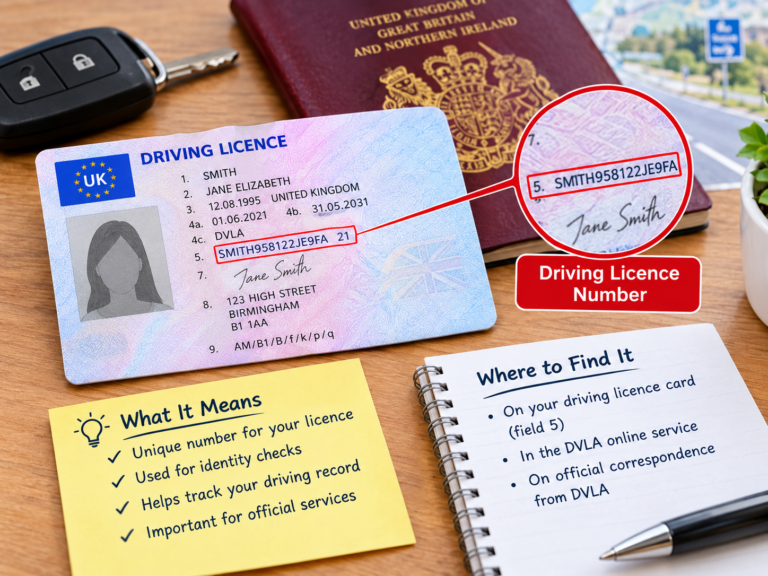
Next, if a declared medical condition affects your renewal, or you need to check what is currently on your driving record, see the full guide to your driving licence number and check codes.