Eyesight Requirements for Driving in the UK: Full Guide
The eyesight requirements for driving in the UK are the same for every car driver, and they are checked from your very first lesson to your last licence renewal. You must be able to read a number plate from 20 metres, meet a minimum sharpness standard of 6/12 on an eye chart, and have an adequate field of vision. This guide explains each rule in simple words, what happens at the driving test, and when you must tell DVLA about an eye problem.
You first meet these rules when you apply for your provisional driving licence, because the application asks you to confirm that your eyesight meets the legal standard. The full official rules are on GOV.UK, and everything below follows them.
Driving Eyesight Standards at a Glance
| Standard | Car and motorcycle (Group 1) | Lorry and bus (Group 2) |
|---|---|---|
| Number plate test | Read a number plate from 20 metres | Read a number plate from 20 metres |
| Visual acuity | At least 6/12 (0.5), using both eyes together or your only eye | At least 6/7.5 (0.8) in the best eye and 6/60 (0.1) in the other eye |
| Field of vision | An adequate field of vision | At least 160 degrees horizontally, extending 70 degrees left and right and 30 degrees up and down, with no defects within the central 30 degrees |
| Glasses or contacts | Wear them if you need them to meet the standard; licence code 01 may apply | Glasses must be no more than +8 dioptres; there is no corrective-power limit for contact lenses |
What Are the Eyesight Requirements for Driving in the UK?
There are three parts to the legal standard, and you must meet all three every time you drive:
- The number plate test: read a standard number plate from 20 metres away.
- Visual acuity: at least 0.5 (6/12) on the Snellen eye-chart scale, using both eyes together, or your only eye if you have sight in one eye only.
- Field of vision: an adequate field of vision, which an optician can test for you.
You are allowed to wear glasses or contact lenses to reach the standard. What matters is how well you see with them on, not how well you see without them.
The 20-Metre Number Plate Test
This is the simplest part of the standard, and you can test yourself today. Stand 20 metres from a parked car — roughly the length of 5 parked cars — and read its number plate out loud. If you cannot read it clearly, your eyesight is below the legal standard and you should see an optician before you drive again.
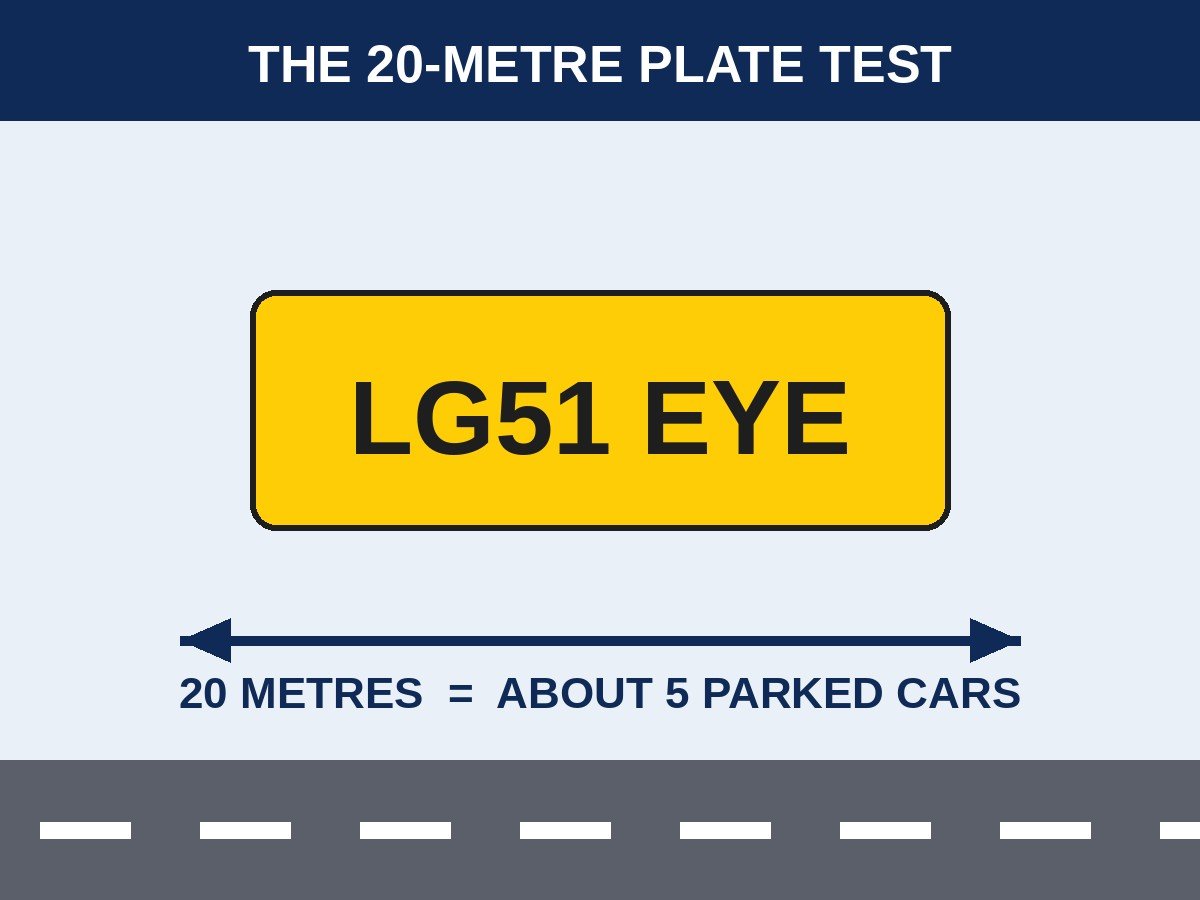
Number plates fitted since September 2001 use narrower characters, so the same 20-metre rule works for modern plates and older ones. If you need glasses or contact lenses to pass this test, the law says you must wear them every time you drive.
Visual Acuity: The 6/12 Standard in Simple Words
Visual acuity means how sharp your vision is. Opticians measure it with a Snellen chart — the letter chart with big letters at the top and smaller letters below. A score of 6/12 means you can read at 6 metres what a person with standard vision can read at 12 metres.
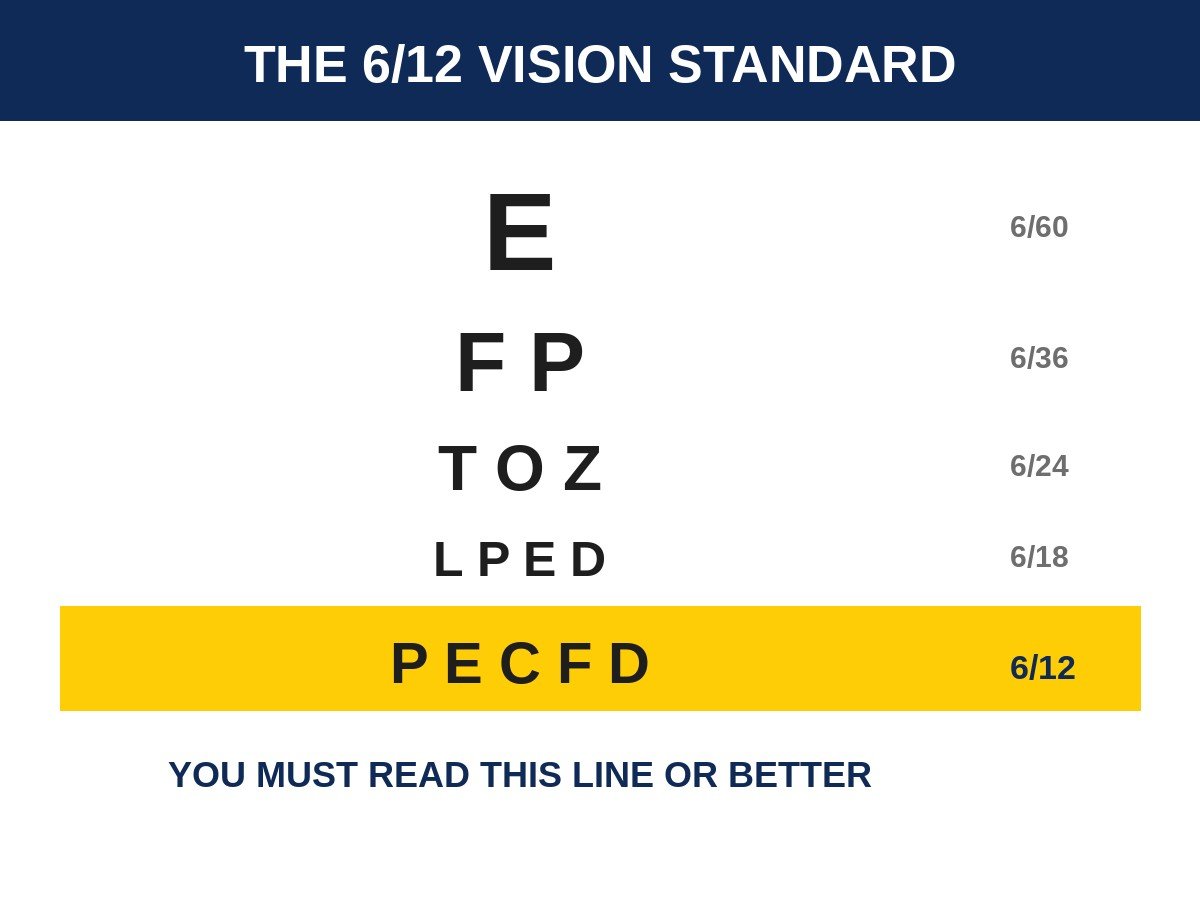
For car driving, 6/12 with both eyes together is the minimum. Many drivers see much better than this, at 6/6 or beyond. If your acuity is worse than 6/12 even with glasses or contact lenses, you do not meet the standard and you must not drive.
Field of Vision: The Part Most Drivers Forget
Field of vision is how much you can see to the sides, up and down, while looking straight ahead. You must have an adequate field of vision to drive — sharp central vision alone is not enough.
An optician can check your field of vision with a special test. If DVLA needs detailed evidence about your vision, they use a test called the Esterman visual field test, which maps the area you can see. Conditions that damage side vision, such as glaucoma, are one of the main reasons drivers fail this part of the standard.
Glasses and Contact Lenses: The Rules
If you need glasses or contact lenses to meet the standard, you must wear them every time you drive. Driving without them when you need them is an offence, and it also puts you and everyone around you in danger.
Your licence shows this with code 01 on the back of the photocard, which means “eyesight correction”. You can see your own licence codes any time by using the DVLA licence check code service to view your record online.
Being short sighted or long sighted is completely normal and you do not need to tell DVLA about it, as long as glasses or lenses bring you up to the standard. The same applies if you have had laser surgery to correct short sight and you now meet the standard without glasses.
Eyesight at the Practical Driving Test
Your driving test starts with the number plate test. Before you even sit in the car, the examiner will ask you to read a number plate on a parked vehicle from 20 metres.
If you cannot read it, you fail the test on the spot and the test does not continue. DVLA is told, and your licence is revoked. If you later reapply for a licence, DVLA will ask you to pass an eyesight test with DVSA at a driving test centre first — and you will still have to pass the same number plate check at the start of your next practical test.
Higher Standards for Lorry and Bus Drivers
Lorry and bus (Group 2) drivers must meet stricter eyesight requirements for driving than car drivers:
- Visual acuity of at least 0.8 (6/7.5) in the best eye and at least 0.1 (6/60) in the other eye.
- Glasses used to reach the standard must have a corrective power of no more than +8 dioptres (there is no limit for contact lenses).
- An uninterrupted horizontal field of vision of at least 160 degrees, extending at least 70 degrees left and right and 30 degrees up and down, with no defects within the central 30 degrees.
Group 2 drivers must also tell DVLA about any eyesight problem that affects either eye, which is a wider duty than the one for car drivers.
When You Must Tell DVLA About Your Eyesight
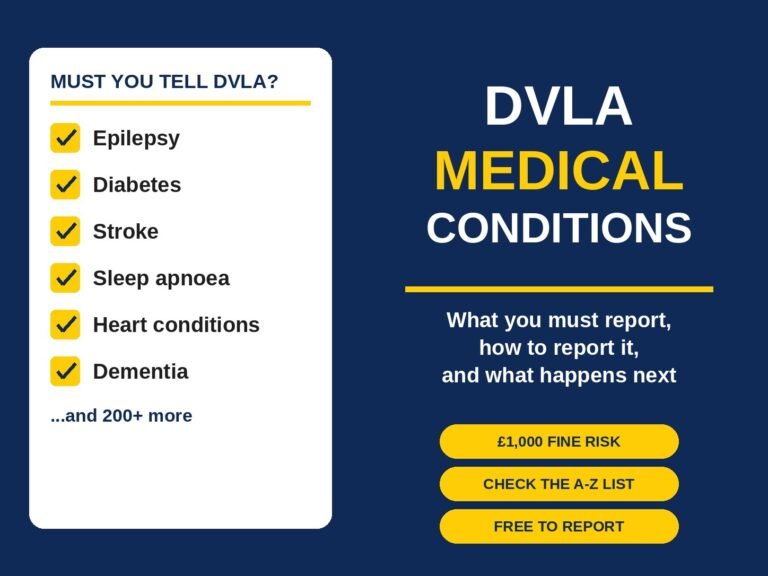
You must tell DVLA if you have an eyesight problem that affects both of your eyes, or the remaining eye if you only have sight in one eye. Eye diseases and conditions such as glaucoma, diabetic retinopathy and double vision are the kind of problems DVLA needs to know about. You do not need to report ordinary short or long sight, or colour blindness.
If you report a condition, DVLA may send you for an eyesight test with their contracted optician. This test is free, and DVLA uses the result together with your other medical evidence to decide your licence. You can also submit a test from your own optician, but you will have to pay for it, it must include an Esterman visual field test, and DVLA does not guarantee they will
For the full list of health conditions and how reporting works, read our guide to DVLA medical conditions.
Renewing Your Licence at 70: The Eyesight Declaration
From age 70, you renew your licence every 3 years, and each renewal asks you to declare that you still meet the eyesight standard. There is no automatic eye test at 70, but the declaration is a legal statement — if your vision has dropped below the standard, you must not sign it and keep driving. Our guide to renewing your driving licence at 70 explains the full renewal process.
A sensible habit at any age is a regular eye test every 2 years, or sooner if you notice a change. Eyesight often gets worse slowly, and the first place it shows is reading plates and road signs at a distance.
What Happens If You Drive Below the Standard
Driving when your eyesight is below the legal standard is an offence, and GOV.UK warns that you could be prosecuted. The police can also notify DVLA if they believe a driver’s eyesight is not good enough, which can lead to a medical investigation and your licence being taken away.
There is an insurance risk too: if you crash while knowingly driving with uncorrected eyesight below the standard, your insurer may refuse to pay out. No journey is worth that risk — if you fail the 20-metre plate check, book an eye test and stay off the road until it is sorted.
Conclusion
The eyesight requirements for driving come down to three things: read a number plate at 20 metres, see at least 6/12 on the eye chart with both eyes together, and have an adequate field of vision. Glasses and contact lenses count towards the standard — you just have to wear them every time you drive. Test yourself against a number plate today, keep up regular eye tests, and tell DVLA straight away if a condition affects both of your eyes.

2 Comments