Show Me Tell Me Questions & Answers: Full DVSA List (2026)
Every driving test includes two vehicle safety questions, known as the show me tell me questions. The examiner asks one ‘tell me’ question at the start, before you drive, where you explain how you would carry out a safety check — and one ‘show me’ question while you are driving, where you operate a control. There are 14 possible tell me questions and 7 show me questions, all published by DVSA. This page lists every one with the answer the examiner wants to hear.
The questions come after the eyesight check that opens every test, and the rest of your test day follows the driving test booking rules. Learn all 21 and this part of the test costs you nothing.
How the Show Me Tell Me Questions Work
- One ‘tell me’ at the very start of the test, before you start driving. You explain the check — you do not have to do it (except the bonnet questions, where you open the bonnet and point).
- One ‘show me’ at some point while you are driving. The examiner asks you to operate a control when it is safe to do so.
- The fault: getting one or both questions wrong records ONE driving fault (a minor). Wrong answers alone cannot fail you — but losing control of the car while doing a show me task is a serious fault, and that does fail the test.
All 14 Tell Me Questions (With the Answers)
| Tell me question | The answer the examiner wants |
|---|---|
| How would you check the brakes are working before starting a journey? | The brakes should not feel spongy or slack. Test them as you set off, and the car should not pull to one side. |
| How would you check the brake lights are working? | Press the brake pedal and use reflections in windows or doors behind you — or ask someone to stand behind and look while you press it. |
| How would you find the recommended tyre pressures, and how would you check them? | The pressures are in the manufacturer’s handbook. Use a reliable pressure gauge, check and adjust the pressures when the tyres are cold, do not forget the spare, and refit the valve caps. |
| How would you make sure the head restraint is correctly adjusted? | The rigid part of the restraint should be at least as high as your eyes or the top of your ears, and as close to the back of your head as is comfortable. Not all restraints are adjustable. |
| How would you check the tyres have enough tread depth and are in good condition? | There must be no cuts or bulges, and at least 1.6mm of tread across the central three-quarters of the tyre, all the way around it. |
| How would you check the headlights and tail lights are working? | Turn them on (with the ignition if needed) and walk round the car to check each light. |
| How would you know if there was a problem with the anti-lock braking system (ABS)? | The ABS warning light on the dashboard would stay on (or come on) if there was a fault. |
| How would you check the direction indicators are working? | Turn on the indicators — or the hazard warning lights — and walk round the car to check all of them. |
| How would you check the power-assisted steering is working before a journey? | Apply gentle pressure to the steering wheel while starting the engine — there should be a slight but noticeable movement as the system starts to work. Or: turn the wheel just after moving off, and it should feel light and easy to turn straight away. |
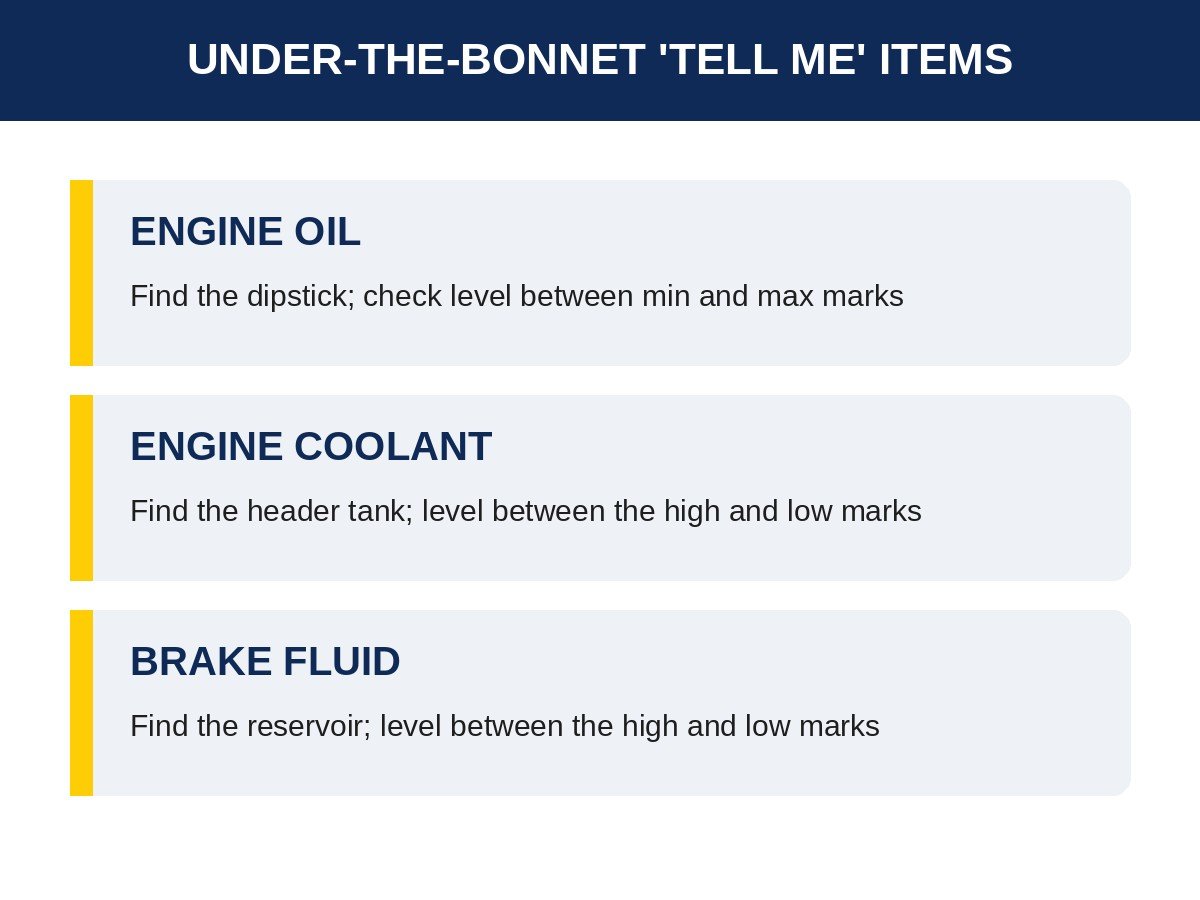
| Open the bonnet: how would you check the engine oil level? | Point to the dipstick. You would pull it out, wipe it, dip it again, and check the oil is between the minimum and maximum markers. |
| Open the bonnet: how would you check the engine coolant level? | Point to the coolant header tank. The level should be between the minimum and maximum marks on the side of the tank. |
| Open the bonnet: how would you check the brake fluid level? | Point to the brake fluid reservoir. The level should be between the minimum and maximum marks. |
| How would you switch on the rear fog light(s), and when would you use them? | Turn on the dipped headlights (and the ignition if needed), operate the fog light switch, and check the warning light is on. Fog lights are used only when visibility is seriously reduced — generally when you cannot see more than 100 metres. |
| How would you switch your headlights from dipped beam to main beam, and how would you know the main beam is on? | Operate the headlight switch or stalk (usually pushed away from you) with the ignition or engine on. The blue main-beam warning light on the dashboard tells you the main beam is on. |
All 7 Show Me Questions (While You Are Driving)
For these, the examiner asks when it is safe. Know where every control is in the car you take to the test — fumbling while moving is what turns a free question into a fault.
| Show me question | What to do |
|---|---|
| Show me how you would wash and clean the front windscreen. | Operate the front washer control (usually pull the wiper stalk towards you) so the screen is washed and wiped. |
| Show me how you would wash and clean the rear windscreen. | Operate the rear washer/wiper control (usually turn or push the end of the stalk the other way). |
| Show me how you would switch on your dipped headlights. | Turn the headlight control to dipped beam. The headlight symbol lights up on the dashboard. |
| Show me how you would demist the front windscreen. | Set the fan to maximum, temperature to hot, and direct the air to the windscreen vents; switch on air conditioning if the car has it, as it clears the screen faster. |
| Show me how you would demist the rear windscreen. | Switch on the heated rear window control (the rectangle symbol with wavy lines). |
| Show me how you would operate the horn. | Give a short, firm press on the horn. |
| Show me how you would open and close a side window. | Use the window switch on your door to lower and raise the window. |
How Show Me Tell Me Faults Are Scored
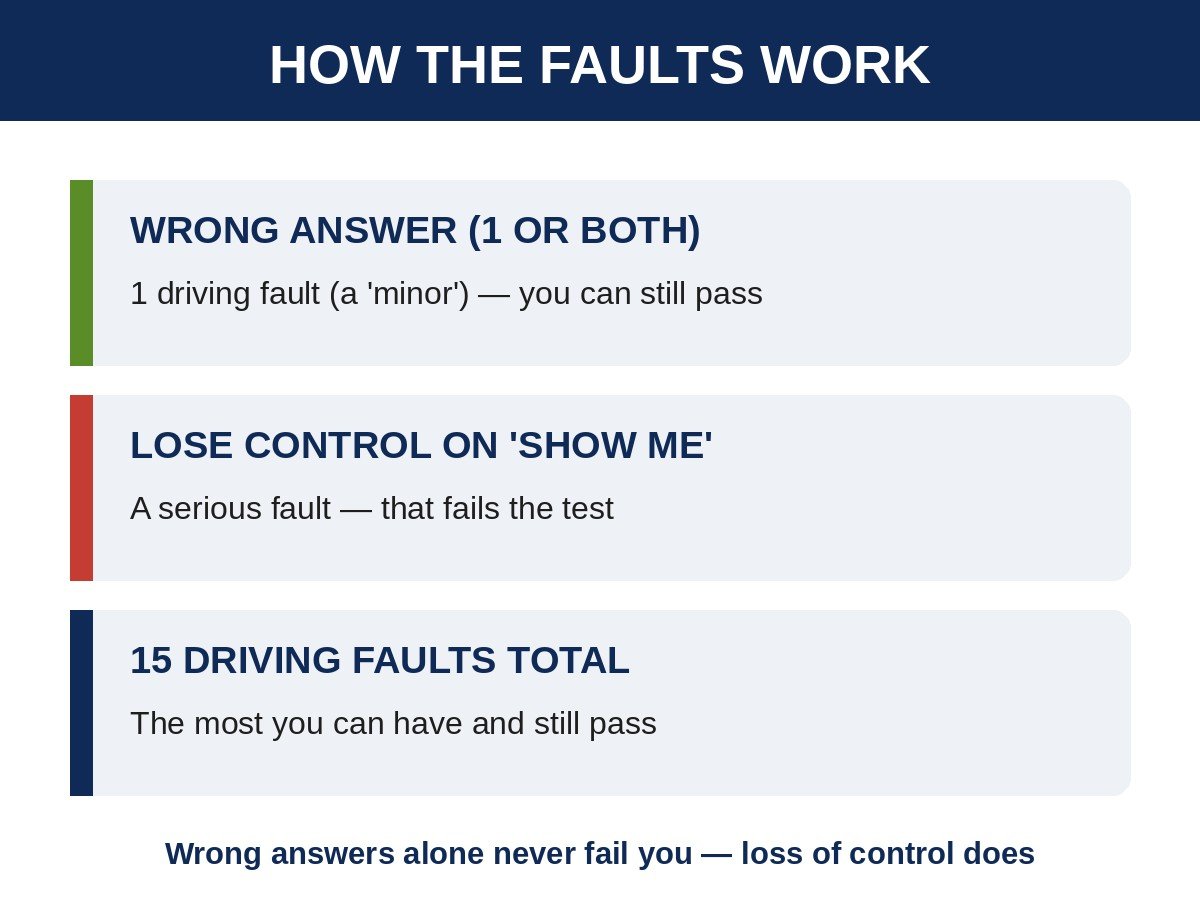
The scoring is more forgiving than learners fear. One wrong answer — or even both wrong — is a single driving fault, and you are allowed up to 15 driving faults and can still pass. These questions only fail a test when a show me task makes you lose control of the car: drifting out of your lane, braking sharply, or staring at the dashboard instead of the road. If you cannot find a control, say so, keep driving safely, and take the minor fault — never grope around in the footwell of a moving car.
How to Practise the Questions
- Learn them in pairs: 2 or 3 questions a day for a week covers all 21 before your test.
- Practise the show me set in the actual test car — controls differ between cars, and the demister layout is the one that catches people out.
- Do the bonnet trio in person: open your instructor’s bonnet and physically point at the dipstick, coolant tank and brake fluid reservoir once. After that you will never forget them.
- Use the official DVSA wording for answers — short, factual sentences like the ones in the tables above are exactly what examiners mark against.
Official source: DVSA’s official car ‘show me, tell me’ questions.
Conclusion
The show me tell me questions are the easiest part of the driving test to make fault-proof: the full list is published, the answers are short, and even getting both wrong costs only one driving fault. Learn the 14 tell me answers, know the 7 show me controls in your test car, and keep your eyes on the road while you operate them. That turns two test questions into two guaranteed non-events.