Is Undertaking Illegal in the UK? (Rules, Fines & Exceptions)
Is undertaking illegal in the UK? Not specifically — there is no standalone “undertaking” offence in UK law. But the Highway Code clearly tells drivers not to do it, and if you undertake badly — at speed, aggressively, or by weaving between lanes — the police can prosecute you for careless or even dangerous driving. That can mean a £100 fixed penalty with 3 points on your licence, or far worse in court. This guide explains exactly what the Highway Code says (Rules 267 and 268), the situations where passing on the left is perfectly allowed, and the real penalties if you get it wrong.
Is It Illegal to Undertake on a Motorway?
On a motorway the same rule applies: undertaking is not a specific offence, but Highway Code Rule 268 says you should not overtake on the left or move to a lane on your left to overtake. A driver who undertakes at speed on a motorway is exactly who the police prosecute for careless or inconsiderate driving — and if the manoeuvre is aggressive, for dangerous driving.
There is one everyday exception. In slow-moving traffic, when queues form and the lane on your left is moving faster than yours, Rule 268 allows you to keep up with the traffic in your own lane — even though that takes you past vehicles on your right. That is not treated as undertaking, because you are not changing lanes to pass.
What you should not do is weave into lane 1 to pass a middle-lane hogger at speed. The legal options are to hold back, or to move right and overtake in the normal way. Frustrating as the hogger is, they may get a fixed penalty for careless driving — but an angry undertake puts you at risk of one too.
The Short Answer: Is Undertaking Illegal in the UK?
- Undertaking means passing another vehicle on its left side (a “nearside overtake”) — for example, moving into lane 1 to pass a car sitting in lane 2 of a motorway.
- There is no specific law against undertaking. You cannot be charged with an offence simply called “undertaking”.
- But the Highway Code says not to do it — Rule 267: “Overtake only on the right” — and a bad undertake can be prosecuted as careless driving (driving without due care and attention) or dangerous driving under the Road Traffic Act 1988.
- The fixed penalty for careless driving is £100 and 3 points on your licence. Just 3 points is already a quarter of the way to a totting-up ban (12 points in 3 years).
What “Undertaking” Actually Means
Undertaking is simply overtaking on the left instead of the right:
- The normal, legal overtake in the UK is on the right (offside) — Rule 264 says to keep left unless overtaking, and Rule 267 says to overtake only on the right.
- Undertaking is the reverse: passing on the left (nearside), usually by moving into a left-hand lane to get past slower traffic on your right.
- The classic trigger is a middle-lane hogger — a driver sitting in lane 2 at 50mph with lane 1 empty. It is tempting to slip past on the left. The Highway Code still says don’t (more on what to do instead below).
What the Highway Code Says: Rules 267 and 268
The two rules that settle it, quoted from the Highway Code’s motorway section:
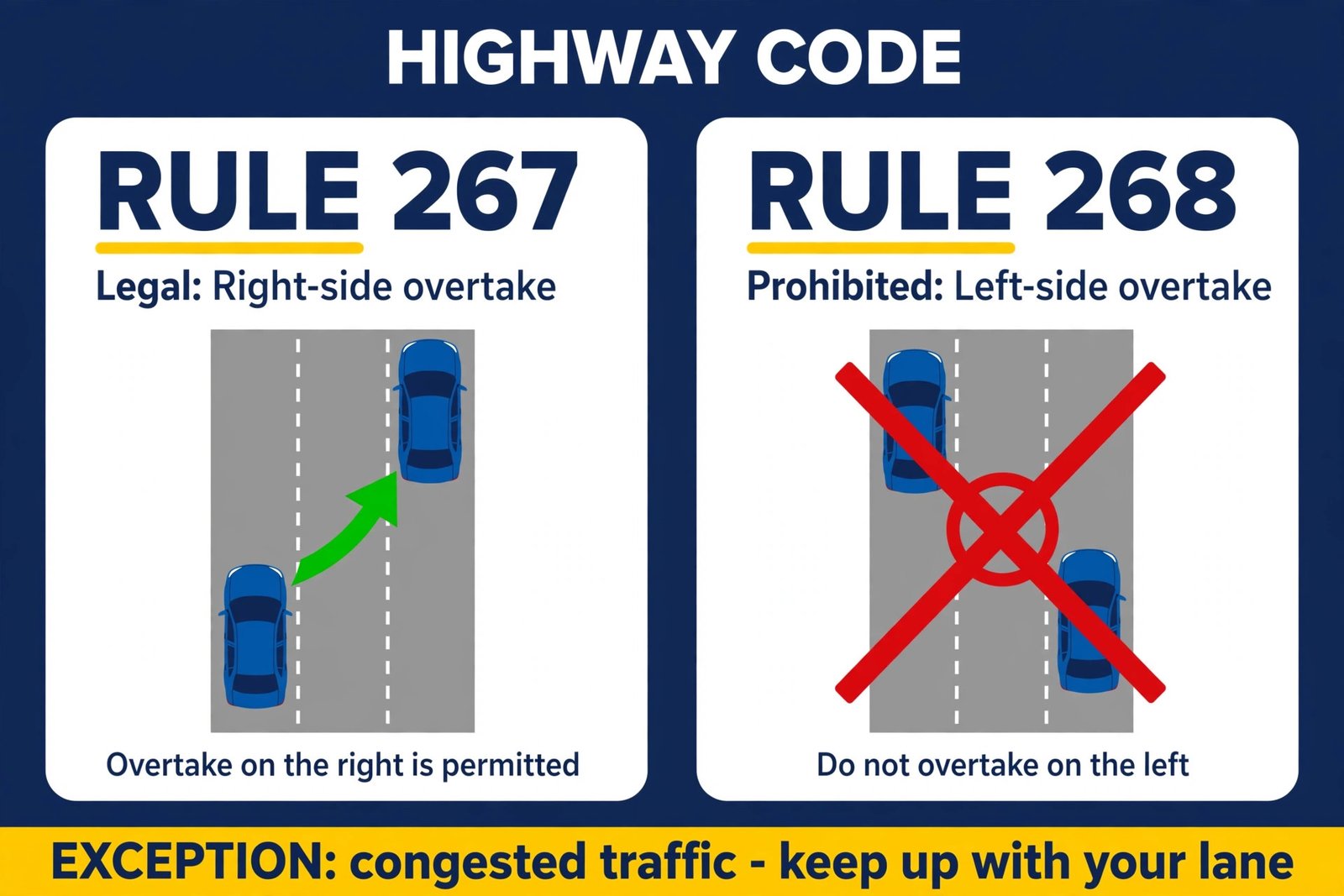
- Rule 267: “Overtake only on the right.”
- Rule 268: “Do not overtake on the left or move to a lane on your left to overtake. In congested conditions, where adjacent lanes of traffic are moving at similar speeds, traffic in left-hand lanes may sometimes be moving faster than traffic to the right. In these conditions you may keep up with the traffic in your lane even if this means passing traffic in the lane to your right. Do not weave in and out of lanes to overtake.”
Two things to note:
- The Highway Code is not itself a law book, but its rules can be used as evidence in court — “I didn’t know” is not a defence.
- Rule 268 contains the one big exception: in congested conditions, you may keep up with the traffic in your own lane even if that means passing vehicles on your right.
When Undertaking Is Allowed in the UK
Passing on the left is perfectly lawful in these situations:
- Congested traffic: Rule 268’s exception — when lanes are moving at similar speeds in heavy traffic, you may keep up with your lane even if you pass traffic on your right. This is the everyday traffic-jam scenario.
- One-way streets: where traffic flows one way, passing on either side is normal.
- Left-turn lanes: where lanes are marked or signposted for turning left, passing on the left is expected.
- Passing a vehicle signalling right: if the vehicle ahead is signalling to turn right (and there is room), passing on its left is permitted.
The key difference: in all of these, you are not changing lanes to overtake — you are simply continuing in your lane or using a lane meant for it. Deliberately moving left to get past someone is what Rule 268 forbids.
When Undertaking Becomes Illegal: Careless vs Dangerous Driving
Undertaking crosses the line into an offence when the manner of driving is bad — not because of the direction you passed in, but how you did it:
- Careless driving (Road Traffic Act 1988, section 3 — “driving without due care and attention”): undertaking at speed, cutting back in sharply in front of the other driver, or startling other road users. This is where most prosecuted undertakes land.
- Dangerous driving: a much more serious charge for driving far below the expected standard — for example, undertaking at very high speed or weaving in and out of lanes to undertake repeatedly.
The practical test is simple: if your undertake forced another driver to brake or swerve, or a police officer judged it aggressive, you are in careless-driving territory at minimum.
Penalties for Undertaking in the UK
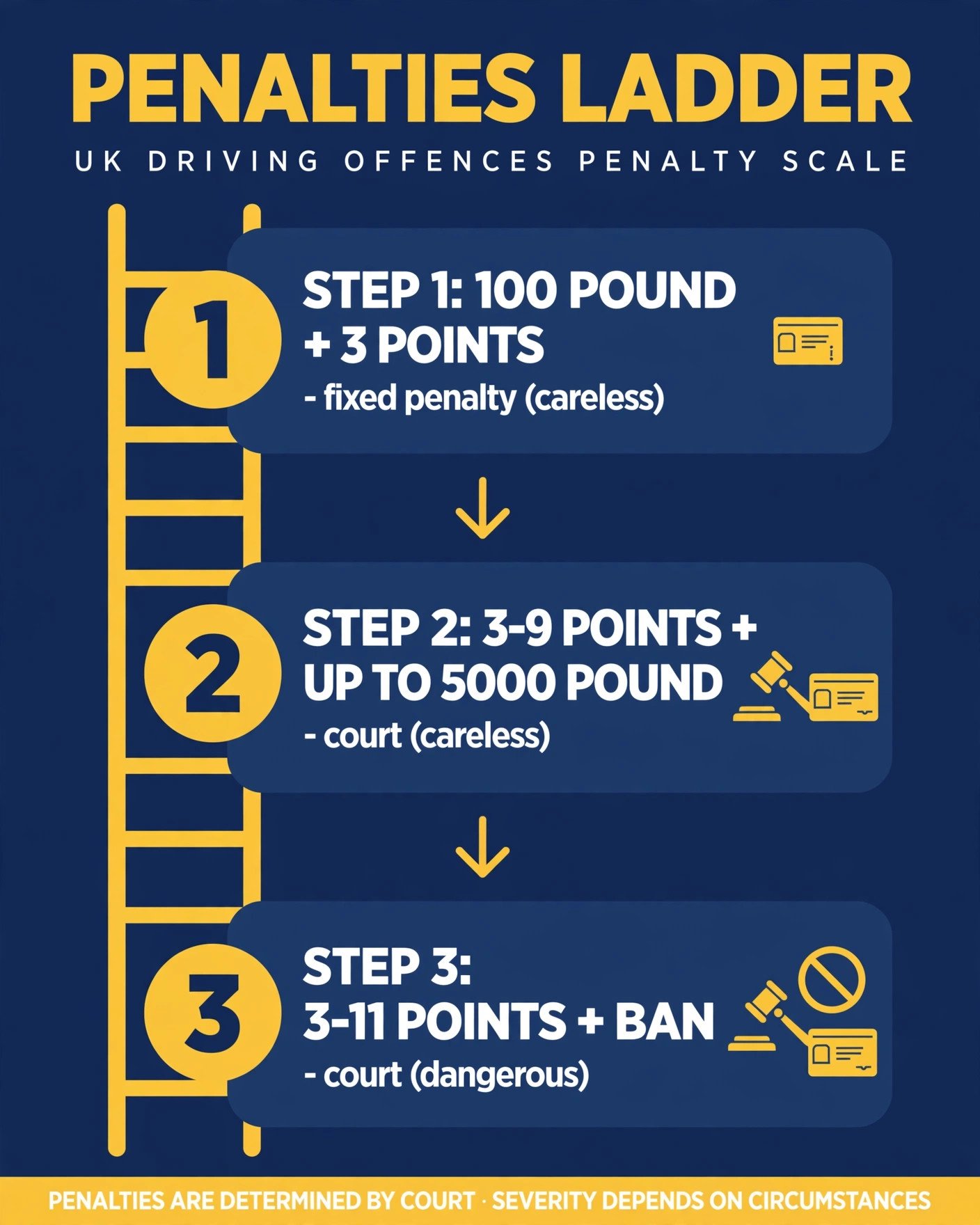
| Careless driving — fixed penalty | Careless driving — court | Dangerous driving — court | |
|---|---|---|---|
| Penalty points | 3 | 3–9 (codes CD10, CD20, CD30) | 3–11 (code DD40) + mandatory disqualification |
| Fine | £100 | Up to £5,000 | Unlimited |
| Driving ban | No | Possible (discretionary) | Yes — minimum 12 months, plus an extended re-test |
Sources: GOV.UK — new penalties for careless driving (£100 + 3 points fixed penalty, in force since 16 August 2013); GOV.UK — penalty points and endorsement codes (CD10–CD30 = 3–9 points; DD40 = 3–11 + disqualification).
Two things that make even the “minor” penalty hurt:
- 3 points is a quarter of a totting-up ban. Reach 12 points within 3 years and you face disqualification — see our totting-up ban guide.
- A ban has lasting consequences — getting your licence back afterwards is its own process (how to get your licence back after a ban), and any conviction must be declared to your insurer, which can raise premiums for years.
The Middle-Lane Hogger: What to Do Instead of Undertaking
Being stuck behind a lane-2 hogger at 50mph is frustrating — but undertaking is still the wrong answer. Do this instead:
- Hang back at a safe distance. Tailgating a hogger achieves nothing and puts you at fault if anything happens.
- Wait for a safe gap, move to lane 3, overtake on the right, and return to lane 1. That is the manoeuvre the Highway Code expects.
- Don’t undertake in frustration. A retaliatory undertake is exactly the kind of driving the police prosecute as careless.
- Report persistent hoggers with dashcam footage to the police if you want — lane hogging is itself poor lane discipline and can also be dealt with as careless driving.
Undertaking on Dual Carriageways and in Towns
The same rules apply everywhere — motorways, dual carriageways, single carriageways and town streets:
- On dual carriageways, Rules 267 and 268 apply exactly as on motorways: overtake on the right, don’t move left to overtake.
- In towns, the exceptions do most of the work: one-way streets, bus lanes you may use, and left-turn filter lanes all make passing on the left normal and lawful.
- Cyclists and motorcyclists often pass slow traffic on the left in towns — that is filtering in congested conditions, covered by the same Rule 268 principle, not the aggressive lane-change undertake the rule targets.
Related guides: how penalty points on a driving licence build up, when 12 points trigger a totting up ban, and the stricter 6 points rule for new drivers.
Conclusion
So, is undertaking illegal in the UK? Not as a standalone offence — no law uses the word “undertaking”. But the Highway Code is unambiguous: overtake only on the right (Rule 267), do not move to a lane on your left to overtake (Rule 268). The exceptions are narrow and sensible — congested traffic where you keep up with your lane, one-way streets, left-turn lanes, and passing a vehicle signalling right. Everything else risks a careless-driving prosecution: £100 and 3 points on the spot, or 3–9 points and up to £5,000 in court — and dangerous driving brings 3–11 points plus a mandatory ban. Next time a middle-lane hogger tempts you left, remember: three points is a quarter of a totting-up ban, and the legal overtake on the right is always the cheaper option.