Can I Drive a Minibus on a Car Licence? UK Rules
Short answer: usually no. A normal Category B car licence does not cover a minibus on its own. The two exceptions are holding a pre-1997 D1 entitlement, or meeting every one of the volunteer conditions at the same time. Everyone else needs a full D1 licence — whether the trip is a school football match, a church day trip or a friend’s wedding hire.
This guide breaks it down simply: what counts as a minibus, the three routes to driving one legally, the seven-condition volunteer checklist, the weight trap that catches out many drivers, and how to get D1 if you need it.
Can I Drive a Minibus on a Car Licence UK?
For most drivers, the answer is no. A standard UK car licence (Category B, passed on or after 1 January 1997) only covers vehicles with up to 8 passenger seats. A minibus has 9 to 16 passenger seats, so it sits outside your car licence.
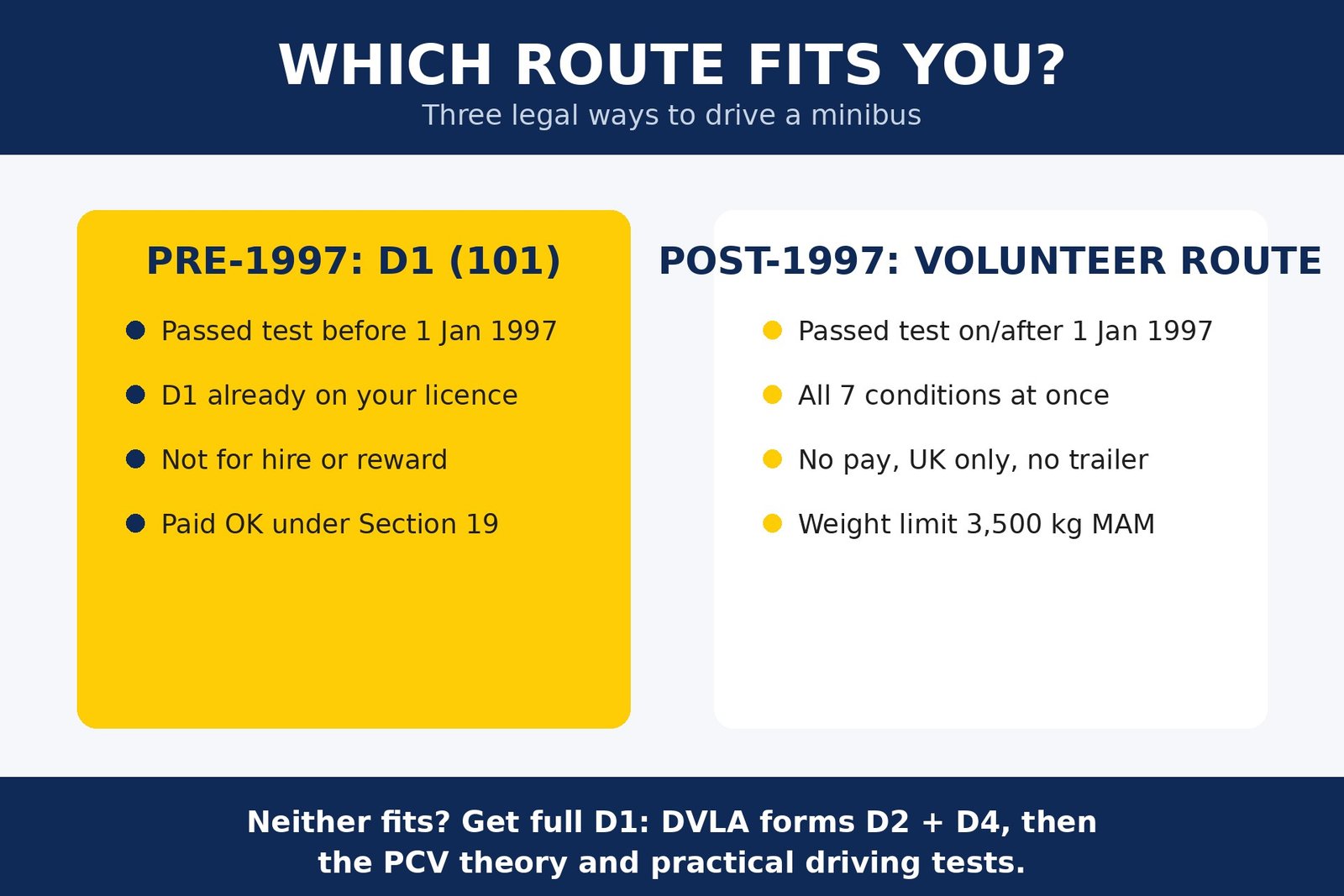
There are three legal routes to driving a minibus, and which one applies to you depends on when you passed your test and what you’re driving for:
- Pre-1997 D1 entitlement. If you passed your car test before 1 January 1997, you normally already hold D1 on your licence with a 101 code — that means you can drive a minibus, but not for hire or reward.
- The volunteer exception (Section 19). If you passed after 1 January 1997, you may drive a minibus for a non-commercial organisation if you meet all seven conditions at once — more on the full checklist below.
- Full D1 licence. If neither route covers you, you’ll need to add D1 to your licence by passing the PCV tests.
Pick the route that fits your situation, and read its section carefully — the details matter, because driving a minibus without the right entitlement is an offence.
What Counts as a Minibus?
A minibus is a vehicle with 9 to 16 passenger seats, plus the driver. That’s the official line: Category D1 on your licence covers vehicles with no more than 16 passenger seats and a maximum length of 8 metres.
It helps to know where the boundaries sit:
- 8 seats or fewer — car territory. Your Category B licence covers this.
- 9 to 16 seats — a minibus. You need D1 or the volunteer exception.
- More than 16 seats — that’s a bus (Category D), a different licence altogether.
Don’t guess the seat count from the outside — a vehicle that “looks like a big van” may legally be a minibus, and some converted vans have been re-registered as minibuses. Count the passenger seats (not including the driver’s seat) before you assume your car licence covers it.
The Volunteer Exception: Every Condition You Must Meet
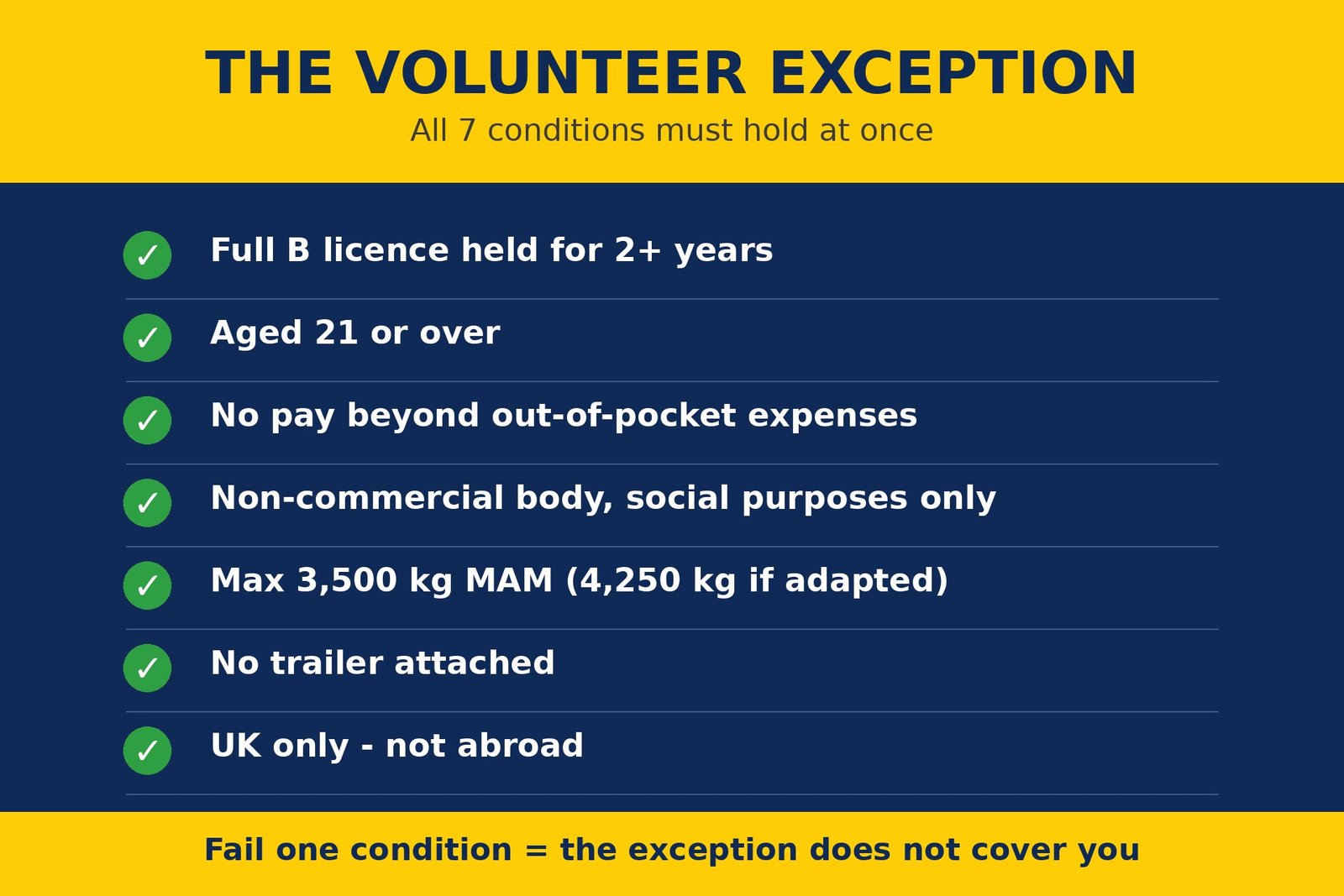
This is the route most car-licence holders ask about. The volunteer exception — linked to the Section 19 permit system — lets someone who passed their test on or after 1 January 1997 drive a minibus without D1, but only if every single condition below holds at the same time. Fail one, and the exception doesn’t apply to you.
Here is the full checklist:
- You hold a full Category B car licence — and you’ve held it for at least 2 years in total (periods can add up; it doesn’t have to be one unbroken stretch).
- You are aged 21 or over.
- You receive no payment for driving — other than out-of-pocket expenses. So fuel money for the trip is fine; a driving fee is not.
- You’re driving for a non-commercial body, for social purposes — think schools, charities, church groups and sports clubs. It must not be for hire or reward.
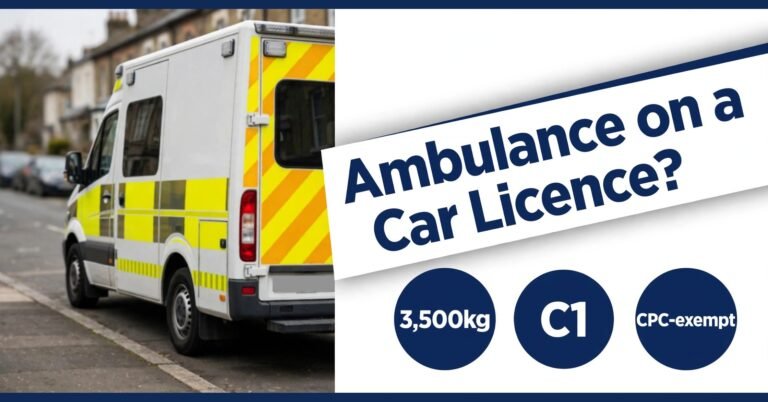
- The minibus weighs no more than 3,500 kg MAM (maximum authorised mass) — or 4,250 kg if it’s fitted with specialist equipment for carrying disabled passengers.
- No trailer attached. The exception doesn’t cover towing.
- UK only. The exception doesn’t cover driving abroad.
Two more details worth knowing. If your licence only covers automatic vehicles, the minibus must be automatic too. And if you’re over 70, this route applies the higher medical standards used for D1 vehicles (the “Group 2” standard for buses and lorries) — check the current DVLA renewal rules before assuming you still meet them.
Be honest with yourself against this list. Driving the school minibus as an unpaid parent helper for a charity school trip? That can fit. Driving the same minibus while being paid a fee, or for a commercial hire company? That’s a different story — keep reading.
The Weight Trap: Why Many 16-Seaters Fail the 3,500 kg Limit
Here’s the trap almost nobody warns you about. Plenty of 16-seater minibuses have a maximum authorised mass (MAM) above 3,500 kg once fully loaded — even though they look like they’d fit. If the vehicle’s MAM is over 3,500 kg and it isn’t fitted with specialist disabled-passenger equipment, the volunteer exception simply doesn’t cover you, no matter how perfectly you meet the other six conditions.
The mistake people make is checking the wrong number. The figure that counts is the MAM — the maximum the vehicle is allowed to weigh when fully loaded with passengers, luggage and fuel — not the empty weight or the brochure figure. You can find it on the vehicle’s VIN plate (usually under the bonnet or on the driver’s door frame) or on its V5C registration certificate.
Before you agree to drive any minibus on your car licence, do this 2-minute check:
- Find the MAM on the VIN plate or V5C.
- If it’s 3,500 kg or under, the weight condition is met.
- If it’s between 3,500 kg and 4,250 kg, it’s only covered if the vehicle is fitted with specialist equipment for carrying disabled passengers.
- If it’s over the limit, don’t drive it on a car licence — you’ll need full D1.
This single check saves more drivers from trouble than any other step in this guide.
Hire or Reward: When You Definitely Need D1
The volunteer exception ends the moment money enters the picture. If you receive any payment or other consideration for driving beyond out-of-pocket expenses — a wage, a fee, or driving as part of a commercial service — you need a full D1 licence, regardless of when you passed your car test. Pre-1997 D1 holders are the exception to the exception: their 101-coded entitlement allows driving under a Section 19 permit, where they may be paid to drive under the permit.
And if you’re driving a minibus professionally for hire or reward, there’s one more requirement on top of D1: Driver CPC (Certificate of Professional Competence) — the initial qualification plus 35 hours of periodic training every 5 years. This is for professional drivers, not for volunteers: Driver CPC is never needed for genuine volunteer driving under the exception.
A quick rule of thumb: unpaid, for a non-commercial group, meeting all seven conditions — the volunteer route may cover you. Anything paid or commercial — you need D1, and if it’s your profession, Driver CPC too. If you’re unsure which side of the line your situation falls on, treat it as needing D1 and check with the DVLA.
How to Get a D1 Licence
If neither the pre-1997 entitlement nor the volunteer exception covers you, you’ll need to add D1 to your licence properly. The process is straightforward:
- Apply to the DVLA using form D2 (the application) and form D4 (a medical report completed by a doctor). This gives you provisional D1 entitlement.
- Pass the PCV theory test — the theory test for passenger-carrying vehicles.
- Pass the PCV practical driving test.
- The DVLA then adds full D1 to your licence.
The D4 medical is a real step, not a formality — it checks you’re medically fit to carry passengers, which is exactly why minibus drivers face higher standards than car drivers. Once D1 is on your licence, you’re covered for minibuses up to 16 seats with a trailer up to 750 kg MAM (D1E covers heavier trailers up to 12,000 kg combined).
Trailers, Driving Abroad, and Hiring a Minibus
Three common follow-up questions, answered plainly:
Can you tow a trailer with a minibus? Not under the volunteer exception — a trailer must not be attached. With full D1, you can tow a trailer up to 750 kg MAM; with D1E, a heavier trailer as long as the combined MAM doesn’t exceed 12,000 kg.
Can you drive a minibus abroad? Not on the volunteer exception — it’s UK only. With a full D1 licence, check the rules of the country you’re visiting before you go, as entitlements and recognition can differ.
Can you hire a minibus on a car licence? This is where many people get caught. Even if the volunteer exception would legally cover your situation, hire firms set their own stricter rules — many require drivers to be over 25, to have held a licence for several years, or to hold full D1 regardless. Always check the hire firm’s own rules before booking; their policy decides whether you drive away, not just the law.
Driving in Northern Ireland? Licence categories differ there — check the nidirect guidance rather than assuming GB rules apply.
What Happens If You Drive a Minibus Without the Right Licence?
Driving a minibus without the proper entitlement is treated as driving otherwise than in accordance with a licence — and the consequences are serious even though they vary case by case. You can face fines, penalty points on your licence, and disqualification from driving — and because you’d be driving unlicensed for that vehicle, your insurance would likely be invalid too, which can make any accident financially devastating.
Note that no specific fine or points figure is stated here deliberately — the outcome depends on the court and the circumstances. The point stands regardless: if you’re not sure your situation meets the rules, don’t drive the minibus until you are.
Conclusion
So — can I drive a minibus on a car licence UK? For most drivers, no: a standard post-1997 car licence only covers up to 8 passenger seats. But the picture has three doors. Passed before 1 January 1997? You likely already hold D1 with a 101 code. Driving unpaid for a non-commercial group and meeting all seven volunteer conditions, including the 3,500 kg weight limit? The exception may cover you. Anything else — paid work, commercial driving, or a heavier vehicle? You’ll need full D1 (and Driver CPC if it’s your profession).
The single most useful thing you can do today: check the MAM on the specific minibus’s VIN plate or V5C. Two minutes, and you’ll know exactly where you stand. And if you’re planning to drive minibuses regularly, adding D1 to your licence is the clean, permanent answer — no checklists, no edge cases, no doubt.
3 Comments