Can I Drive a Tuk Tuk on a Car Licence UK?
Can I drive a tuk tuk on a car licence UK? The short answer is: it depends. If you are over 21 and hold a full Category B car licence (passed on or after 1 January 1997), you can drive a motor tricycle with a power output higher than 15kW — and that is the legal box a tuk tuk sits in. Lower-powered tricycles (up to 15kW) fall under Category A1 instead. And here is the part that catches people out: a provisional car licence does not cover a tuk tuk at all, and that old “pre-2013 B1 covers tuk tuks” claim you may have read online does not match what GOV.UK says today.
In this guide you get the full picture on one page: what a tuk tuk is in UK law, the exact 15kW power line and the age-21 line, what to do if you are under 21, why a provisional licence is not enough, the B1 myth, what extra council licensing applies when you carry paying passengers, and the road-legal checklist every tuk tuk must pass before it touches a public road.
Can I Drive a Tuk Tuk on a Car Licence UK?
Yes — sometimes. There is no single yes-or-no answer for every tuk tuk, because the answer turns on two facts: the vehicle’s power output and your age.
Here is the split, straight from GOV.UK’s driving licence categories page:
| Your situation | What covers a tuk tuk |
|---|---|
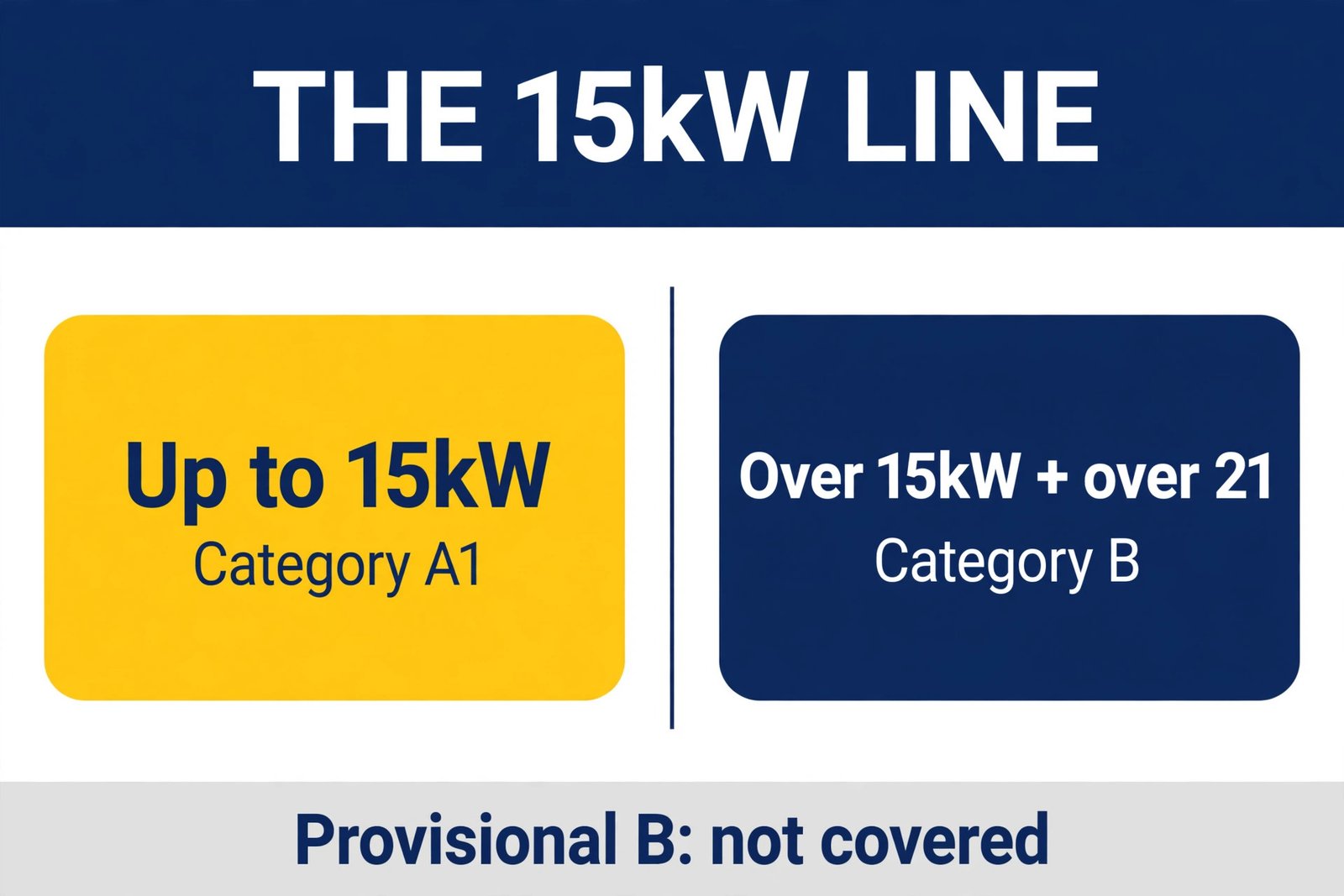
| Over 21, full Category B car licence (passed on or after 1 January 1997) | You can drive motor tricycles with a power output higher than 15kW |
| Any age with Category A1 | You can drive motor tricycles with a power output up to 15kW |
| Category A | Covers motor tricycles with a power output more than 15kW |
| Provisional Category B (non-disabled drivers) | Does not cover motor tricycles |
So: if you are over 21 with a full post-1997 car licence, a standard tuk tuk — a motor tricycle — is normally within your entitlement, because most full-size tuk tuks sit above the 15kW line. If the tuk tuk is a lower-powered model at or under 15kW, you need A1 — check that the category is actually on your licence before you drive. If you only hold a provisional licence, stop here: it does not cover a tuk tuk, and we explain why below.
One more caution before we go further: models differ. Petrol and electric tuk tuks do not all have the same power output, so the 15kW line is what decides your category — not the badge on the side. Always check the exact vehicle’s power output on its V5C registration certificate or the manufacturer’s spec before you drive it.
What a Tuk Tuk Is in UK Law
Forget the holiday image for a moment. In UK licence law a tuk tuk is a motor tricycle — a three-wheeled motor vehicle. That one fact decides everything, because the licence categories treat tricycles as their own thing.
It is not a car. A car has four wheels and sits under Category B’s vehicle rules; a tuk tuk does not, so the ordinary “B covers cars” logic does not directly apply — what covers it is the specific motor-tricycle entitlement written into categories B, A1 and A.
It is also not a quad bike. Quad bikes have four wheels and follow different rules (B/B1 territory), so any article that tells you “quad bike rules apply to tuk tuks” is mixing up two different vehicle types.
And it is not a light quadricycle or microcar either — those are a different category again. Three wheels: motor tricycle. Four wheels: something else. Keep that split in your head and the rest of the rules make sense.
The Licence Rule: The 15kW Line and the Age-21 Line
The whole licence question comes down to two lines: 15kW of power, and 21 years of age.
Category B — the standard car licence. If you passed your test on or after 1 January 1997 and you are over 21, Category B lets you drive motor tricycles with a power output higher than 15kW. That is the entitlement most tuk tuk drivers rely on. Note the two conditions together: over 21 and a full licence. One without the other does not unlock it.
Category A1 — the light motorcycle category. This covers motor tricycles with a power output up to 15kW. If the tuk tuk you want to drive is a lower-powered model at or under 15kW, A1 is the category that covers it.
Category A — the full motorcycle category. This covers motor tricycles with a power output more than 15kW (as well as bigger motorbikes). So a full motorcycle licence also covers a tuk tuk, within those limits.
Category B1 — the one people get wrong. Current GOV.UK wording defines B1 as motor vehicles with 4 wheels up to 400kg unladen, or 550kg if designed for carrying goods. Read that again: four wheels. B1 is a four-wheel category and it does not describe tricycles — so do not count on B1 to cover a three-wheeled tuk tuk. There is a whole section below on the old B1 claim, because it is the single most repeated piece of misinformation on this topic.
For completeness, a post-1997 Category B licence generally covers vehicles with up to 8 passenger seats, a MAM of up to 3,500kg (4,250kg for zero-emission vehicles only), plus a trailer up to 3,500kg within a 7,000kg combined limit. driving licence categories
All of the above applies in Great Britain. In Northern Ireland the licence categories differ, so check nidirect instead — do not apply GB rules there.
Age Rules: Under 21? Here Are Your Options
Being under 21 does not shut every door — it just changes which category you need.
If you hold a full car licence but you are under 21, the over-21 condition on the B motor-tricycle entitlement does not yet apply to you. What you do have:
- Category A1 covers motor tricycles with a power output up to 15kW — so a lower-powered tuk tuk is within reach on A1.
- An over-15kW tricycle needs Category A, and the age-21 condition applies — so check the exact category printed on your own licence before assuming you are covered.
The practical move if you are under 21 and eyeing a tuk tuk: find a model at or under 15kW, confirm A1 is on your licence, and confirm the power figure on the vehicle’s V5C — not on a dealer’s sales page. Never guess the power output from how the vehicle looks; two tuk tuks that look identical can sit on opposite sides of the 15kW line.
Provisional Licence: Why It Does Not Cover a Tuk Tuk
This one is blunt: non-disabled drivers can no longer ride motor tricycles with a provisional Category B licence. That is the current GOV.UK position, and it means a learner driver with only a provisional car licence cannot legally drive a tuk tuk on the road — even with L plates, even with a qualified driver beside them.
There is one narrow exception, and it is genuinely narrow: physically disabled drivers holding a provisional B licence also get provisional A1/A motor-tricycle entitlement. If that does not describe you, it does not apply to you.
Why does this matter so much? Because the most common tuk tuk scenario — renting one on impulse, or “learning” in one before your test — runs straight into this wall. The licence you are learning on does not cover the vehicle. If a rental firm offers you a tuk tuk on a provisional licence alone, that is a red flag about the firm, not a loophole in the law. provisional driving licence
The Pre-2013 B1 Claim — Check Your Own Licence, Do Not Assume
You will find websites claiming that if you passed your test before 2013, your Category B1 entitlement covers tuk tuks. Do not trust it.
Here is what we can verify: current GOV.UK wording defines B1 as motor vehicles with 4 wheels up to 400kg unladen (550kg if designed for carrying goods). It is a four-wheel category. A tuk tuk has three wheels. The claim relies on how B1 used to be described years ago — but what matters for you today is what is printed on your licence right now, and what GOV.UK says right now.
So do this instead of trusting the claim:
- Look at the categories actually printed on the back of your photocard licence.
- Run DVLA’s online licence check to see your live entitlements.
- If neither shows a motor-tricycle entitlement you recognise, you do not have one — whatever a forum or an old blog post told you.
Licence records can also carry restrictions you have forgotten about. “My mate said pre-2013 B1 covers it” is not a defence; the categories on your licence are.
Driving for Paying Passengers: Council Taxi / PHV Licensing
Here is the second layer most articles skip: the DVLA category is only half the story when money changes hands. Carrying paying passengers normally needs a council taxi or private-hire vehicle (PHV) licence and a licensed driver — and that is council licensing, not a DVLA category rule.
What that means in practice:
- Driving your own tuk tuk for fun needs only the right licence category (B/A1/A as above) plus a road-legal vehicle.
- Driving a tuk tuk for hire or reward — tours, wedding hire, city rides where passengers pay — normally needs the local council’s taxi/PHV licensing on top, and the driver needs to be licensed by that council too.
- The rules vary by council. There is no single national PHV application process for tuk tuks, so check your own council’s licensing pages before you take a single paying passenger.
Keep the two layers separate in your head: the DVLA category answers “am I licensed to drive this vehicle?”, the council licence answers “am I allowed to charge passengers for it?” You need the right answer to both.
Hiring or Renting a Tuk Tuk
Renting a tuk tuk does not change the licence rules — it just adds a rental company’s paperwork on top of them.
The category rules apply exactly the same whether you own the tuk tuk or rent it for a weekend. A hire firm should check your licence before handing over the keys; if it does not, treat that as a warning sign. Before you sign:
- Confirm the exact vehicle’s power output (V5C or manufacturer’s spec) and match it against your licence category — the 15kW line again.
- Confirm the vehicle is properly registered, taxed and insured for road use — ask to see it, do not take it on trust.
- Check what the rental insurance actually covers and what excess you carry.
One firm, one vehicle, one V5C at a time. “The last one I rented was fine” tells you nothing about the one in front of you.
Where Can You Drive a Tuk Tuk?
Once a tuk tuk is fully road-legal — approved, registered, taxed, MOT’d and insured — it can be driven on public roads like any other road-legal vehicle. There is no separate “tuk tuk zone” law in licence legislation, and no special road type reserved for or banned to tricycles as a class.
That said, three practical limits apply: the vehicle must be road-legal first (a tuk tuk that is not registered, taxed or insured cannot be driven on a public road at all — the licence question never even arises); hire and rental firms set their own restrictions in their contracts; and for paid work, your council’s taxi/PHV licence defines where you may operate.
So the real “where” answer is simple: anywhere your licence category, the vehicle’s road-legal status, and (for paid work) your council licence all line up.
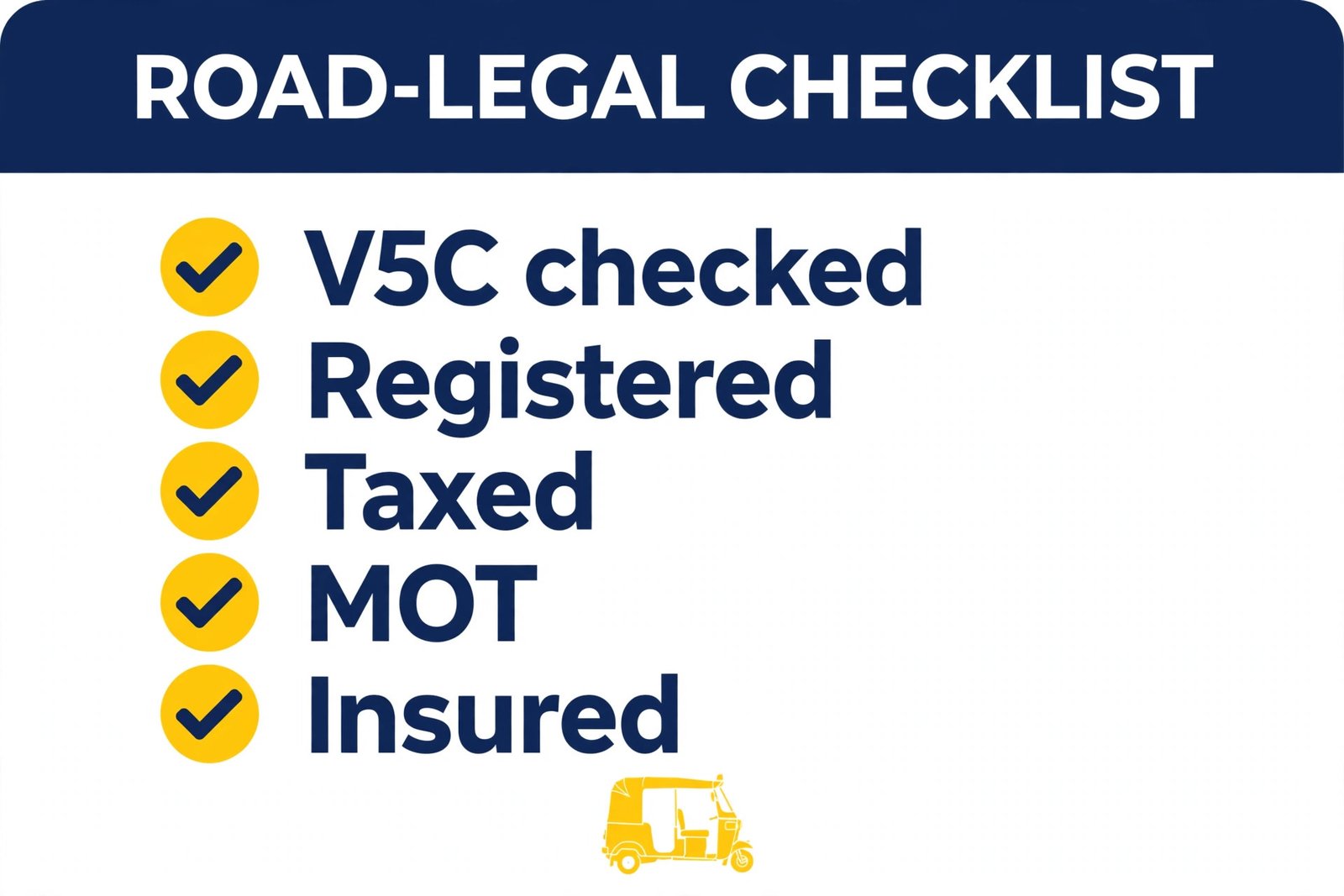
Road-Legal Checklist: Approval, Registration, Tax, MOT, Insurance — Check the V5C
A tuk tuk is not automatically road-legal. Like any vehicle used on a public road, it must be approved, registered, taxed and insured — and this is where buyers get caught, because not every tuk tuk on the market meets that bar.
Run this checklist on the exact vehicle, not the model in general:
- Type approval. The vehicle must be approved for UK road use. Dealer-sold UK models are typically DVSA-approved before sale (that is the dealers’ own claim — verify it on the specific vehicle rather than assuming).
- Registration. It must be registered with DVLA and carry a number plate. Check the V5C registration certificate (log book) — and check that the V5C in front of you belongs to this vehicle.
- Vehicle tax. It must be taxed. Untaxed vehicles cannot be used on the road.
- MOT. It needs a valid MOT once it is old enough to require one, like any other vehicle.
- Insurance. It must be insured for road use, at least third-party. Riding or driving uninsured is an offence whatever the vehicle.
And the step everyone skips: check the V5C for the power output. Models differ — petrol and electric tuk tuks do not share one spec — and the 15kW line is what decides whether your B, A1 or A entitlement covers it. The V5C (or the manufacturer’s spec for that exact vehicle) is the document that settles it. driving licence check code
Conclusion
So, can I drive a tuk tuk on a car licence UK? If you are over 21 and hold a full Category B licence (passed on or after 1 January 1997), you can drive a motor tricycle with a power output over 15kW — and that covers most full-size tuk tuks. Lower-powered models at or under 15kW sit under A1, and a full motorcycle licence (A) also covers tricycles over 15kW. What does not work: a provisional B licence, which covers no motor tricycle at all, and the old “pre-2013 B1 covers it” claim, which does not match current GOV.UK wording — check the categories printed on your own licence instead.
Remember the two layers: the DVLA category answers whether you may drive the vehicle, and council taxi/PHV licensing answers whether you may charge passengers for it. And whatever the licence says, the vehicle itself must be approved, registered, taxed, MOT’d and insured — with its power output confirmed on the V5C, because the 15kW line is what decides your category.