Do You Need a Driving Licence for a Mobility Scooter? (UK Guide)
Do you need a driving licence for a mobility scooter in the UK? For most mobility scooters — no. If your scooter is a Class 2 or Class 3 “invalid carriage”, you do not need a driving licence, you do not need to pass a test, and no driving licence category applies. But there are real exceptions where the answer flips to yes: larger, faster vehicles that fall outside the Class 2 and Class 3 definitions do require a valid driving licence, and Class 3 scooters must be registered with the DVLA even though no licence is needed. This guide gives you the complete, plain-English rules — which class your scooter is, where you may use it, and what the law requires.
The Short Answer
In UK law, mobility scooters and powered wheelchairs are called “invalid carriages” and come in three groups:
- Class 2 (pavement scooters, max 4mph): no driving licence needed, no DVLA registration, no insurance required by law.
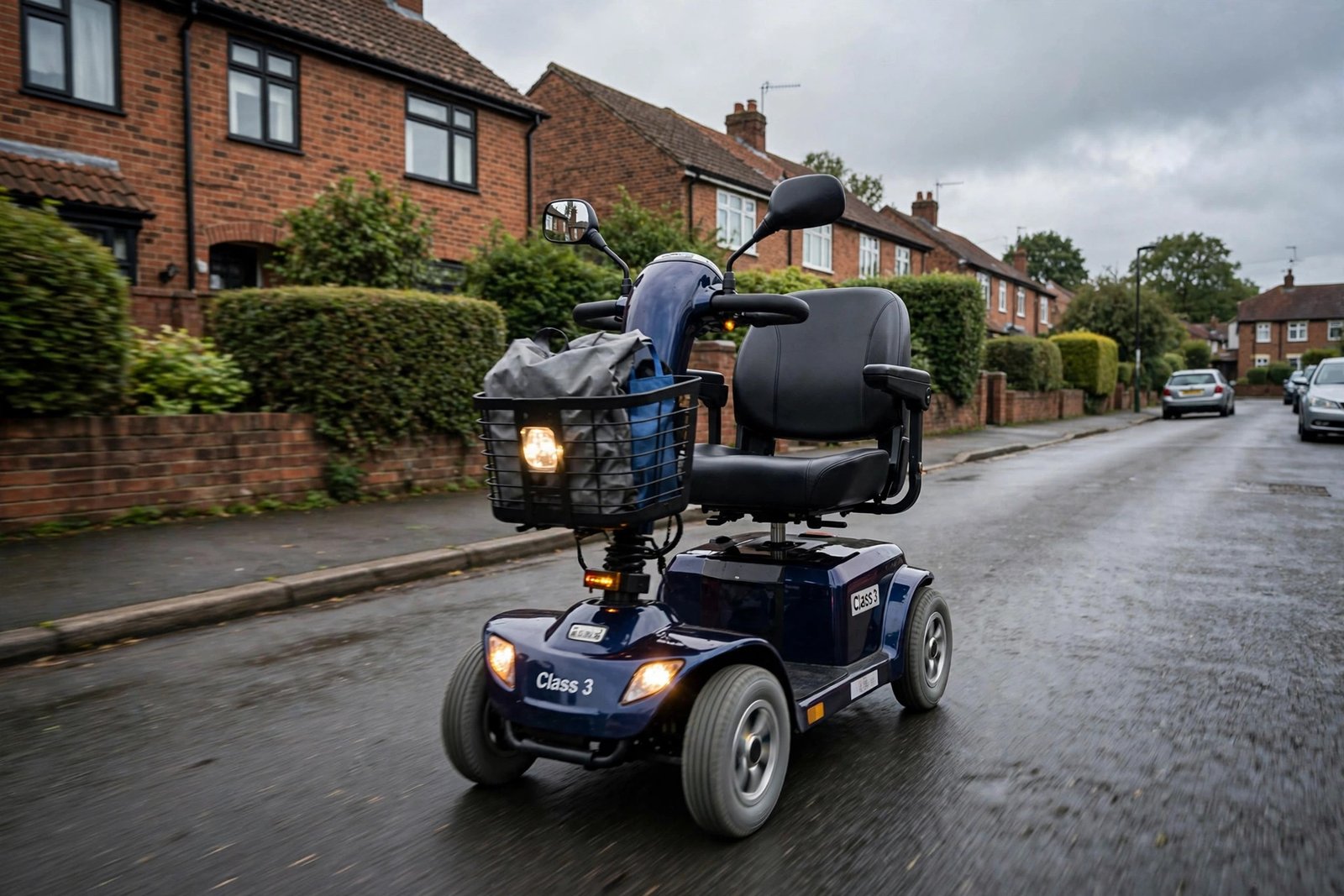
- Class 3 (road-capable scooters, max 8mph on roads): no driving licence needed, but you must register it with the DVLA (free) — and the user must be at least 14 years old.
- “Not in a class” (can go over 8mph, wider than 0.85m, or weighs over 150kg — 200kg with medical equipment attached): a valid driving licence IS required, plus DVLA registration, and road use only.
So for the two scooter types most people buy, the answer is reassuringly simple: no licence. The rest of this guide explains how to tell which class yours is, and exactly what the rules are for each. You can read the official rules in GOV.UK’s mobility scooters and powered wheelchairs rules.
Class 2 vs Class 3: The One Table That Settles It
| Class 2 | Class 3 | |
|---|---|---|
| Maximum speed | 4mph (6.4kph) | 8mph (12.8kph) on roads; 4mph on pavements |
| Where you can use it | Pavements, footpaths, pedestrian areas, cycle tracks; roads only where there is no pavement | Pavements (at 4mph) and most roads |
| Driving licence | Not needed | Not needed |
| DVLA registration | Not needed | Required — free, nil-duty vehicle tax |
| Insurance | Not legally required (recommended) | Not legally required (recommended) |
| Minimum age | None | 14 years old |
| Must have fitted | Efficient brakes, clear view, audible horn | Brakes, lights front and rear, reflectors, indicators that double as hazard lights, rear-view mirror, audible horn |

Class 2 scooters are the smaller, lighter models — often the kind that can be dismantled to fit in a car boot. Class 3 scooters are the larger, sturdier road-capable models with headlights, indicators and a rear-view mirror. If your scooter does 8mph and has lights and indicators, it is almost certainly Class 3.
Class 3 on the Road: Registration, Equipment and the 4mph Rule
Owning a Class 3 scooter without a licence is fine — but the law does require three things:
- Register it with the DVLA. Registration is free and the vehicle is in the nil-duty tax class. If you buy new, the dealer usually registers it for you. Otherwise you complete form V55/MV. The V5C registration certificate should arrive within 4 to 6 weeks — if it does not, apply with form V62. You can read more about how the DVLA handles vehicle records in our DVLA driving licence guide.
- Fit the required equipment. A Class 3 scooter must have efficient brakes, a clear view of the road, front and rear lights with reflectors, direction indicators that can also work as hazard warning lights, a rear-view mirror and an audible horn. If your scooter is 4-wheeled and you use it on a dual carriageway, it also needs an amber flashing light.
- Respect the speed settings. On the road you may use the 8mph setting; on pavements and in pedestrian areas you must switch down to 4mph. You must obey traffic lights and road signs like any other road user, and you must not use motorways, bus lanes (while in operation) or cycle lanes. On dual carriageways with a speed limit above 50mph, the official advice is to avoid them; on other dual carriageways a flashing amber beacon is required.
There is no MOT, no number plate and no vehicle excise duty for Class 3 scooters — but registration with the DVLA is the one step people most often miss.
The Exception: “Not in a Class” Vehicles DO Need a Driving Licence
This is the part most competitor articles skip entirely. If your powered vehicle: can travel at more than 8mph, or is wider than 0.85 metres, or has an unladen weight over 150kg (or over 200kg with medical equipment attached) …it is “not in a class” — and the rules change sharply. You must hold a valid driving licence (a provisional licence is not enough — see our guide to the provisional driving licence for what a provisional actually permits), you must register it with the DVLA, and you may use it on the road only — never on pavements, cycle tracks or cycle lanes.
Insurance becomes compulsory when the unladen weight exceeds 254kg. The eyesight standard is also stricter: you must be able to read a car number plate from 20 metres (65.5 feet), compared with 12.3 metres for Class 2 and 3.
If you bought your vehicle as an ordinary mobility scooter, it is very unlikely to fall into this category — but anyone using a modified or unusually large machine should check, because driving one on a pavement or without a licence is an offence.
Insurance: When It’s Optional, When It’s Compulsory
For Class 2 and Class 3 scooters, insurance is not a legal requirement — but it is strongly recommended. Policies covering theft, accidental damage and third-party liability are inexpensive (often around £50 a year from specialist providers), and worth having given how much a scooter costs to replace.
Insurance becomes compulsory only for “not in a class” vehicles with an unladen weight over 254kg — the same principle as car insurance: if your machine is big and fast enough to need a licence, it needs insurance too.
Who Is Legally Allowed to Use a Mobility Scooter?
This surprises many buyers, and it is the rule most retailer guides leave out: under the law, you may only use a Class 2 or Class 3 invalid carriage if you have difficulty walking — because of injury, physical disability or a medical condition.
The only other lawful uses are: taking it to or from maintenance or repair, the manufacturer testing it, demonstrating it before sale, or training a disabled person to use it. Misuse is taken seriously: using a scooter when you are not entitled to can bring the same penalties as motoring offences — including prison, a driving ban and an unlimited fine.
Many Class 3 users are older drivers who still hold a licence or are approaching the driving licence renewal at 70 — if that is you, your existing licence is more than enough; it simply is not required for the scooter itself.
Eyesight and Safety Rules
The eyesight rules are simple and practical:
- Class 2 and Class 3: you should be able to read a car number plate from 12.3 metres (40 feet) — the same standard as the driving test.
- Not in a class: 20 metres (65.5 feet).
Beyond that, the Highway Code’s rules 36 to 46 apply to mobility vehicles: give way to pedestrians, park considerately so you do not block pavements, and at night use your lights. On any road, remember you are far less visible than a car — the amber flashing light on dual carriageways is required for a reason.
Related guides: the DVLA medical conditions you must report, the eyesight requirements for driving, and whether you can drive a golf buggy on the road.
Conclusion
Do you need a driving licence for a mobility scooter in the UK? For a Class 2 pavement scooter or a Class 3 road-capable scooter — no, no licence and no test, full stop. What Class 3 ownership does require is free DVLA registration, the right safety equipment, 14 years of age or more, and a strict 4mph limit on pavements. The only scenario where a driving licence enters the picture is the “not in a class” vehicle — over 8mph, over 0.85m wide or over 150kg — which must be registered, insured if over 254kg, kept to the road, and driven only by someone with a valid licence. Check your scooter’s top speed against those numbers and you will know exactly where you stand.