Can I Drive a Go Kart on the Road in the UK?
No — you cannot drive a standard go-kart on the road in the UK. It does not matter how quiet your street is, or that the kart feels like a small car: a standard go-kart is not a road-legal vehicle. It has no registration, no number plates, no road tax, no MOT, and no insurance — and it never went through the approval process every road vehicle must pass. In this guide, you will see exactly why a go-kart fails the road-legal test, the full list of what one would need to become road legal, the penalties if you are caught on the road, and the places where you CAN drive a go-kart legally.
Can I Drive a Go Kart on the Road in the UK?
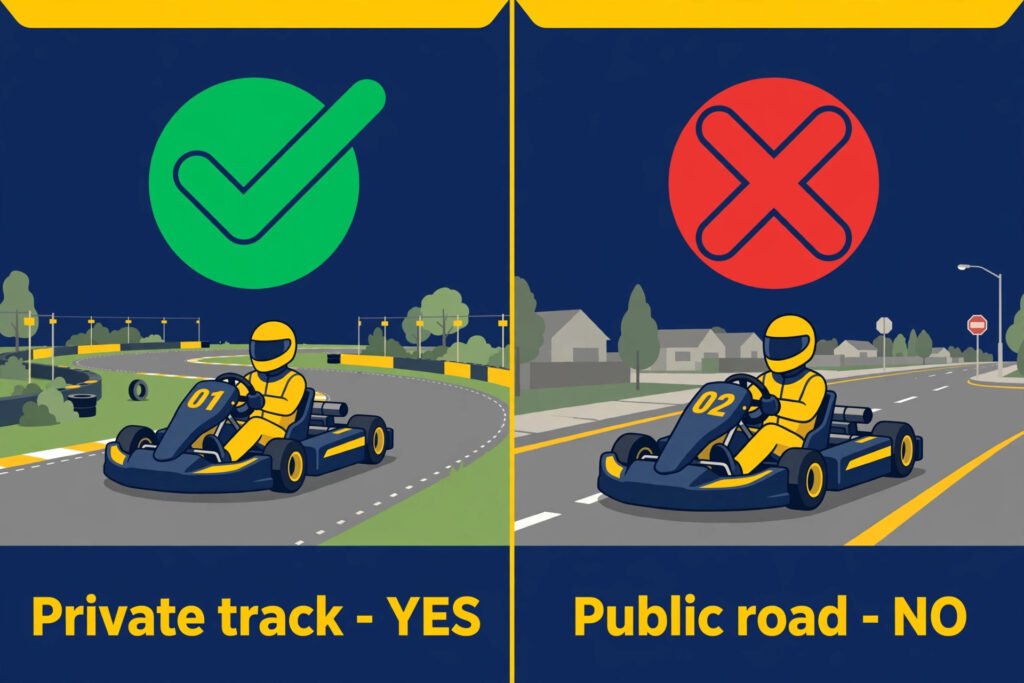
No. A standard go-kart is not road legal in the UK, and you cannot drive one on a public road. Public roads are only for vehicles that meet every road-vehicle requirement: approval, registration, tax, insurance, MOT, and a driver holding the right licence. A standard go-kart meets none of these. It is built for private tracks and private land — not for streets, country lanes, or housing estates. Could a go-kart ever become road legal? Only in theory, if it passed every single requirement below — in practice, standard go-karts do not, and the cost and work involved mean almost nobody does it. If you want to drive a go-kart, the legal places are private land (with the landowner’s permission) and karting circuits.
Why a Standard Go Kart Is Not Road Legal
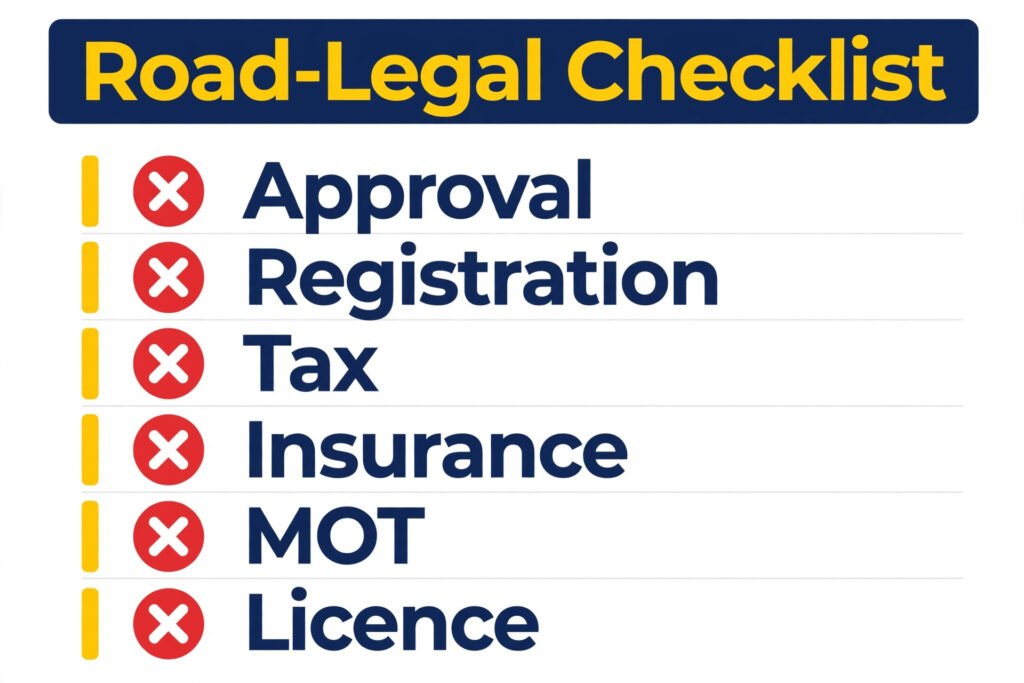
A vehicle is road legal only when it ticks every box in the UK’s road rules. A standard go-kart fails on all of them at once:
- No vehicle approval. Vehicles that are built, rebuilt, radically altered, or imported must go through an approval process before they can be registered. Routes include IVA (individual vehicle approval) for unregistered vehicles and MSVA (motorcycle single vehicle approval) for smaller two-, three-, or four-wheeled vehicles. The DVLA will not register a vehicle without proof of approval.
- No registration or number plates. A go-kart has no registration, so it cannot be taxed or identified the way road vehicles must be.
- No road tax. A vehicle must be registered and taxed before it can be used on the road.
- No insurance. A vehicle must be insured before it is used on the road.
- No MOT. Road vehicles need a valid MOT once they are old enough. A go-kart has none.
- No road equipment. Lights, indicators, mirrors, brakes, and other equipment that road vehicles must have are missing or not to road standard.
One missing item alone would be enough. A go-kart is missing all of them, which is why the answer is a flat no.
What a Go Kart Would Need to Become Road Legal
For a go-kart to ever be driven on a public road, it would have to pass every one of these steps:
- Vehicle approval. Apply for approval (IVA or MSVA, depending on the vehicle) and get proof of approval. Without it, the DVLA will not register the vehicle. See GOV.UK’s guidance on vehicle approval.
- Registration. Register the vehicle with the DVLA and get number plates.
- Road tax. Tax the vehicle before using it on the road.
- Insurance. Insure the vehicle for road use. See GOV.UK’s guidance on vehicle insurance.
- MOT. Get a valid MOT once the vehicle is old enough to need one. See GOV.UK’s guidance on getting an MOT.
- A licensed driver. The driver must hold a driving licence covering the vehicle class.
Be honest with yourself: by the time a go-kart has proper brakes, lights, indicators, mirrors, a body that passes approval, and all the paperwork, it is no longer the go-kart you started with. That is why almost nobody road-registers a go-kart — and why vague online claims about “just adding lights” are wrong. Lights alone do not make a vehicle road legal.
What Happens If You Drive a Go Kart on the Road?
There is no single fixed fine for “driving a go-kart on the road” as a standalone offence. What happens is that you commit the ordinary road offences that come with using an unregistered, uninsured, untaxed vehicle. The verified penalties include:
- Driving without insurance: a £300 fixed penalty and 6 penalty points.
- Driving without a valid MOT: a fine of up to £1,000 — and up to £2,500, a ban, and 3 points if the vehicle failed with a “dangerous” problem.
- Driving without a licence (LC20): 3–6 penalty points.
On top of that, the vehicle can be seized, and if you are involved in a crash, your insurance position will be serious — an uninsured, unregistered vehicle is unlikely to be covered. The message is simple: the road is not a place for a go-kart, and the penalties stack up fast.
Where Can You Drive a Go Kart Legally?
Plenty of places — just not public roads. The legal options are:
- Private land, with the landowner’s permission. A field, a farm track, or a large garden where the owner has agreed. “Private” means genuinely private: a car park that the public can use, or a private road the public drives on, may still count as a public place for road-traffic purposes, so check before you assume.
- Private karting tracks and circuits. This is what go-karts are made for. Tracks provide a safe course, safety rules, and karts built for the job.
- Organised karting events. Race meetings and hire-kart sessions run under the venue’s rules.
What about age? There is no legal minimum age for off-road karting set by statute. Venues set their own age and height rules, so check the venue’s rules before you book — especially for children.
Go Kart vs Golf Buggy vs Quad Bike
These three get mixed up constantly, and the rules differ:
- Go-kart: not road legal. Private land and tracks only. No licence category covers “go-kart” for road use.
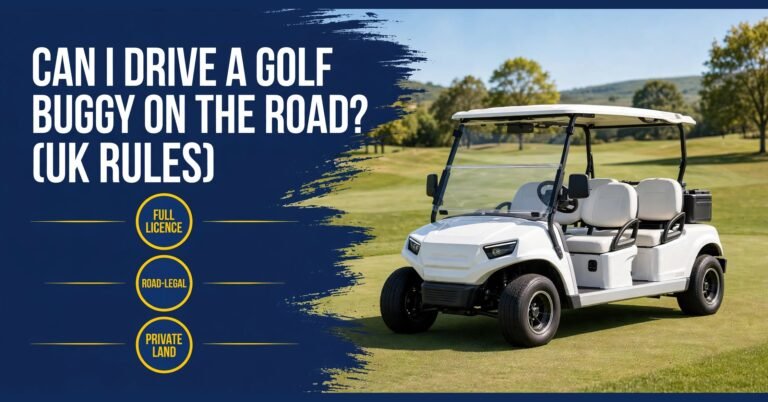
- Golf buggy: also not road legal as standard — it needs registration, tax, insurance, and the rest, just like any road vehicle. See our guide to golf buggy rules.
- Quad bike: some quads ARE road legal, because they are built and registered as road vehicles with approval, plates, tax, insurance, and MOT. A quad that is not registered and equipped for the road is in the same position as a go-kart.
- Mobility scooter: a different class entirely, with its own rules for pavement and road use. See our guide to mobility scooter rules.
- 125cc bikes: a 125cc motorcycle is a road vehicle, and some car licence holders can ride one. See our guide to 125cc bikes.
The pattern: the vehicle’s paperwork and equipment decide road legality, not what it looks like or how fast it goes.
Conclusion
A go-kart is great fun — on a track. On a public road, it is not road legal, not insured, not registered, and not worth the fines, points, and seizure risk. If you own a go-kart, keep it where it belongs: private land with permission, or a karting circuit. If you want to drive on the road, use a vehicle built and registered for it. Official sources: GOV.UK guidance on vehicle approval, vehicle insurance, and getting an MOT.
One Comment