Can I Drive a Golf Buggy on the Road? (UK Rules)
Can I drive a golf buggy on the road in the UK? Yes — but only if two conditions are met: you hold a full UK driving licence, and the buggy itself is road-legal (registered with DVLA, taxed and insured). Most standard course buggies are not road-legal and can never be made so. On private land — a golf course, a private estate — none of this applies and you need no licence at all. This guide explains exactly what makes a buggy road-legal, which licence you need, and the penalties for getting it wrong.
The Short Answer: Can I Drive a Golf Buggy on the Road in the UK?
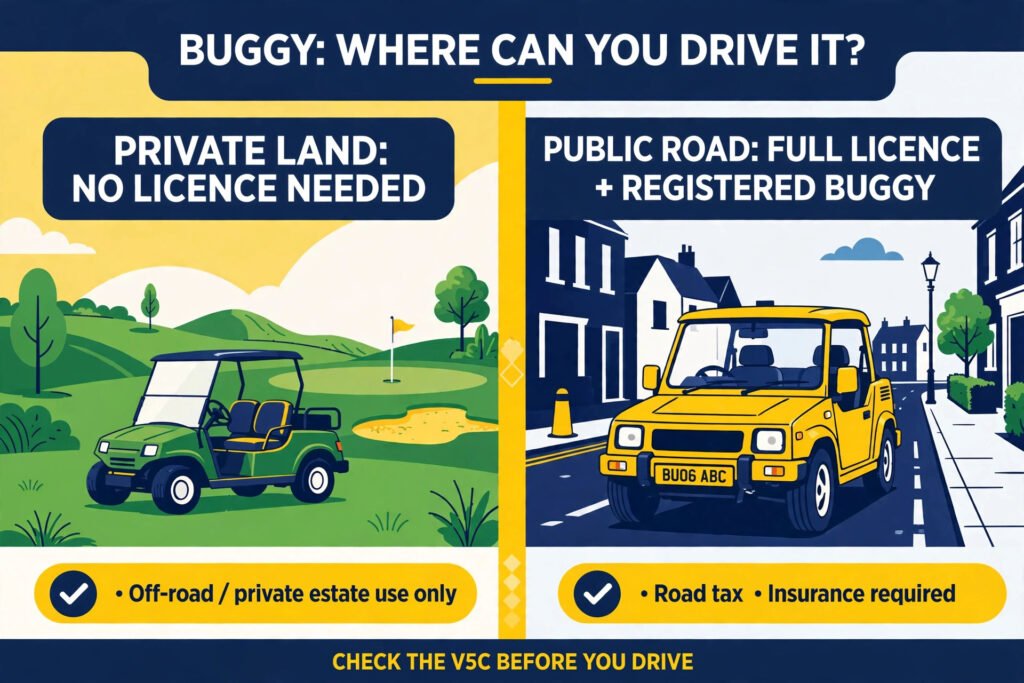
- On a public road: yes, with a full UK driving licence and a road-legal buggy — meaning DVLA-registered (with a V5C), taxed and insured, with number plates, lights, indicators, mirrors and a horn.
- On private land: no licence, registration, tax or insurance needed — a golf course, a private estate or anywhere else you have the owner’s permission.
- The honest catch most dealers bury: most standard course buggies can never be made road-legal (more on that below). Driving one on a public road is illegal, licence or not.
What Makes a Golf Buggy Road-Legal?
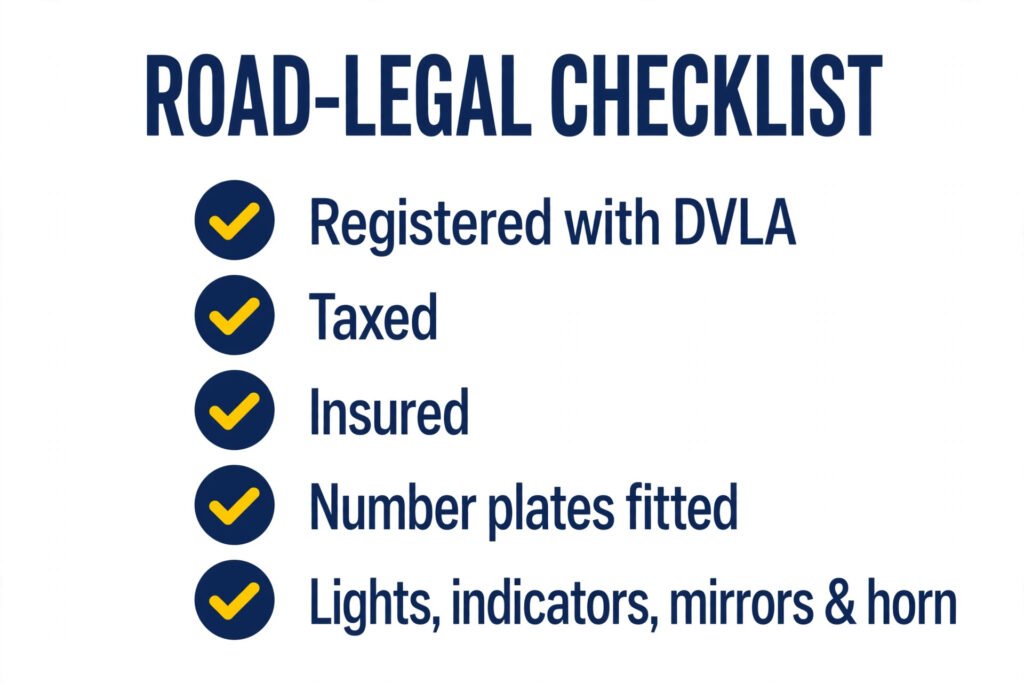
A golf buggy is treated like any other vehicle on a public road — it must meet the standard motor-vehicle requirements. GOV.UK is clear on the basics (gov.uk/vehicle-registration):
- Registered with DVLA — the buggy must be registered and have a V5C log book, plus number plates fitted.
- Taxed — “You need to tax the vehicle before you can use it on the road.” First registration carries a £55 fee, and DVLA may inspect the vehicle.
- Insured — “You must have motor insurance to drive your vehicle on UK roads” (gov.uk/vehicle-insurance). Third-party cover is the legal minimum.
- Roadworthy equipment — working lights, indicators, mirrors and a horn, the same as any car.
- Type approval — the design must meet construction and use standards (the usual route is Individual Vehicle Approval). This is where most standard buggies fail — they were never designed or approved for road use.
Which Driving Licence Do I Need for a Golf Buggy?
- A full UK Category B (car) licence covers a road-legal golf buggy (gov.uk/driving-licence-categories).
- A provisional licence is NOT enough — a provisional only lets you drive under supervision with L plates and a qualified supervisor beside you; it does not let you drive a buggy alone on public roads.
- Pre-1997 note: drivers who passed before 1 January 1997 also carry B1 entitlement (4-wheel vehicles up to 400kg unladen) — relevant only for very light quadricycle-registered buggies. For everyone else, Category B is the answer.
- This sits in the same entitlement family as our other “can I drive X” guides — 125cc on a car licence and manual with an automatic licence.
Can a Standard Course Buggy Be Made Road-Legal?
Usually no — and this is the part dealers skip:
- A standard course buggy lacks the lighting, mirrors, indicators, horn and, crucially, the type approval needed for road registration.
- Getting an unapproved buggy through Individual Vehicle Approval is expensive and often fails — manufacturers of genuinely “road-legal” buggies have done this work at the factory.
- If your buggy isn’t registered, it cannot legally touch a public road — not for five metres, not to “just get to the course”. That includes driving it on the road to reach a golf course.
Bottom line: if your buggy was bought as a course buggy and never registered, treat it as private-land-only forever. If you need road use, buy one sold as road-legal and check the V5C before you pay.
Golf Buggies on Private Land: No Licence Needed
- On a golf course, your own private estate, or any private land with the owner’s permission: no licence, no registration, no tax, no insurance.
- Crossing a public road counts as road use. Driving the buggy across a road that cuts through the course, or along the road to reach the course entrance, puts you on a public road — and everything in this guide applies.
Golf Buggy vs Mobility Scooter: Not the Same Thing
Some dealers advertise “pavement-friendly” buggies — do not confuse these with standard golf buggies:
- Mobility (Class 2/3) vehicles must have only one seat (gov.uk/mobility-scooters-and-powered-wheelchairs-rules). A multi-seat golf buggy can never be registered as a mobility vehicle.
- A genuinely Class-2-adapted single-seat buggy is a different vehicle: pavement use at up to 4mph, no licence needed — but it is not a golf buggy you can use normally.
- If someone sells you a “road or pavement” buggy with two or more seats, treat the claim with suspicion and ask for the registration documents.
Penalties for Driving a Golf Buggy Illegally
Driving an unregistered or uninsured buggy on a public road is treated like any other motor-vehicle offence:
- No insurance: fixed penalty of £300 and 6 points on your licence. In court: an unlimited fine, possible disqualification, and the buggy can be seized and destroyed.
- Driving otherwise than in accordance with a licence (code LC20 — e.g. on a provisional alone): 3–6 points on your licence.
- Points feed the same totting-up system as any other offence: 12 points within 3 years means a ban — see our penalty points guide.
Conclusion
So, can you drive a golf buggy on the road in the UK? Yes — with a full Category B licence and a genuinely road-legal buggy: DVLA-registered, taxed, insured, plated and properly equipped. The two traps to avoid: assuming a provisional licence is enough (it isn’t), and assuming a standard course buggy can be “fixed up” for the road (it usually can’t — without type approval and registration it is private-land-only). On a golf course or your own estate, none of this applies. Before you drive any buggy onto a public road, check the V5C, the insurance and your licence — because the penalties (£300 + 6 points for no insurance, 3–6 points for LC20) are exactly the same as for a car.
3 Comments