Can I Drive a Segway on the Road? (UK Rules)
Can I drive a Segway on the road in the UK? No. Under UK law a Segway counts as a motor vehicle, so riding one on a public road or on the pavement is illegal. The only place you can legally ride a Segway is private land with the landowner’s permission — which is exactly why Segway experience days happen on private estates. This guide explains why the law treats a Segway this way, where the bans come from, what the penalties are, and the one place you can ride legally.
The Short Answer: Can I Drive a Segway on the Road in the UK?
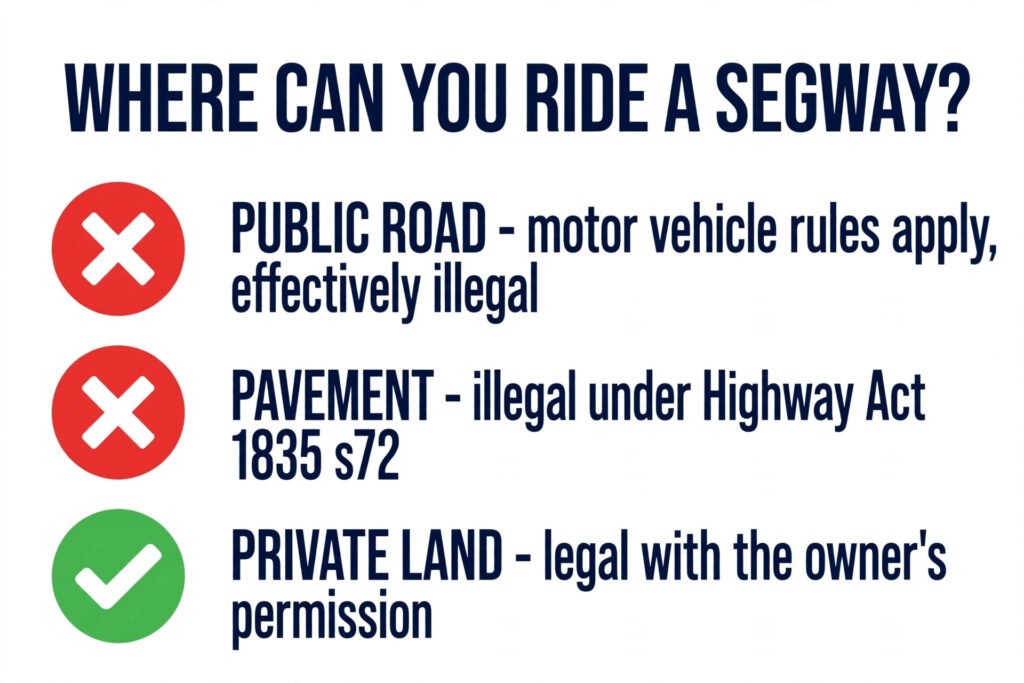
- Public road: effectively illegal — a Segway would have to meet every motor-vehicle requirement (insurance, tax, registration, licence, technical approval), which GOV.UK says users “will find it very difficult”. Using one on the road without meeting them is a criminal offence.
- Pavement: illegal — section 72 of the Highway Act 1835 makes it an offence to ride a vehicle on the pavement, and the High Court confirmed this for Segways in Coates v CPS [2011].
- Cycle lanes, footpaths, bridleways: also illegal (Road Traffic Act 1988, sections 21(1) and 34).
- Private land with the owner’s permission: legal — the only legal option.
Why UK Law Treats a Segway as a Motor Vehicle
There is no special “Segway ban” in UK law — and that is exactly why Segways are caught by it. GOV.UK’s powered-transporters guidance explains that Segways, e-scooters, hoverboards and go-peds are all “powered transporters”. Because they are motorised, they fall within the legal definition of a “motor vehicle” in the Road Traffic Act 1988: “any mechanically propelled vehicle intended or adapted for use on roads”.
That single classification does all the work. Once a Segway is a motor vehicle, every law that applies to motor vehicles applies to it — insurance, tax, registration, licensing, construction standards — even though no one designed those rules with Segways in mind. The courts have confirmed the classification three times: a Go-Ped was ruled a motor vehicle in DPP v Saddington [2000], an electric scooter in Winter v DPP [2002], and a Segway itself in Coates v CPS [2011].
Can You Ride a Segway on the Pavement?
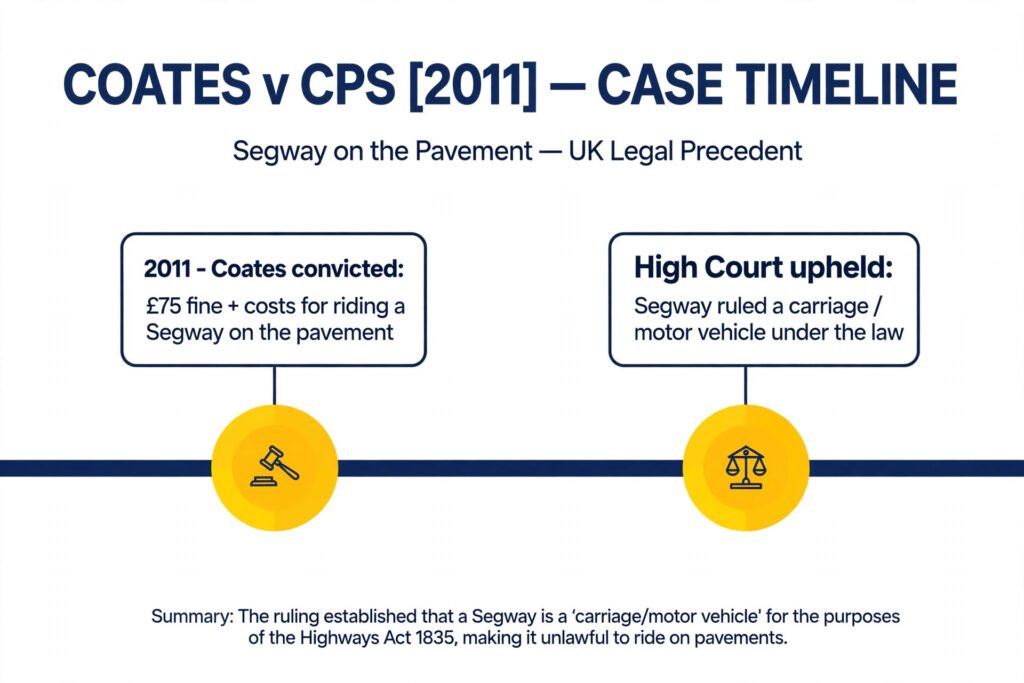
No. Section 72 of the Highway Act 1835 makes it an offence to ride on, or to lead or draw a carriage on, a pavement. In Coates v CPS [2011], the High Court considered a Segway rider convicted of riding on the footway and upheld the conviction: the Segway was a carriage — either by analogy to other forms of carriage like bicycles, or because as a motor vehicle it is a carriage by operation of statute.
This is the rule that catches most people out. A Segway feels like a pedestrian device — you stand on it, it moves at walking-to-jogging speed — but the law treats the pavement as pedestrian-only space. Mobility scooters and wheelchairs are the exceptions, not Segways.
Can You Ride a Segway on the Road?
In practice, no. For any motor vehicle to use public roads lawfully it must meet a full list of requirements: insurance, conformity with technical standards, vehicle tax, licensing and registration, driver testing and licensing, and the right safety equipment. GOV.UK says that if a powered-transporter user could meet these requirements, road use might in principle be lawful — but “it is likely that they will find it very difficult to comply with all of these requirements, meaning that it would be a criminal offence to use them on the road.”
In other words, there is no licence or registration you can realistically get that makes riding a Segway on the road legal. Anyone selling you a “road-legal Segway” should be asked for the registration documents — and if they cannot produce them, walk away. This is the same honesty test we apply to golf buggies: if it is not registered, it does not belong on a public road.
What About Cycle Lanes, Footpaths and Bridleways?
Also banned. Powered transporters are prohibited from cycle tracks, cycle lanes on roads, and any other space dedicated to pedal-cycle use (Road Traffic Act 1988, section 21(1)). The only exemptions are electrically-assisted pedal cycles (EAPCs) and mobility scooters. Footpaths and bridleways are off-limits too — mechanically-propelled vehicles are forbidden from using them under section 34 of the same Act.
The same restrictions reach other public-access spaces: car parks, public squares, privately-owned roads, industrial estates and university campuses. If the public can access it, assume the ban applies.
Where CAN You Legally Ride a Segway?
Private land with the landowner’s permission — that is the whole list. GOV.UK puts it plainly: there are no statutory restrictions on powered transporters on private land that is not accessible to the public, but the permission of the owner or occupier is required.
In practice this means:
- Segway experience days on private estates — the main legal way most people ever ride one.
- Your own land, if it is not open to the public — a private estate, a farm, a large private garden.
- Hired venues where the operator has the landowner’s permission and runs the activity on closed private ground.
A supermarket car park does not count: it is accessible to the public, so the restrictions apply. Neither does a friend’s driveway if it opens directly onto a public road you would have to cross to get there.
E-Scooters, Hoverboards and Go-Peds — Same Rules?
Yes — the same powered-transporter rules cover e-scooters, hoverboards, go-peds, powered unicycles and u-wheels. The confusion comes from the e-scooter rental trials: the government has begun trials of approved rental e-scooters only, in specific trial areas. The rules for private e-scooters and every other powered transporter have not changed.
So if you have seen someone riding an e-scooter legally on a road, they were almost certainly on an approved rental scooter inside a trial area — not on a private one. Your own e-scooter, hoverboard or Segway stays illegal in public exactly as before. If you use an e-scooter illegally, you could face a fine and penalty points on your licence, and the device could be impounded.
Penalties for Riding a Segway Illegally
Breaches of motor-vehicle law are generally criminal offences, enforced by local police forces and prosecuted with the CPS where relevant. The penalties depend on the nature and gravity of the offence:
- Fines and penalty points — the standard range for motor-vehicle offences; see our penalty points guide for how points add up.
- Disqualification from driving for more serious offences.
- Imprisonment for riding dangerously or under the influence of drink or drugs — the same dangerous-driving and drink/drug-driving offences apply.
- Impoundment of the device for illegal e-scooter use, and the same seizure powers apply to other powered transporters.
There is no single published fixed fine for riding a Segway on the pavement — courts decide the fine based on the offence. In the Coates case, the rider was fined £75 plus costs. That was one court’s decision in one case, not a tariff — do not treat £75 as “the fine”.
Conclusion
So, can you drive a Segway on the road in the UK? No — and the reason is not a Segway-specific ban but the opposite: a Segway is a motor vehicle under the Road Traffic Act 1988, so all motor-vehicle law applies to it, and in practice no Segway can meet the road-use requirements. Pavements, cycle lanes, footpaths and bridleways are all banned too. The one legal option is private land with the owner’s permission — which is why experience days exist. Before you buy a Segway, hoverboard or private e-scooter for getting around, know that riding it anywhere public is a criminal offence with real penalties, from fines and points to disqualification.
The Short Answer: Can I Drive a Segway on the Road in the UK?
- Public road: effectively illegal — a Segway would have to meet every motor-vehicle requirement (insurance, tax, registration, licence, technical approval), which GOV.UK says users “will find it very difficult”. Using one on the road without meeting them is a criminal offence.
- Pavement: illegal — section 72 of the Highway Act 1835 makes it an offence to ride a vehicle on the pavement, and the High Court confirmed this for Segways in Coates v CPS [2011].
- Cycle lanes, footpaths, bridleways: also illegal (Road Traffic Act 1988, sections 21(1) and 34).
- Private land with the owner’s permission: legal — the only legal option.
Why UK Law Treats a Segway as a Motor Vehicle
There is no special “Segway ban” in UK law — and that is exactly why Segways are caught by it. GOV.UK’s powered-transporters guidance explains that Segways, e-scooters, hoverboards and go-peds are all “powered transporters”. Because they are motorised, they fall within the legal definition of a “motor vehicle” in the Road Traffic Act 1988: “any mechanically propelled vehicle intended or adapted for use on roads”.
That single classification does all the work. Once a Segway is a motor vehicle, every law that applies to motor vehicles applies to it — insurance, tax, registration, licensing, construction standards — even though no one designed those rules with Segways in mind. The courts have confirmed the classification three times: a Go-Ped was ruled a motor vehicle in DPP v Saddington [2000], an electric scooter in Winter v DPP [2002], and a Segway itself in Coates v CPS [2011].
Can You Ride a Segway on the Pavement?
No. Section 72 of the Highway Act 1835 makes it an offence to ride on, or to lead or draw a carriage on, a pavement. In Coates v CPS [2011], the High Court considered a Segway rider convicted of riding on the footway and upheld the conviction: the Segway was a carriage — either by analogy to other forms of carriage like bicycles, or because as a motor vehicle it is a carriage by operation of statute.
This is the rule that catches most people out. A Segway feels like a pedestrian device — you stand on it, it moves at walking-to-jogging speed — but the law treats the pavement as pedestrian-only space. Mobility scooters and wheelchairs are the exceptions, not Segways.
Can You Ride a Segway on the Road?
In practice, no. For any motor vehicle to use public roads lawfully it must meet a full list of requirements: insurance, conformity with technical standards, vehicle tax, licensing and registration, driver testing and licensing, and the right safety equipment. GOV.UK says that if a powered-transporter user could meet these requirements, road use might in principle be lawful — but “it is likely that they will find it very difficult to comply with all of these requirements, meaning that it would be a criminal offence to use them on the road.”
In other words, there is no licence or registration you can realistically get that makes riding a Segway on the road legal. Anyone selling you a “road-legal Segway” should be asked for the registration documents — and if they cannot produce them, walk away. This is the same honesty test we apply to golf buggies: if it is not registered, it does not belong on a public road.
What About Cycle Lanes, Footpaths and Bridleways?
Also banned. Powered transporters are prohibited from cycle tracks, cycle lanes on roads, and any other space dedicated to pedal-cycle use (Road Traffic Act 1988, section 21(1)). The only exemptions are electrically-assisted pedal cycles (EAPCs) and mobility scooters. Footpaths and bridleways are off-limits too — mechanically-propelled vehicles are forbidden from using them under section 34 of the same Act.
The same restrictions reach other public-access spaces: car parks, public squares, privately-owned roads, industrial estates and university campuses. If the public can access it, assume the ban applies.
Where CAN You Legally Ride a Segway?
Private land with the landowner’s permission — that is the whole list. GOV.UK puts it plainly: there are no statutory restrictions on powered transporters on private land that is not accessible to the public, but the permission of the owner or occupier is required.
In practice this means:
- Segway experience days on private estates — the main legal way most people ever ride one.
- Your own land, if it is not open to the public — a private estate, a farm, a large private garden.
- Hired venues where the operator has the landowner’s permission and runs the activity on closed private ground.
A supermarket car park does not count: it is accessible to the public, so the restrictions apply. Neither does a friend’s driveway if it opens directly onto a public road you would have to cross to get there.
E-Scooters, Hoverboards and Go-Peds — Same Rules?
Yes — the same powered-transporter rules cover e-scooters, hoverboards, go-peds, powered unicycles and u-wheels. The confusion comes from the e-scooter rental trials: the government has begun trials of approved rental e-scooters only, in specific trial areas. The rules for private e-scooters and every other powered transporter have not changed.
So if you have seen someone riding an e-scooter legally on a road, they were almost certainly on an approved rental scooter inside a trial area — not on a private one. Your own e-scooter, hoverboard or Segway stays illegal in public exactly as before. If you use an e-scooter illegally, you could face a fine and penalty points on your licence, and the device could be impounded.
Penalties for Riding a Segway Illegally
Breaches of motor-vehicle law are generally criminal offences, enforced by local police forces and prosecuted with the CPS where relevant. The penalties depend on the nature and gravity of the offence:
- Fines and penalty points — the standard range for motor-vehicle offences; see our penalty points guide for how points add up.
- Disqualification from driving for more serious offences.
- Imprisonment for riding dangerously or under the influence of drink or drugs — the same dangerous-driving and drink/drug-driving offences apply.
- Impoundment of the device for illegal e-scooter use, and the same seizure powers apply to other powered transporters.
There is no single published fixed fine for riding a Segway on the pavement — courts decide the fine based on the offence. In the Coates case, the rider was fined £75 plus costs. That was one court’s decision in one case, not a tariff — do not treat £75 as “the fine”.