Can I Drive a Forklift on a Car Licence UK?
No. A car licence does not qualify you to drive a forklift in the UK. There is no DVLA “forklift licence” at all — what actually qualifies you is accredited lift-truck training, a certificate of basic training, and your employer’s written authorisation. A car licence only matters if the forklift is driven on a public road, where normal road-traffic law applies.
That surprises a lot of people. You might assume that years of driving a car counts for something. The Health and Safety Executive (HSE) says the opposite: the ability to drive a car does not remove the need for proper lift-truck training, because forklifts have very different controls and stability. This guide covers exactly what you need to do instead — the 3 stages of training, the certificate, who is allowed, and the public-road rules.
Forklift Rules at a Glance
| Situation | Is a car licence enough? | What is required |
|---|---|---|
| Workplace, yard or site use | No | Accredited lift-truck training, a certificate of basic training and your employer’s written authorisation |
| Driving on a public road | No — not by itself | Forklift training and authorisation, plus compliance with normal road-traffic law |
| A so-called ‘forklift licence’ | There is no DVLA forklift licence | Check the training provider’s stages and certificate, not a DVLA product |
Can I Drive a Forklift on a Car Licence?
No — a car licence (category B) is a licence for road vehicles. Forklift trucks are workplace equipment, and the law that governs them is health and safety law, not driving-licence law. Holding a car licence gives you no legal right to operate a lift truck, on any site, anywhere in the UK.
What qualifies you is three things together: accredited lift-truck training, a certificate of basic training, and your employer’s written authorisation for the truck type you will use. The only place a car licence enters the picture is public-road use — and even there, it is road-traffic legislation that applies, not a “forklift entitlement” on your licence.
There Is No DVLA Forklift Licence
First, let’s clear up the biggest myth. There is no government-issued “forklift licence” in the UK. The DVLA issues driving licences for road vehicles — cars, lorries, buses, motorcycles. Forklift trucks are not road vehicles in that sense.
What you get instead is a certificate of basic training. HSE notes there is no legal requirement to issue one, but certificates provide evidence of training and ability — and you will need that evidence if you change jobs, because your new employer must be satisfied you are trained before they authorise you.
So the paper that matters is a training certificate, not a licence. Anyone selling you a “forklift licence” is selling you the wrong word — check what is actually included before you pay.
The 3 Stages of Forklift Training
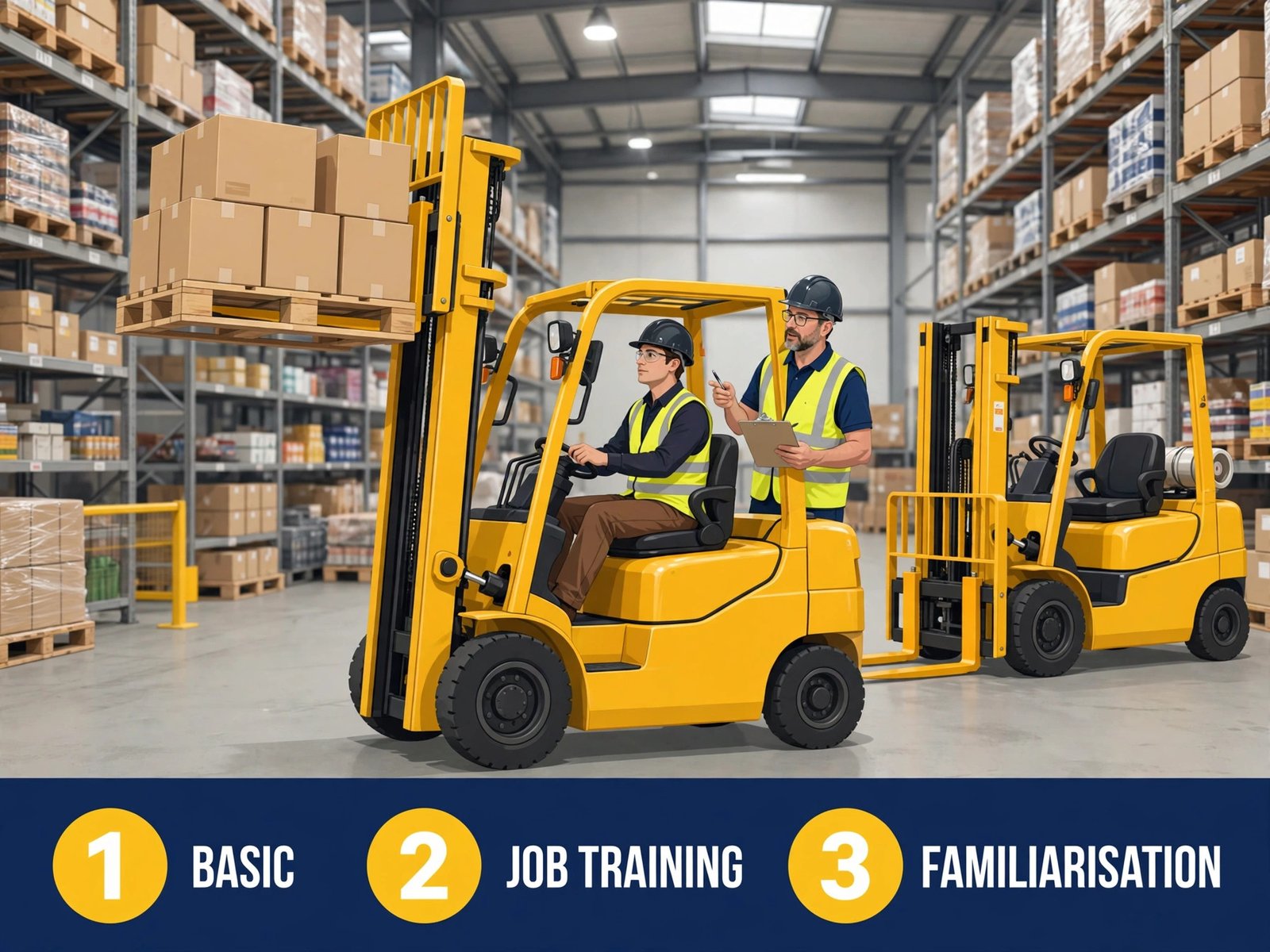
HSE’s Approved Code of Practice (L117, “Rider-operated lift trucks”) says operator training always has three stages. You cannot skip any of them:
Stage 1 — Basic training. This covers the basic skills and knowledge needed to operate a lift truck safely and efficiently. A basic course typically lasts 3 to 5 days. It is usually done away from your normal workplace, on a training centre’s equipment.
Stage 2 — Specific job training. The operating principles and controls of the exact truck you will use, and how it will be used in your workplace. This matters because an operator trained on one type of lift truck cannot safely operate others without additional conversion training. A reach truck and a counterbalance truck behave very differently.
Stage 3 — Familiarisation training. Applying everything you learned under normal working conditions, on the job, under close supervision.
Only after all three stages should your employer authorise you to work on your own.
How to Get Qualified to Drive a Forklift
Here is the practical route, step by step:
- Choose an accredited training provider. Look for providers whose courses follow HSE’s L117 guidance. Be wary of vague promises — ask specifically which three stages the course covers.
- Complete basic training (3–5 days). You will learn controls, stability, load handling, and safety checks, usually ending in a practical and theory assessment.
- Get your certificate of basic training. Keep it safe — it is your evidence of ability when you change jobs. If the job involves any road driving, an employer may also ask you to generate a DVLA check code so they can view your driving record.
- Do specific job and familiarisation training with your employer. Your employer must arrange this on the truck type you will actually operate.
- Get written authorisation. After all three stages, your employer should give you written authorisation stating your name, the date, the truck types or categories you may operate, and any special conditions. Nobody should operate a lift truck on any premises without this authorisation — except a trainee under close supervision.
One important point: nobody needs to hold a car licence first. Off-road, a car licence is completely irrelevant — training and authorisation are what count.
Who Can Drive a Forklift: Age, Fitness and Authorisation
HSE sets out how employers should select operators:
- Age: operators should be over the minimum school-leaving age (16). In ports the minimum is 18, unless the person is on a suitable supervised training course. Children under 16 should never operate lift trucks. Many employers set 18 as their own company policy — that is employer policy, not the law, but it is the rule you will actually meet in most warehouses.
- Fitness: operators should be reasonably fit, physically and mentally, reliable, with a responsible attitude. For most lift-truck work, HSE says a standard equivalent to the Group 1 (ordinary driving licence) medical standard is appropriate; more demanding environments may suit the stricter Group 2 standard. Fitness is judged case by case.
- Authorisation: as above — written, naming the truck types. Operators also need routine monitoring and, where necessary, retesting or refresher training.
Can I Drive a Forklift on a Public Road?

This is where the car licence question finally matters. On private premises — a warehouse yard, a construction site — health and safety law applies and a car licence is irrelevant. But the moment a lift truck is driven on a public road, road-traffic legislation applies.
HSE’s L117 deliberately does not state a DVLA category for lift trucks; it directs questions about driver and vehicle licensing for road use to the DVLA. In practice, short crossings between premises are handled differently from actual road travel, and vehicle registration, lighting, and insurance all come into play. The safe rule: if your work involves public-road use, check with the DVLA what driver and vehicle licensing your road use needs before you do it.
Refresher Training and Staying Competent
A certificate of basic training has no expiry date printed by law — HSE’s L117 gives no specific period after which refresher training or formal assessment is required. That does not mean “trained once, trained forever.” Employers must monitor operators and arrange refresher training or retesting where necessary — for example, where operators have not used trucks for some time, are only occasional users, or after an incident or a change in equipment.
You will often hear “every 3 years” quoted by training companies. That is industry practice, not law — treat it as a sensible benchmark, not a legal deadline. What the law requires is that you stay competent; the employer decides how to evidence that.
What Happens If You Drive a Forklift Without Training
Driving a forklift without proper training is not just a policy breach — it is a legal problem for both you and your employer. Under the Health and Safety at Work etc Act 1974, employers must ensure the health and safety of their employees; under PUWER 1998, work equipment must be suitable and maintained, and users must be adequately trained; under LOLER 1998, lifting operations must be properly planned and supervised.
HSE’s own context figure: lift trucks are involved in about a quarter of all workplace transport accidents. An untrained operator is exactly the scenario these regulations exist to prevent. Enforcement can mean prohibition notices, prosecution, and — practically — your employer’s insurance will not cover an untrained operator.
If you are an employee being asked to operate a truck without training, ask for the three-stage training and written authorisation. It protects you as much as your employer.
Conclusion
A car licence does not qualify you to drive a forklift — there is no DVLA forklift licence at all. What qualifies you is the HSE three-stage training (basic, specific job, familiarisation), a certificate of basic training, and your employer’s written authorisation. Off-road, a car licence is irrelevant; on a public road, road-traffic law applies and you should check with the DVLA what licensing is needed. Get trained properly, keep your certificate, and never operate a truck type you are not authorised for.