Can I Drive with a Broken Arm in the UK? (2026)
Broken your arm and wondering, can I drive with a broken arm in the UK? It’s one of the most common questions after a fracture — and the answer surprises most people. There is no UK law that specifically bans driving with a broken arm. But in practice, the answer is usually no while you’re in a cast: the NHS advises against it, your insurance may not cover you, and if the injury keeps you off the road for months, DVLA must be told. Here’s the full 2026 picture.

Can I Drive with a Broken Arm? The Short Answer
- In a plaster cast or splint: don’t drive. NHS plaster-care guidance is clear — do not drive while wearing a cast.
- After the cast comes off: you can drive again once you can safely handle every emergency situation without hesitation — emergency stops, full steering control, quick reactions.
- Your doctor’s word overrides everything. If your doctor says don’t drive, don’t drive.
- Insurance first: several NHS trusts warn your insurance may not be valid in a cast — check with your insurer before you even consider it.
- The DVLA rule: you must tell DVLA only if the broken limb will keep you unable to drive for more than 3 months.
What the Law Actually Says
No section of the Road Traffic Act names broken arms. What the law does require is fitness to drive:
- Highway Code Rule 90 — “Make sure that you are fit to drive. You MUST report to the DVLA any health condition likely to affect your driving.” (Law: Road Traffic Act 1988, section 94.)
- Proper control: you must be in full control of the vehicle at all times. If a cast or sling stops you steering properly, changing gear, or reacting in an emergency, you’re not meeting that standard — and could face a careless driving charge (Road Traffic Act 1988, section 3).
- If stopped by police: they can ask to see your licence — see whether you actually need to carry it: Do I Need to Carry My Driving Licence in the UK.
The legal test isn’t “do you have a broken arm?” — it’s “are you fit to drive with it?”
When You Must Tell DVLA: The 3-Month Rule
GOV.UK’s broken limbs and driving page sets one clear trigger: you must tell DVLA if you’ll be unable to drive for more than 3 months because of a broken limb.
The details:
- How to report (car or motorcycle licence): report your condition online, or fill in form G1 and post it to DVLA.
- Bus, coach or lorry licence: fill in form G1V instead.
- The penalty: up to a £1,000 fine if you don’t tell DVLA about a condition that affects your driving — and you may be prosecuted if you’re in an accident as a result.
- Not sure how long you’ll be off the road? GOV.UK says: ask your doctor.
Most simple fractures heal in 6–8 weeks, so the 3-month rule won’t apply to you — but complicated breaks, surgery, or slow healing can cross the line. More on how DVLA handles medical notifications: DVLA Driving Licence Explained.
What the NHS Says About Driving in a Cast
NHS plaster-care guidance across multiple trusts says the same thing:
- Do not drive while wearing any type of plaster cast — “as well as being dangerous, your insurance may not be valid.”
- After the cast is removed, you may drive again once you feel you can safely deal with all emergency situations without hesitation — stopping quickly, in full control, and safely avoiding obstacles.
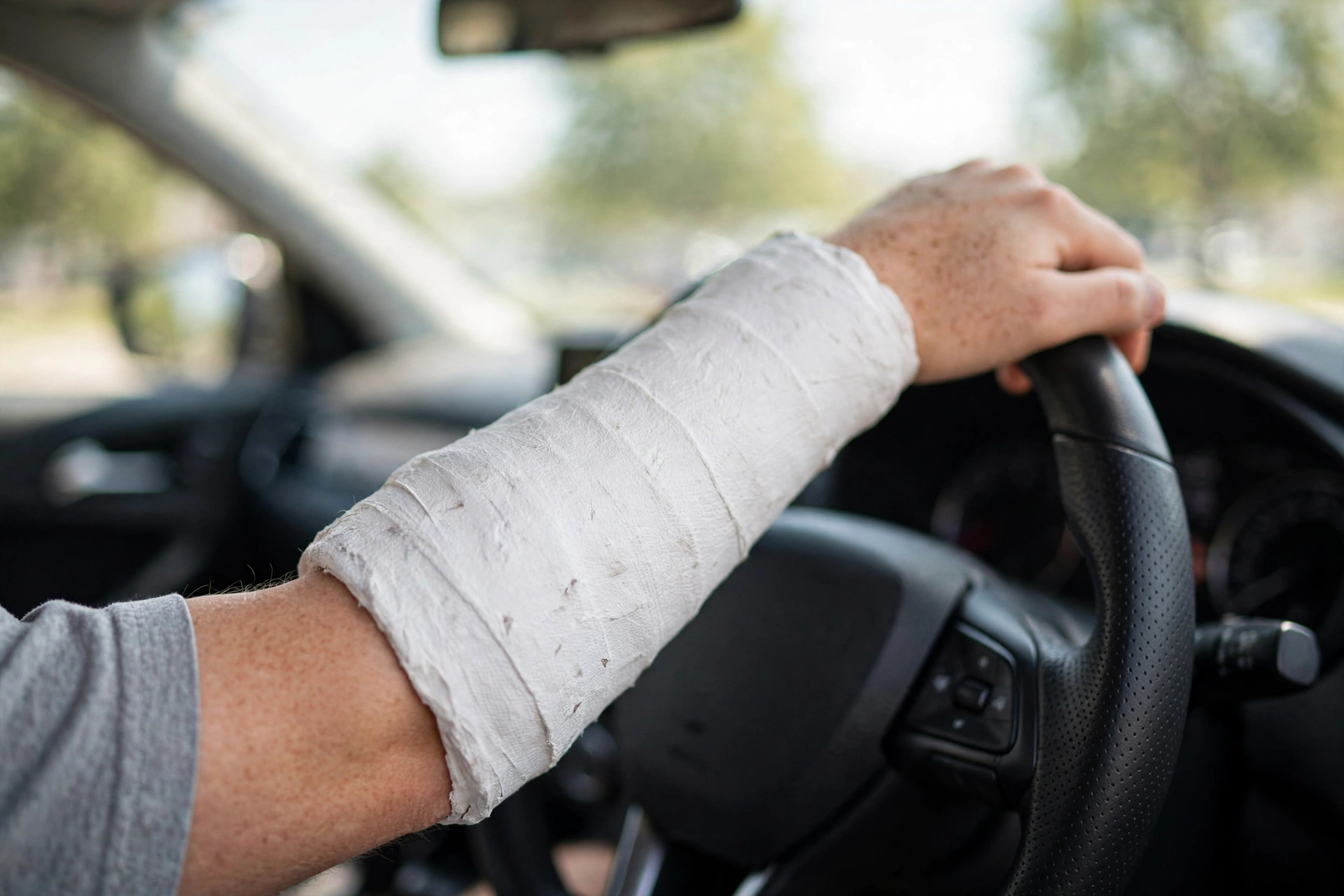
Why so strict? A cast reduces grip strength, slows your reactions, and can snag on the steering wheel or handbrake. In an emergency stop, a fraction of a second matters — and a cast costs you that fraction.
Insurance: Check Before You Drive
This is the one people forget — and it’s the most expensive mistake:
- NHS plaster-room guidance warns that your insurance may not be valid while you’re being treated in a cast or splint.
- Some NHS trusts put it bluntly: do not drive without first checking with your insurance company.
- Driving without valid insurance is a separate offence in its own right — 6 to 8 penalty points and an unlimited fine. More on how points work: Penalty Points on a Driving Licence.
- Call your insurer before you drive, describe the injury and the cast, and get their answer in writing if they say you’re covered.
If your insurer says no, that’s the end of the discussion — driving anyway means driving uninsured.
Broken Arm vs Broken Leg: Why It Matters
Not all fractures are equal behind the wheel:
- Broken arm (in a cast): steering, gear changes (manual cars), handbrake use, and indicating are all affected. An automatic is easier — but the NHS “no cast” advice still applies.
- Broken leg or foot (in a cast): this is a definite no. You cannot operate the pedals safely — no reliable braking means no driving, full stop.
- Sling (no cast): slightly better, but a sling still restricts movement and can invalidate the same insurance concerns. Same rules apply: doctor’s advice first, insurer second.
- After healing: rebuild strength before long drives — a weak arm tires fast on the wheel.
What to Do: Step by Step
- Ask your doctor — can I drive with this injury? Their answer overrides everything below.
- Don’t drive in the cast — follow NHS guidance.
- Call your insurer — confirm whether you’re covered; get it in writing.
- Count the months — if you’ll be unable to drive for more than 3 months, tell DVLA (online or form G1).
- After the cast comes off — test yourself honestly: emergency stop, full lock-to-lock steering, mirror-signal-manoeuvre without hesitation. If anything feels wrong, wait.
- Keep records — doctor’s notes, insurer confirmation, DVLA correspondence.
Conclusion
So, can you drive with a broken arm in the UK? Legally, no single law bans it — but the combined weight of the rules says don’t: the Highway Code requires you to be fit to drive, the NHS advises against driving in any cast, your insurance may be void, and DVLA must be told if you’re off the road for more than 3 months (with a £1,000 fine for staying silent). Wait for the cast to come off, get your doctor’s all-clear, check with your insurer — and only then get back behind the wheel.

One Comment