Can I Drive a Motorhome on a Car Licence UK?
Yes — you can drive a motorhome on a standard UK car licence, as long as the motorhome is not too heavy. A full Category B car licence covers motorhomes up to 3,500kg MAM (4,250kg if it is zero-emission). Go over that weight and you need a bigger entitlement — C1 or C. The traps are in the details: the weight that counts is the plated maximum, not the empty weight; the rules change depending on whether you passed your test before or after 1 January 1997; and at 70, renewing your licence works differently if you hold C1. In this guide, you will see the exact weight limits, how to check your motorhome’s MAM, the over-70 rules, the payload trap, towing, and hiring.
Can I Drive a Motorhome on a Car Licence in the UK?
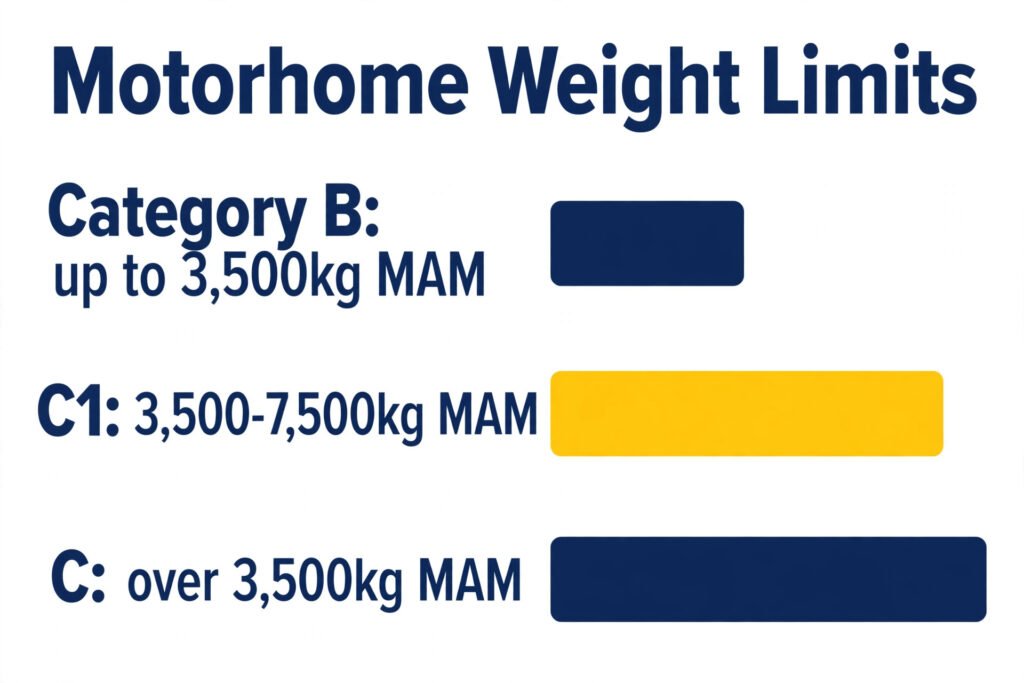
Yes — with a full UK car licence (Category B), you can drive a motorhome up to 3,500kg MAM. If the motorhome is zero-emission (electric or hydrogen), the limit rises to 4,250kg MAM. You must hold a FULL licence — a provisional licence does not cover a motorhome. The weight limits at a glance:
| Licence / situation | Motorhome limit |
|---|---|
| Category B, passed test on/after 1 Jan 1997 | 3,500kg MAM (4,250kg zero-emission) |
| Category B, passed test before 1 Jan 1997 | Vehicle + trailer combination up to 8,250kg MAM |
| C1 entitlement | 3,500–7,500kg MAM |
| C entitlement | Over 3,500kg MAM (any weight, trailer up to 750kg) |
MAM means Maximum Authorised Mass — the most the vehicle is allowed to weigh when fully loaded. It is the plated figure that decides your entitlement, not what the motorhome happens to weigh on the day.
What Counts: MAM vs Empty Weight
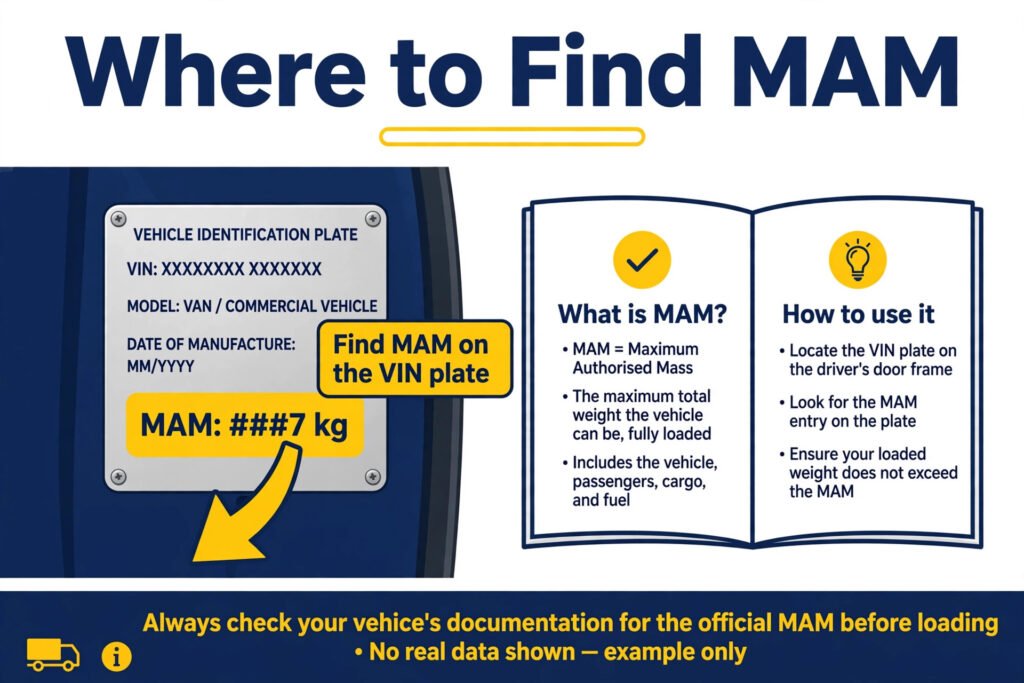
This is the most common mistake. People look at the motorhome’s empty (unladen) weight and think they are fine — but the law looks at MAM. A motorhome plated at 3,500kg MAM counts as 3,500kg even if it currently weighs 3,100kg empty. Where do you find the MAM? On the motorhome’s VIN plate (usually on the door frame, under the bonnet, or in the engine bay) and in the handbook. If the VIN plate says 3,500kg, your Category B licence covers it. If it says 4,250kg and the motorhome is a diesel, your Category B licence does NOT cover it — unless you passed before 1997 or hold C1. Check the plate before you buy, hire, or drive a motorhome. Do not guess from the size or the number of berths.
If You Passed Your Test Before 1 January 1997
“Grandfather rights” help here. If you passed your car test before 1 January 1997, your Category B licence usually lets you drive a vehicle and trailer combination up to 8,250kg MAM. That covers most motorhomes, including heavier ones, plus a trailer. Check your licence details to confirm — entitlements are printed on the back of your photocard. This is the main reason two drivers with the same “car licence” can have very different motorhome rights. The 1997 split is the single biggest factor in this whole topic.
If You Passed Your Test After 1 January 1997
If you passed on or after 1 January 1997, the standard Category B rules apply: vehicles with up to 8 passenger seats and a MAM of 3,500kg (petrol, diesel, or hybrid) or 4,250kg (electric or hydrogen, zero-emission only). An extra 750kg MAM is allowed ONLY for extra equipment for disabled passengers. That is the whole allowance — a post-1997 Category B licence does not stretch to a 4,500kg diesel motorhome, however experienced you are. For heavier motorhomes, you need to add C1 or C entitlement, which means extra tests.
What If Your Motorhome Is Over 3,500kg?
Over 3,500kg MAM, you need more than a standard car licence:
- C1 (3,500-7,500kg MAM): covers most large motorhomes, with a trailer up to 750kg. C1E extends this: a C1 vehicle plus a trailer over 750kg, with a combined maximum of 12,000kg.
- C (over 3,500kg): covers the biggest motorhomes, with a trailer up to 750kg. CE covers a C vehicle plus a trailer over 750kg.
Getting C1 or C means applying for provisional entitlement, passing the theory and practical tests for that category, and (for professional driving) Driver CPC. For the full lorry-entitlement picture, see our guide to driving a lorry on a car licence. C1 is NOT “Class 1” — Class 1 means C+E (articulated lorries). Do not let anyone sell you the wrong course.
Driving a Motorhome After 70
At 70, you must renew your driving licence every 3 years. Online renewal is free. But there is a catch for heavier motorhomes: the online service cannot be used to renew a C1 or D1 entitlement — those must be renewed by post. So if you rely on C1 to drive a motorhome over 3,500kg, plan for the postal route at each renewal and allow extra time. Do not assume your C1 entitlement carries over automatically when you renew online — it does not. See our guide to renewing your driving licence at 70 for the full process.
The Payload Trap
Here is the trap that catches people out. You buy a motorhome plated at 3,500kg MAM — perfect for your Category B licence. Then you load it: water, fuel, gas bottles, food, clothes, bikes, passengers. If the loaded weight goes over the plated MAM, two problems follow. First, the vehicle is overloaded, which is an offence in itself. Second, you are now driving a vehicle heavier than your licence entitlement covers. The entitlement limit is the plated MAM — but overloading past it makes a bad situation worse. The fix is simple: know your payload (MAM minus the motorhome’s empty weight), weigh your load, and do not treat the MAM as a rough guide. No fine figure is given here because penalties depend on the specific offence and circumstances.
Can You Tow a Trailer With a Motorhome on a Car Licence?
On a post-1997 Category B licence, you can tow a trailer up to 3,500kg MAM, as long as the combined vehicle + trailer MAM does not exceed 7,000kg. So a 3,500kg motorhome plus a 3,500kg trailer is the maximum combination. If you passed before 1997, the 8,250kg combination rule applies instead. Check both MAM figures — the motorhome’s and the trailer’s — before you tow. A trailer’s MAM is its plated maximum, not its current load.
Hiring a Motorhome on a Car Licence
Yes — hire firms will rent you a motorhome your licence covers, and they check. Expect them to ask for your photocard licence and a DVLA check code so they can view your record, including your entitlements and any points. They will match the motorhome’s MAM against your licence. Provisional licence holders cannot hire a motorhome. If you passed before 1997, bring proof — hire firms go by what your licence actually shows. Book early in peak season, and confirm the MAM of the exact vehicle you will get, not just the model range.
Conclusion
A standard car licence is enough for most motorhomes — up to 3,500kg MAM (4,250kg zero-emission) for post-1997 drivers, and up to an 8,250kg combination for pre-1997 drivers. Heavier motorhomes need C1 or C. The three things that catch people out are checking the wrong weight (empty instead of MAM), forgetting the over-70 postal-only C1 renewal, and overloading past the plated MAM. Check the VIN plate, know your entitlement, and the open road is yours.
Official sources: GOV.UK guidance on driving licence categories and renewing your driving licence at 70.

One Comment