Can I Drive a Fire Engine on a Car Licence UK?
No — not a standard operational fire engine. A full-size fire appliance is a large goods vehicle, well over the 3,500kg maximum authorised mass (MAM) limit of a car licence (category B). Which licence you actually need depends on the appliance’s weight: C1 if it is 3,500–7,500kg MAM, C if it is over 7,500kg — and most full-size appliances need C.
And the licence category is only half the story. Driving on blue lights under emergency conditions is separate fire-service training, not something any DVLA category gives you. This guide covers the weight test, the firefighter qualification route, the CPC exemption, the age rules, and the two situations — private land and preserved appliances — where the answer changes.
Can I Drive a Fire Engine on a Car Licence?
No — not the kind of fire engine that answers 999 calls. A category B car licence stops at vehicles up to 3,500kg MAM (and up to 8 passenger seats). A standard pumping appliance is far heavier than that, which puts it in lorry territory, not car territory.
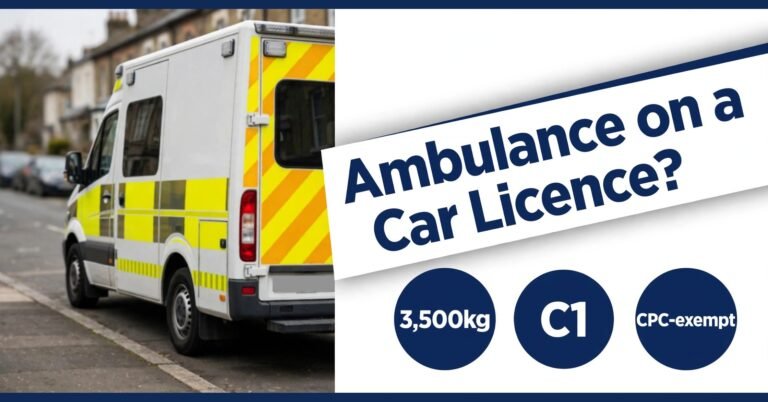
The one case where a car licence does cover a fire-service vehicle is a light response vehicle at or under 3,500kg MAM — a small support vehicle, not a fire appliance. Everything bigger needs a goods-vehicle category, as the next section shows. The closest comparison on this site is the ambulance guide — same principle (licence category + professional rules), different category.
The Weight Test: Why a Car Licence Stops at 3,500kg
Everything turns on the appliance’s maximum authorised mass (MAM) — the most it may legally weigh fully loaded, with crew, water, and equipment. GOV.UK’s categories split like this:
- Category B (car licence): up to 3,500kg MAM. Light vehicles only.
- Category C1: vehicles between 3,500kg and 7,500kg MAM, trailer up to 750kg. Covers smaller appliances and support vehicles.
- Category C: vehicles over 3,500kg MAM, trailer up to 750kg — the full large-goods category. Most full-size fire appliances sit here, because they are plated over 7,500kg.

Fire appliances vary — pump, aerial, rescue, and light response vehicles all have different weights — so there is no single “fire engine weight.” Check the appliance’s MAM on its V5C or VIN plate, then apply the thresholds above. Full category list: GOV.UK driving licence categories.
Passed Your Test Before 1 January 1997?
Drivers who passed before 1 January 1997 are usually allowed a vehicle-and-trailer combination of up to 8,250kg MAM — but do not read that as “any fire engine.” A full-size appliance plated over 7,500kg MAM still needs category C unless your licence actually shows that entitlement.
Entitlements from that era vary from person to person, so check your own licence — view your categories online or use a DVLA check code to see exactly what you hold.
How Firefighters Qualify to Drive a Fire Engine
The route is the standard higher-category route — there is no fire-service shortcut around the test:
- Hold a full car licence (category B) first.
- Apply for provisional entitlement for category C using form D2 (from a Post Office offering DVLA services). A D4 medical form, filled out by a doctor, may also be needed — the D2 tells you. Send the form and your photocard licence to the DVLA. There is no application fee, and the new licence normally arrives within about 3 weeks. Applying for provisional C also gives you provisional C1, C1+E, C and C+E.
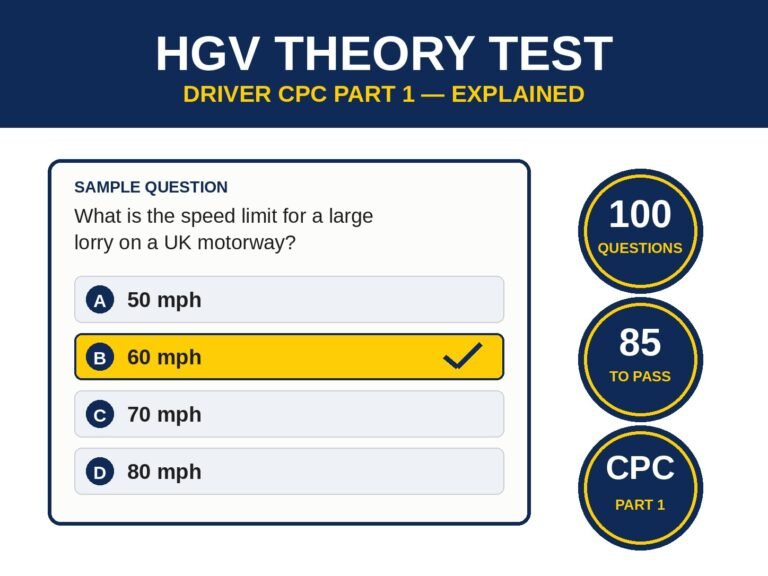
- Pass the tests for the category: part 1 (theory), part 3a (off-road exercises) and part 3b (on-road driving).
You do not need to pass a C1 test before a C test — you can go straight to the category you need. Full official steps: adding higher categories to your licence. (This is the same basic route as the lorry guide, minus the CPC — see next section.)
Do Firefighters Need Driver CPC?
No. GOV.UK’s list of who does not need the full Driver CPC includes vehicles used or controlled by the fire and rescue service (alongside the armed forces, police, emergency ambulance and prison services), and vehicles used for rescue missions or in states of emergency.
Read that exemption carefully: it removes the CPC qualification only. It does not remove the category driving test — a firefighter still needs provisional entitlement and must pass theory, 3a and 3b to hold C or C1. Official wording: when you don’t need Driver CPC.
One more rule for the professional categories: bus and HGV licences renew every 5 years from age 45, and every year from age 65. (For contrast, ordinary drivers of big passenger vehicles follow the same category-plus-CPC route in the bus guide.)
Can You Drive a Fire Engine at 18?
Yes — in fire-service use. The standard minimum age for category C is 21, but the Motor Vehicles (Driving Licences) Regulations 1999 substitute 18 where the vehicle is being used by the fire service (the same substitution covers maintaining public order and road-testing vehicles for repair or maintenance). So a firefighter can hold category C from 18 for fire-service appliances — the 21 limit you see quoted generally does not apply to them. Source: legislation.gov.uk, 1999 Regulations.
A Licence Is Not Blue-Light Training
Holding category C makes it legal for you to drive the appliance. It does not qualify you to drive it to an emergency on blue lights and sirens. That is separate, service-run training — for example, Merseyside Fire & Rescue Service runs a Large Goods Vehicle course covering categories C and C1, and a separate Emergency Fire Appliance Driving (EFAD) course that qualifies personnel to drive fire engines and other specialised vehicles under blue-light emergency response conditions.

Two different qualifications, two different purposes: the DVLA category is the legal licence; EFAD is the service’s own standard for emergency response driving. One never replaces the other.
Can You Drive a Fire Engine Without a Licence?
In two situations, the public-road rules fall away or change:
- Private land / experience days: yes — no driving licence is needed at all off the public road. Experience-day operators say this plainly: their sessions are on private land away from public roads, so no licence is necessary to drive the appliance there. (On a public road, the same operators confirm firefighters need category C.)
- Preserved appliances: a privately owned, preserved fire engine driven on a public road still needs the correct licence category for its MAM, plus tax, MOT and insurance like any other vehicle — and its blue lights and sirens are not for public-road use.
And if you are moving down in size instead: ordinary vans are covered in the van guide. Note these rules are for Great Britain; driving licence categories are different in Northern Ireland.
Conclusion
A car licence does not cover a standard fire engine: category B stops at 3,500kg MAM, C1 covers 3,500–7,500kg, and most full-size appliances need full category C. Firefighters reach C through provisional entitlement (form D2, no fee) and the theory + 3a + 3b tests, they are exempt from full Driver CPC (but not from the category test), they can hold C from 18 in fire-service use, and blue-light response driving is separate EFAD training on top. Off-road on private land, no licence is needed at all.