Can I Drive a Hearse on a Car Licence UK?
Yes — in most cases you can. If you hold a full UK car (category B) licence, you can drive a hearse, including for a funeral business. A hearse is not a bus, a lorry or a special category of vehicle. It is a coach-built car or van, and a standard hearse sits within the limits of a normal car licence.
The one test that decides it is weight. Category B covers vehicles up to 3,500kg maximum authorised mass (MAM). For a typical hearse — built on a production estate car or van — that limit is not a problem. Only an unusually heavy hearse, over 3,500kg MAM, would need a higher licence category.
There is one more surprise in this article: funeral vehicles have genuine exemptions in UK law. A hearse used for funerals does not need a private hire licence, and a vehicle being used for funerals does not need a goods vehicle operator licence. Those exemptions are explained below.
Hearse Licence Rules at a Glance
| Hearse type | Licence needed | Notes |
|---|---|---|
| Standard petrol or diesel hearse | Category B | Up to 3,500kg MAM and up to 8 passenger seats |
| Electric or hydrogen hearse | Category B | Up to 4,250kg MAM |
| Hearse over the Category B weight limit | Higher category, usually C1 | Check the actual MAM on the VIN plate or V5C |
| Funeral work | No separate hearse licence | Specific funeral-vehicle exemptions are explained in this guide |
Can I Drive a Hearse on a Car Licence?
Yes. Your full car licence covers a hearse as long as the hearse fits category B: up to 8 passenger seats, and a maximum authorised mass of 3,500kg for a petrol or diesel vehicle, or 4,250kg for an electric or hydrogen vehicle. A standard hearse meets both tests easily — it carries a driver and a small number of passengers, not a busload, and its MAM is normally well within the limit.
This is why funeral businesses ask for a normal, full licence when they advertise hearse-driving work. There is no separate “hearse licence” in the UK, and you do not need to tell DVLA anything special about driving one.
You can also see your own licence entitlements at any time. If you want to confirm exactly what your licence covers before you drive, use the driving licence check code service to view your record online.
What Counts as a Hearse?
A hearse is a vehicle built or adapted to carry a coffin. Most UK hearses are coach-built versions of ordinary cars — a long estate body on a production chassis — or converted vans. Some funeral fleets also run matching “limousine” cars for mourners, which are ordinary large cars.
For licence purposes, what matters is not the shape of the vehicle but two numbers from the GOV.UK category definitions: how many passenger seats it has, and its maximum authorised mass. A hearse has a driver, a front passenger seat and sometimes a small number of extra seats — far below the “more than 8 passenger seats” line that would make a vehicle a bus needing category D. It is a car-category vehicle, full stop.
The Weight Test: Why Most Hearses Fit Category B
Category B lets you drive vehicles with a MAM of up to 3,500kg, or 4,250kg if the vehicle is electric or hydrogen powered. The MAM is the vehicle’s own weight plus the maximum load it is designed to carry — it is not the weight on the day.
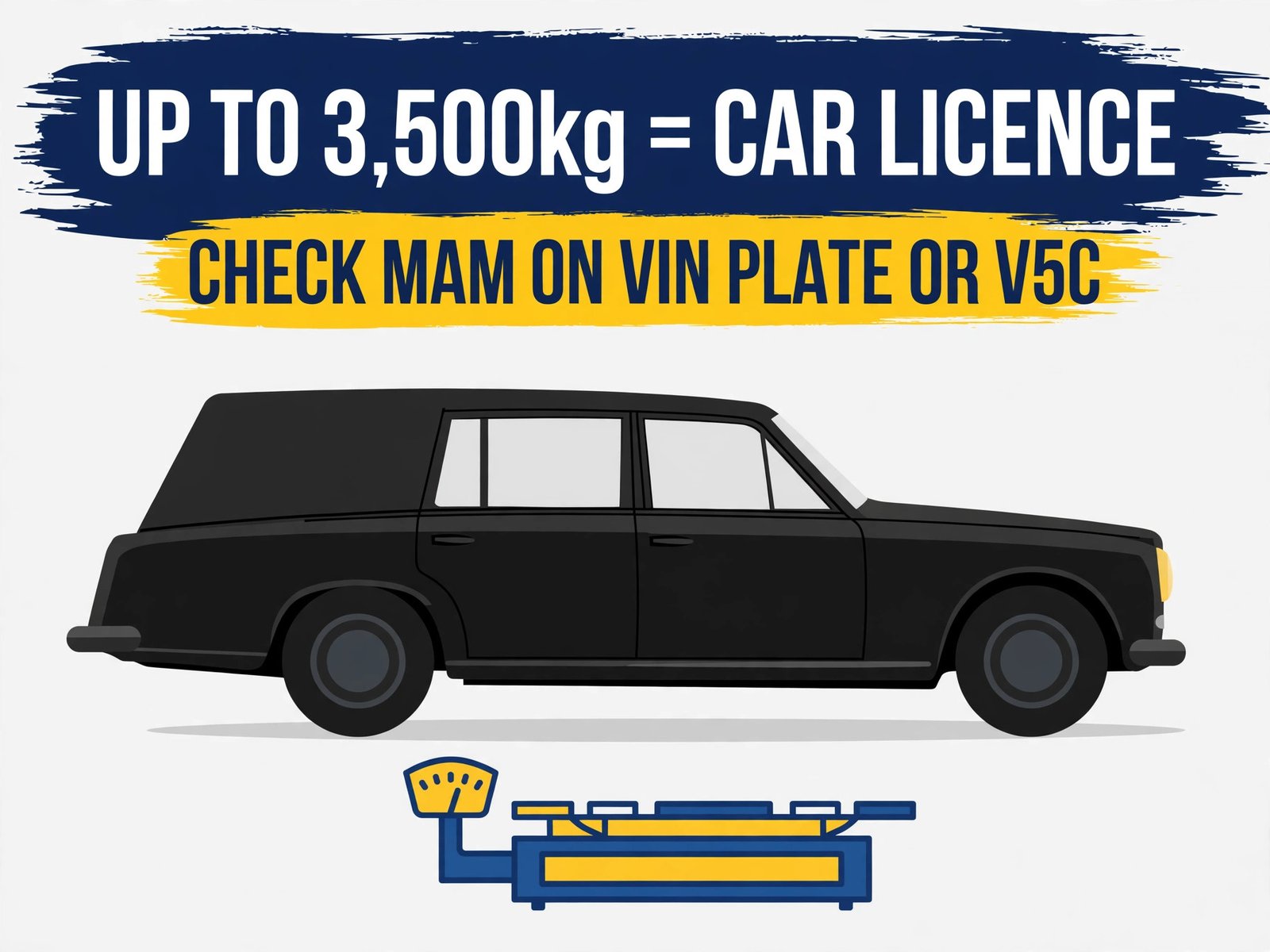
Do not guess a hearse’s weight from its size. Hearses vary a lot: a standard estate-based hearse is very different from a stretched or American-style one. Before driving any unfamiliar hearse, check its actual MAM. You will find it on the VIN plate (usually under the bonnet or in a door frame) and on the V5C registration document. If the MAM is 3,500kg or under, your car licence covers it.
The same weight logic runs through this whole licence series. It is why a van on a car licence UK question and a hearse question get the same answer — both are category B vehicles until the weight says otherwise.
Passed Your Test Before 1 January 1997?
If you passed your car test before 1 January 1997, you usually have wider entitlements: GOV.UK says drivers who passed before that date are usually allowed to drive a vehicle and trailer combination up to 8,250kg MAM. That extra headroom makes the hearse question even simpler for you — but entitlements from that era vary from person to person, so check your own licence record rather than assuming. The rule for everyone is the same: your licence, not the vehicle type, decides what you can drive.
What If the Hearse Is Over 3,500kg?
A small number of hearses — very large, stretched or heavily coach-built vehicles — could exceed 3,500kg MAM. In that case a car licence does not cover the vehicle:
- 3,500kg to 7,500kg MAM: you need category C1.
- Over 7,500kg MAM: you need category C.
Getting a higher category follows a set route. You must hold a full car licence first, then apply for provisional entitlement for the higher category using form D2 (and form D4, filled in by a doctor, if required — the D2 form tells you). There is no application fee, and your new licence normally arrives within about 3 weeks. You then pass the driving test for that category. You do not need to pass a test for a lower category first — applying for provisional C also gives you provisional C1, C1+E, C and C+E entitlements.
For comparison with vehicles that sit above car-licence limits by design, see the guides to driving an ambulance on a car licence UK and a lorry on a car licence UK.
Driving a Hearse for a Funeral Business
Here is where hearses genuinely are special — not in driving licence law, but in licensing law:
- No private hire licence needed. In England and Wales, the private hire licensing rules in the Local Government (Miscellaneous Provisions) Act 1976 do not apply to a vehicle while it is being used in connection with a funeral, or to a vehicle used wholly or mainly by a funeral director for funerals. London has an equivalent exemption in the Private Hire Vehicles (London) Act 1998 for vehicles whose private hire use is limited to funerals or weddings, and Scotland’s Civic Government (Scotland) Act 1982 says the same for vehicles used in connection with a funeral or wedding.
- No operator licence needed. The Goods Vehicles (Licensing of Operators) Regulations 1995 list a vehicle being used for funerals as one that does not require a goods vehicle operator’s licence.

None of this changes the basics. A working hearse still needs road tax, a valid MOT and proper insurance for funeral work, and the driver still needs the right licence category for the vehicle’s weight, as explained above. A bus on a car licence UK, by contrast, has no equivalent shortcut — buses sit in category D with their own rules.
Do You Need Driver CPC to Drive a Hearse?
For a standard hearse, no — because Driver CPC is the qualification for lorry, bus and coach drivers, and a category B hearse is none of those. CPC simply does not arise for a car-category vehicle.
Be careful with claims you may read elsewhere: funeral vehicles are not named in the GOV.UK list of Driver CPC exemptions. So if you ever drove an unusually heavy hearse — one needing C1 or C — as the main part of your job, do not assume a “funeral exemption” covers you. Check whether Driver CPC applies to your situation and take advice. The honest position is: B-category hearse, no CPC question; heavier vehicle driven professionally, check properly.
Can You Drive a Privately Owned Hearse?
Yes. Some people buy a hearse privately — as a novelty vehicle, a project or for events — and the licence answer is identical. A privately owned hearse is still just a category B vehicle if it is within the B weight and seat limits. It needs tax, MOT and insurance like any other car, and private ownership does not change the category.
Two cautions for private owners. First, ignore American advice online: US pages talk about “Class C licences” and a 26,001 lb threshold, which is the US system and has nothing to do with UK law. Second, a funeral procession has no special exemption from the rules of the road. A hearse follows normal road rules — other drivers showing courtesy in a procession is courtesy, not a legal right.
Note: this article covers Great Britain. Driving licence categories are different in Northern Ireland, so check the NI rules if that is where you drive.
Official source: GOV.UK driving licence categories.
Conclusion
So, can you drive a hearse on a car licence UK rules say yes — in almost every real case. A standard hearse is a category B vehicle: few seats, MAM within 3,500kg, and no special licence category exists for it. Check the individual vehicle’s MAM on the VIN plate or V5C if you are ever unsure, remember the pre-1997 entitlements are wider but personal, and only an over-3,500kg hearse pushes you towards C1 or C. For funeral work, the law even helps: funeral use is exempt from private hire licensing and from operator licensing. The licence question, for once, is the easy part.