Can I Drive a Taxi on a Car Licence UK?
No — not on a car licence alone. Your car licence covers the car, but it does not let you carry paying passengers. To drive a taxi or a private hire car (a minicab) for hire or reward, you also need a taxi or private hire driver licence, issued by your local council — or, in London, by Transport for London.
That surprises a lot of people, because a taxi is just an ordinary car. Under licence law it is: a standard taxi has up to 8 passenger seats and a maximum authorised mass within 3,500kg, so it sits squarely in category B and your car licence covers the vehicle completely. The extra licence exists because of what you are doing with the car — carrying members of the public for money — not because of the car itself.
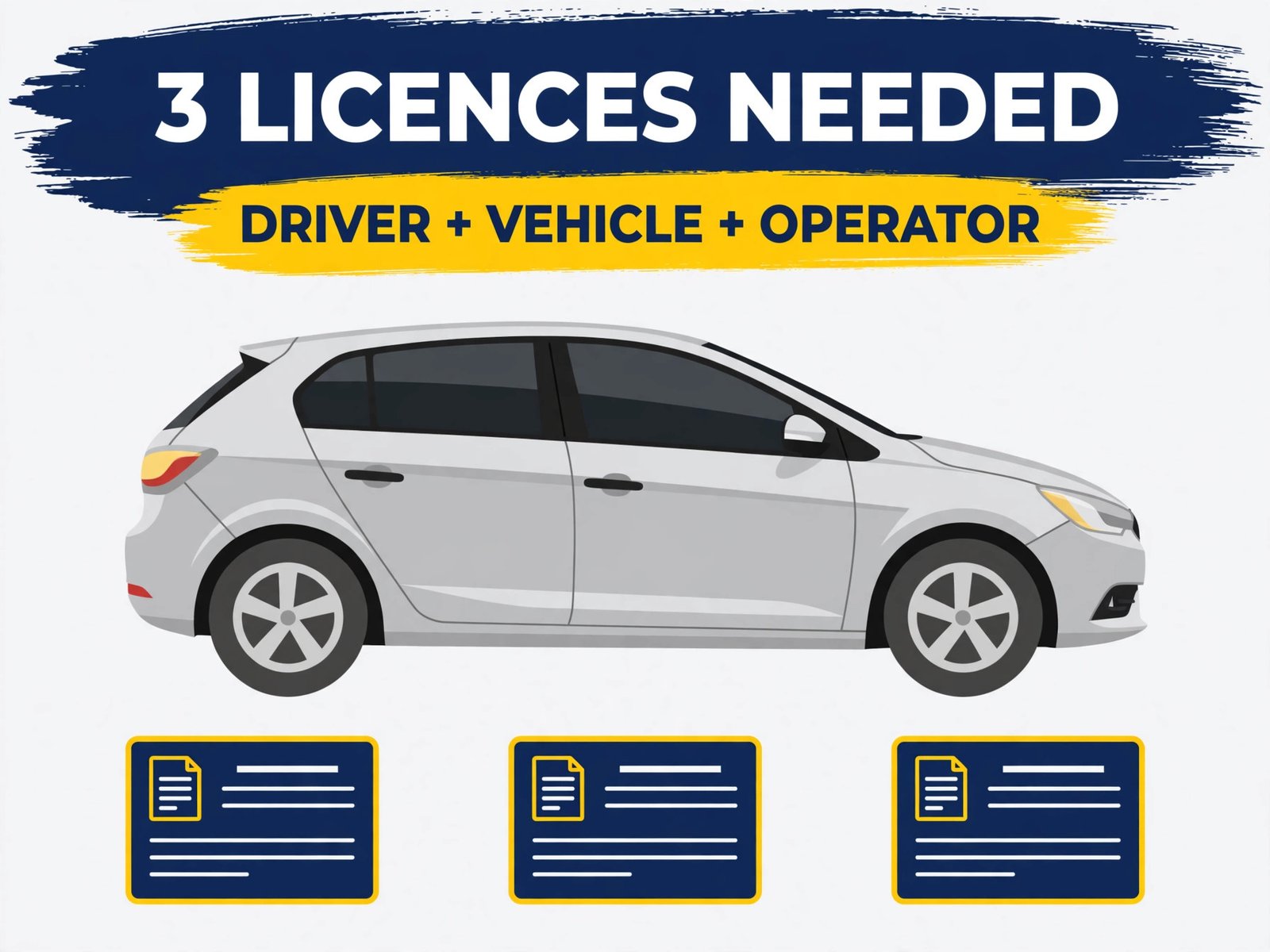
And the driver licence is only one of three licences involved. This article explains the hackney versus private hire split, what councils actually check before they license you, why London is a special case, and how Scotland and Northern Ireland differ.
Taxi and Private Hire at a Glance
| Licence layer | Who issues it | What it covers |
|---|---|---|
| Driving licence | DVLA | Lets you drive the car itself, normally under Category B |
| Driver licence | Local council, or TfL in London | Lets you carry passengers for hire or reward |
| Vehicle licence | Local council, or TfL in London | The taxi or private-hire vehicle itself is licensed and checked |
| Operator licence (private hire) | Local council, or TfL in London | Private-hire bookings must run through a licensed operator |
Can I Drive a Taxi on a Car Licence?
Not for paying passengers. A full car (category B) licence is the starting point — you cannot get a taxi licence without one — but on its own it only entitles you to drive the car privately. The moment you carry passengers for hire or reward, taxi licensing law applies on top of driving licence law.
In England and Wales, the Local Government (Miscellaneous Provisions) Act 1976 is clear: in a controlled district, nobody may drive a private hire vehicle without a driver licence, the vehicle itself needs a vehicle licence, and the bookings must run through a licensed operator. Hackney carriages (taxis you can hail) are licensed under the same system, with their roots in the Town Police Clauses Act 1847.
So think of it as two layers. Layer one is your driving licence — it says you can drive the vehicle. Layer two is the taxi licence — it says you are a fit and proper person to carry the public for money, in a licensed vehicle, under a licensed operator where one is required.
Why a Car Licence Is Not Enough
Taxi licensing exists to protect passengers. A council needs to know who is driving strangers around at night, whether that person has a safe driving record and clean background, and whether the car is checked and insured for the job. Your ordinary driving licence answers none of those questions, which is why the second layer exists.
The “three licences” structure matters because a gap in any one of them leaves you illegal:
- Driver licence — issued to you personally by the council (or TfL in London). It permits you to drive a licensed vehicle for hire.
- Vehicle licence — attached to the car. The taxi or private hire vehicle itself must be licensed and meet the council’s standards, which can include age and condition rules.
- Operator licence — needed for private hire work. Bookings must go through a licensed operator; a licensed driver in a licensed car still cannot legally take a private hire job that was not booked through one.
Two things a taxi is not. First, it is not a minibus: a vehicle with 9 to 16 passenger seats needs category D1 thinking on the licence side, which is a different question — see the guide to driving a minibus on a car licence UK. Second, it is nothing like the funeral-vehicle exemptions you may have read about: funeral use is specifically exempt from private hire licensing, while taxi work is exactly what that licensing exists for — compare the guide to driving a hearse on a car licence UK.
Hackney Carriage vs Private Hire: The Key Split
“Taxi” in everyday speech covers two legally different jobs:
- Hackney carriage (a “taxi” proper): can be hailed in the street, can wait at taxi ranks, and can take direct bookings. Hackney carriages have a roof sign and a meter, and the council can set conditions on the vehicle’s design and appearance. Hackney drivers do not need an operator — they work for themselves.
- Private hire vehicle (PHV / minicab): every journey must be pre-booked through a licensed operator. A minicab cannot use ranks and cannot be hailed — if you flag one down, it is not insured or licensed for that journey.
Many councils issue a “dual” driver licence that covers both hackney and private hire driving. The practical point for new drivers: with a private hire licence you live and die by bookings through your operator; with a hackney licence you can also work ranks and street hails.
The vehicle side of the split follows the same vehicle logic as everywhere else in this series — the car is a category B vehicle, exactly like a van on a car licence UK question. It is the work, not the wheels, that needs the extra licence.
How to Get a Taxi or Private Hire Driver Licence
You apply to your local council — the district, borough or city council where you will work. London is the exception (next section). There is no single national taxi licence and no single national rulebook, so expect this pattern, with local variation:
- Fit and proper person test — the council’s overall judgement of whether you should be trusted with the public.
- Enhanced DBS check — a criminal record check is standard everywhere.
- Medical — many councils require a Group 2 standard medical, often done with your GP.
- Driving record — the council checks your DVLA record. Points and bans matter here, because they feed the fit and proper decision; the penalty points on a driving licence guide explains how points build up, and you can view your own record any time with a driving licence check code.
- Right to work in the UK, and sufficient English to communicate with passengers.
- Safeguarding training — required by many councils.
- Knowledge or local-area test — many councils set one, but not all. West Lindsey, for example, removed its knowledge test requirement in June 2026. Check your own council rather than assuming.
The numbers genuinely vary, so treat these as examples, not national rules:
- Minimum age: ranges from 18 to 21 depending on the council.
- How long you must have held a full licence: ranges from 12 months to 3 years depending on the council.
- Licence length: commonly 3 years, with the council confirming the exact term.
- Fees: set by each council and vary widely — one council’s new dual driver licence costs £391, another’s starts nearer £112 for a year. Always check your council’s current fees before budgeting.
- Renewals: you will be asked for an HMRC tax check code when you renew.
London: TfL, the PCO Licence and the Knowledge
London does its own thing. Transport for London (TfL) licenses both taxis and private hire in the capital — there is no council route.
- Black cabs (hackney carriages): the famous barrier is the Knowledge of London — learning around 25,000 streets and 20,000 landmarks within a six-mile radius of Charing Cross, tested in oral exams called “appearances”. It typically takes 2 to 4 years of study. Drivers who pass earn the Green Badge. You also need to be at least 21, hold a full DVLA licence, pass an enhanced DBS check and a medical, and pass the SERU safety, equality and regulatory test.
- Private hire (minicabs): licensed by TfL with what is still widely called a PCO licence. Instead of the Knowledge, private hire applicants take a topographical skills test (map reading and route planning), must meet TfL’s English Language Requirement, and also pass the medical, DBS and SERU checks. No Knowledge is required for private hire.

None of this applies outside London. The Knowledge is a London black-cab requirement only.
Scotland and Northern Ireland
Scotland licenses taxi and private hire drivers through councils under the Civic Government (Scotland) Act 1982. A Scottish taxi driver licence lets you drive both taxis and private hire cars; a private hire licence covers private hire only, pre-booked. Taxis carry a roof sign and meter and can be hailed or use ranks; private hire cars are pre-booked only. Fees and licence lengths are set by each council, with 1, 2 and 3-year options in some areas.
Northern Ireland is different again — councils are not involved. The Driver & Vehicle Agency (DVA) licenses taxi drivers, vehicles and operators. First-time driver applicants must have held a full category B licence continuously for at least 3 years, be of good repute, pass a medical, have the right to work in NI, and pass both a taxi driver theory test and a practical test. The DVA advises applying at least 16 weeks ahead. Every NI taxi driver must work for a licensed operator or hold their own taxi operator licence, and renewals involve periodic training plus an HMRC tax code.
One boundary rule for everyone: your taxi licence is issued by one authority. Working outside that authority’s area has its own rules — check with your licensing authority before you rely on another area’s work.
What Happens If You Drive Without the Licence?
Keep it simple: driving a taxi or private hire vehicle for hire without the licences is an offence. Under the 1976 Act, knowingly driving a private hire vehicle without a current driver licence (or using an unlicensed vehicle, or working without a licensed operator) is an offence you can be prosecuted for, in England and Wales.
The licensing consequences run alongside any prosecution. A council can suspend, revoke or refuse to renew a driver licence — the 1976 Act lists grounds including convictions for offences involving dishonesty, indecency or violence, offences under the taxi legislation itself, or “any other reasonable cause”.
There is also an insurance trap. Ordinary car insurance does not cover taxi work. Carrying paying passengers without hire-and-reward (taxi) insurance means you are effectively uninsured for that journey — which is a serious problem on its own, quite apart from the licensing offence.
Official source: GOV.UK taxi driver licence guidance.
Conclusion
So, can you drive a taxi on a car licence UK rules say: the licence covers the car, but not the job. A taxi is a category B vehicle, so your full car licence is the necessary first layer — but carrying passengers for hire or reward needs the second layer: a council (or TfL) driver licence, a licensed vehicle, and for private hire work, a licensed operator behind the booking. The checks are thorough because passengers have to trust a stranger: DBS, medical, driving record, safeguarding and, in London’s black cabs, the Knowledge. Get the right licence from the authority where you will work, and the car licence you already have does the rest.