Mock Theory Test UK: Free Practice Questions & Answers (2026)
A mock theory test is a practice version of the real DVSA theory test — the same style of questions, the same 50-question format, and the same pass mark of 43, but with no pressure and no fee. Taking mock tests is the most reliable way to know whether you are ready to book the real thing. This page explains how mock tests work and gives you 12 real-style practice questions with answers to test yourself right now.
Before you can book any theory test you need a provisional driving licence. The questions in every mock come from the same three official sources as the real test: The Highway Code, Know Your Traffic Signs, and Driving — The Essential Skills.
The Real Theory Test at a Glance
| Test part | Format | Pass mark |
|---|---|---|
| Multiple-choice questions | 50 questions in 57 minutes | 43 out of 50 |
| Hazard perception | 14 video clips, with 15 developing hazards in total | 44 out of 75 |
| Overall result | Both parts are taken back to back and both must be passed | Pass certificate valid for 2 years |
What Is a Mock Theory Test?
A mock theory test (sometimes called a theory exam mock or a practice theory test) copies the real exam as closely as possible. You answer multiple-choice questions under timed conditions, then get a score straight away so you can see which topics are weak. Unlike the real test, you can take a mock as many times as you like, at home, for free.
Mocks exist for both parts of the test. The question part is easy to practise anywhere. The hazard perception part needs video clips, which the official DVSA kit and apps provide. The questions below cover the multiple-choice part — the part most learners fail on topics like road signs, speed limits and stopping distances.
The Real Test Format You Are Practising For
The real car theory test has two parts, taken back to back in one sitting, and you must pass both:
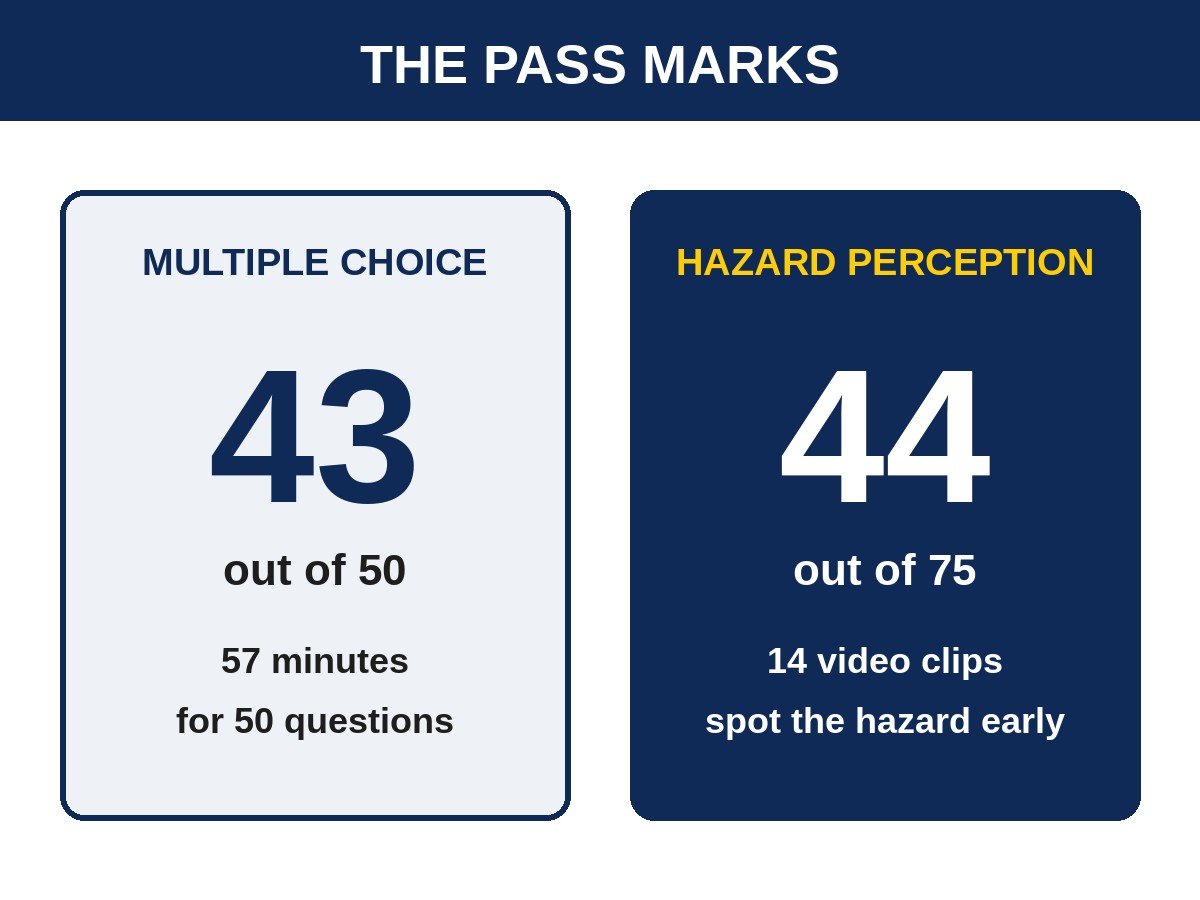
- Multiple choice: 50 questions in 57 minutes. Three of the questions are about a short video clip. You can flag questions and return to them. Pass mark: 43 out of 50.
- Hazard perception: 14 video clips of everyday road scenes. One clip has 2 developing hazards. You score up to 5 points for spotting each hazard early. Pass mark: 44 out of 75.
Our full guide to the theory test pass mark explains the scoring and topics in more detail. If you fail either part, you fail the whole test and must wait at least 3 working days before taking it again.
Free Mock Theory Test: 12 Practice Questions
Try these 12 questions without looking at the answers first. Each one follows the real test style: read the question, pick A, B, C or D, then open the panel to check yourself. In the real test you need 43 out of 50 — here, aim for at least 10 out of 12.
Scored 10 or more? You are on track. Below 8? Your weak topics are showing — note which questions you missed (signs, limits, distances or rules) and revise those first, then try another mock.
Hazard Perception: How to Practise
Hazard perception is the part learners find strangest, because it tests timing, not knowledge. You watch 14 clips filmed from the driver’s seat. Each clip contains a developing hazard — something that would make you slow down or change direction, like a car pulling out or a cyclist swerving.
- Click as soon as the hazard starts to develop — the earlier you spot it, the more of the 5 points you score.
- Do not click in a pattern or keep clicking — DVSA treats rhythmic clicking as cheating and you score zero for that clip.
- One click per hazard is enough, with a second click a moment later if you are unsure — you do not lose points for a wrong click.
- Practise with the official DVSA clips so the film style and timing feel familiar on the day.
How to Use Mock Tests to Pass First Time
- Study first, test second: read a topic in the Highway Code, then take a topic mock on it the same day.
- Use timed mode once you know the basics — 57 minutes for 50 questions is about a minute per question.
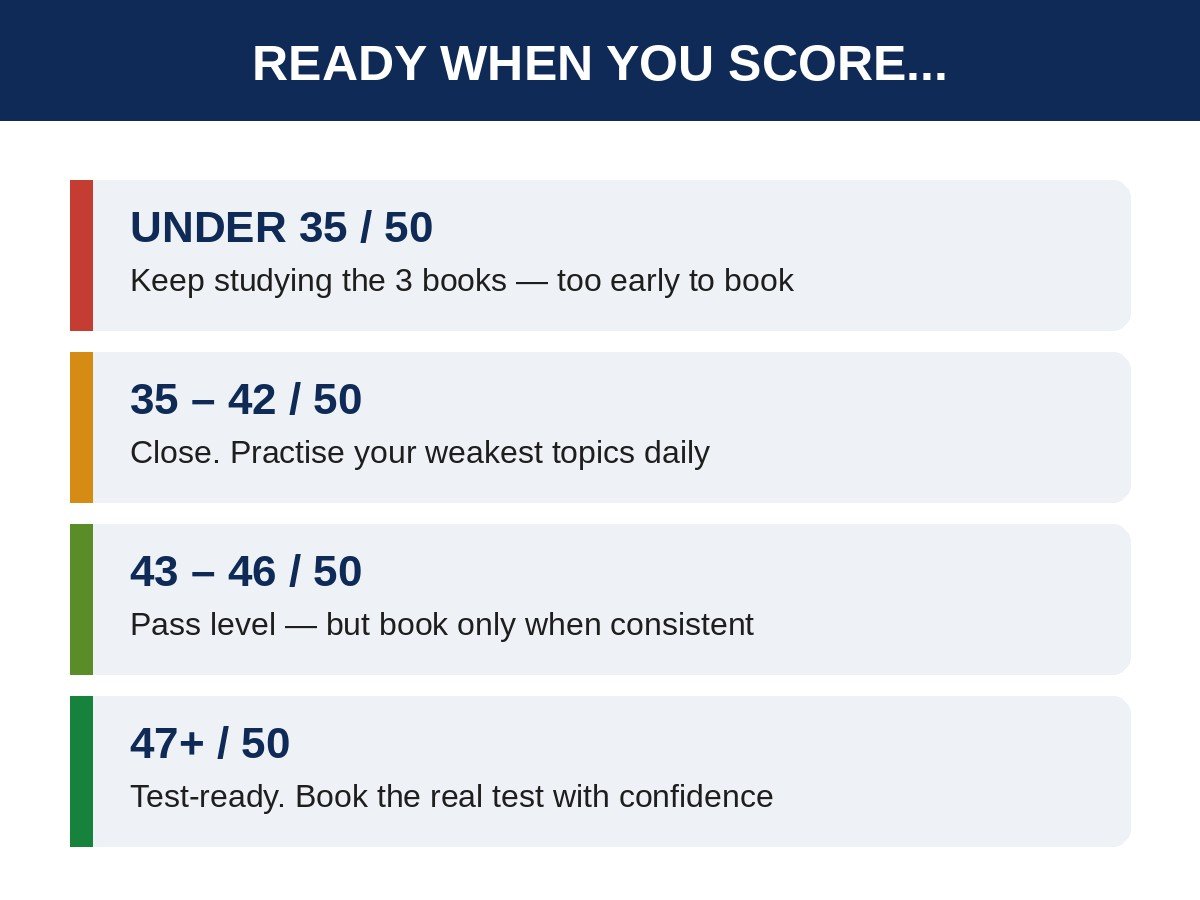
- Track your scores: write down every mock score. One pass proves nothing; three passes in a row at 47 or more means you are ready.
- Review every wrong answer — the explanation teaches more than the question.
- Mix in sign-only practice: traffic signs are the most common weak spot in mocks.
Booking the Real Test When You Are Ready
When mock scores say you are ready, book the real test on GOV.UK — you will need your provisional licence number and a debit or credit card. Our guide to the driving test booking rules covers changing or cancelling appointments for both tests.
Pass, and you get a pass certificate number at the test centre. It lasts 2 years — our guide to how long a theory test certificate is valid explains what happens if it runs out before you pass the practical test. Fail, and you must wait at least 3 working days and retake the whole test, including the part you passed.
Official source: GOV.UK theory test guidance.
Conclusion
A mock theory test turns a scary unknown into a number you can improve. Learn the three official books topic by topic, take timed mocks, review every mistake, and book the real test only when you are passing comfortably at 47 or above. Do that, and the real 43-out-of-50 pass mark feels easy on the day.


2 Comments