L Plates Rules UK: Size, Placement and Penalties (2026 Guide)
If you’re learning to drive in the UK, displaying L plates the right way isn’t optional — it’s the law. The L plates rules UK learners must follow cover the exact plate size, where they go on the car, and what happens if you get it wrong (£100 fine and penalty points). This guide gives you every rule in plain English, so you can drive with confidence.
L Plate Rules at a Glance
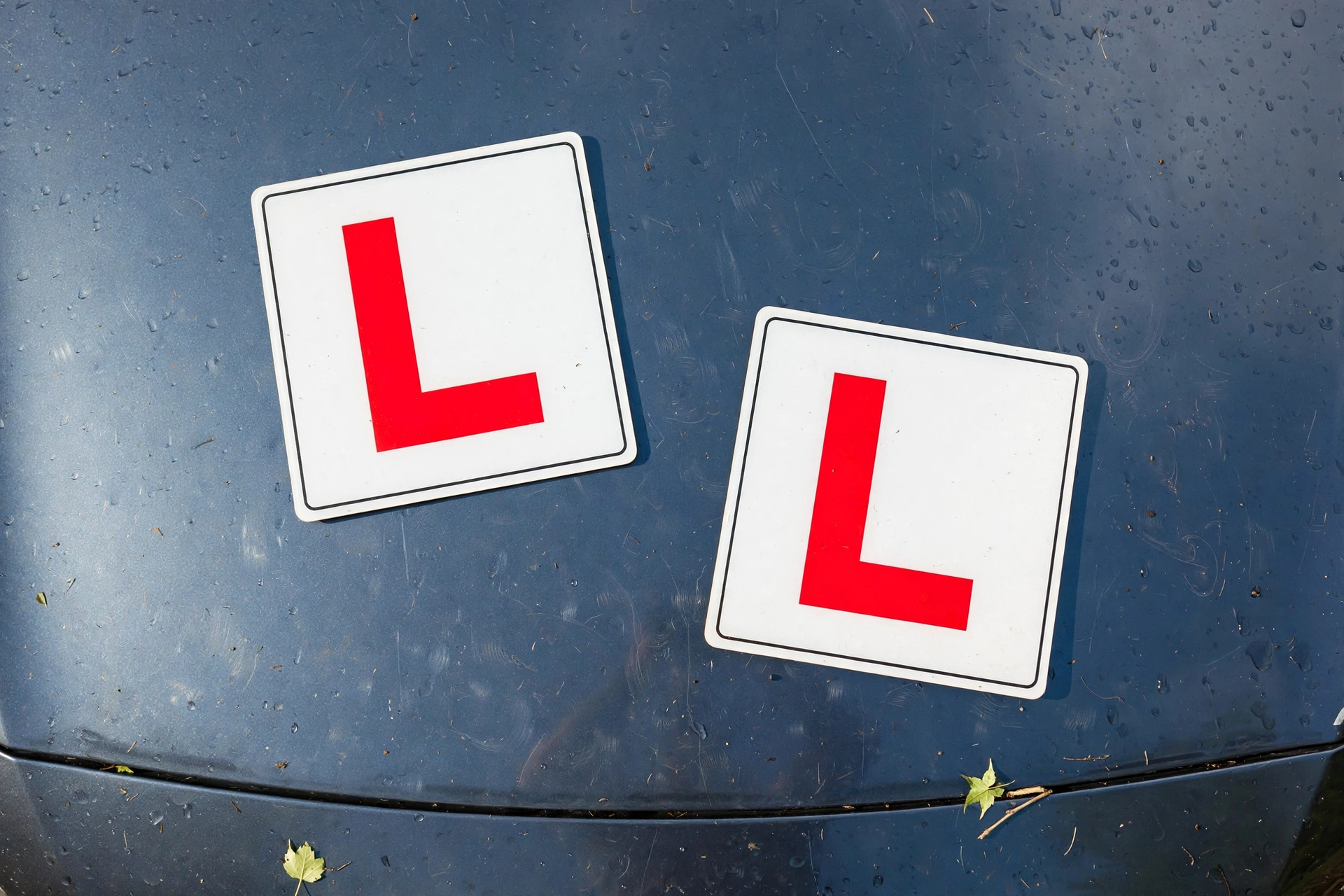
- You must display L plates on the front and rear of the vehicle whenever a learner is driving on a public road.
- Each plate must show a red L on a white background and measure 178mm × 178mm.
- In Wales, you may use a D plate instead of (or as well as) an L plate.
- Remove or cover the plates whenever a fully qualified driver is using the car.
- Getting it wrong can mean a £100 fine and 3 penalty points (offence code LC20), or up to 6 points in serious cases.
L Plate Size: The 178mm Rule
The legal size of an L plate is 178mm by 178mm (about 7 inches square). This isn’t a rough guideline — the dimensions are set in law, and plates that are too small don’t count. There are also exact specifications for the lettering itself: the proportions of the red L within the white square are fixed.
Practical tips:
- Buy plates from a reputable UK retailer that states they meet UK legal specifications. (Note: the Republic of Ireland uses slightly different L plate dimensions — Irish plates are not legal in the UK.)
- Keep plates clean and undamaged. A faded, cracked, or mud-covered plate that can’t be read clearly can still land you in trouble.
- Magnetic plates are fine as long as they stay flat and fully visible at speed. If yours curl or flap, replace them.
Where to Put L Plates on Your Car
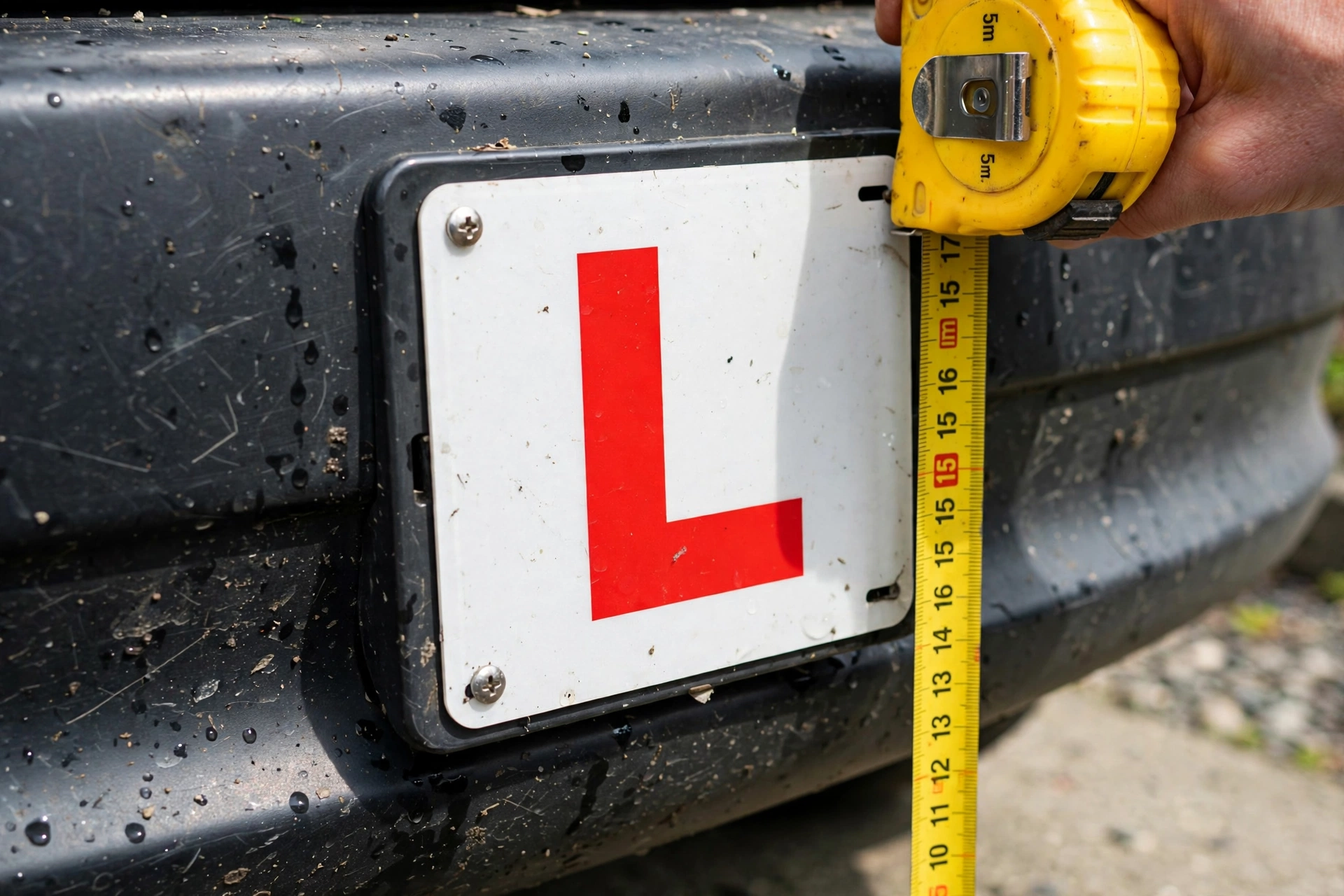
The rule is simple: L plates must be clearly visible from the front and the rear of the vehicle. That means at least two plates — one front, one back.
- Common spots: the bonnet (front) and the boot or rear bumper (back).
- Do not stick them on windows where they block your view — they shouldn’t restrict the driver’s vision.
- There’s no single mandated position, because what works on one car may be hidden on another. Use your judgement: if another driver can’t easily see the plate, move it.
- For motorcycles, the L must be visible from behind in the equivalent way.
L Plate Colour and Design Rules
Every legal L plate must have:
- A red letter L on a white background
- No extra text, logos, or decorations on the plate face
- The correct 178mm × 178mm size
Homemade plates, printed paper signs, or novelty designs do not meet the legal standard. If stopped, “it looked about right” is not a defence — buy proper plates; they cost only a few pounds.
D Plates in Wales
In Wales, learners may display a D plate (from the Welsh “dysgwr”, meaning learner) instead of an L plate — or alongside one. The same size and colour rules apply: red D on white, 178mm × 178mm, front and rear. Outside Wales, stick to L plates.
When You Must Remove L Plates
L plates may only be displayed while a learner driver is actually driving the vehicle. When a fully qualified driver takes the wheel — a parent driving to the shops, for example — the plates must come off or be covered.
Why it matters: displaying L plates when you’re not a learner is itself against the rules, and it confuses other road users who expect a learner’s driving behaviour.
Who Can Sit Beside You (Supervisor Rules)
L plates are only half the learner equation — you also need a legal supervisor in the front passenger seat. The supervisor must:
- Be at least 21 years old
- Have held a full driving licence for at least 3 years (for the vehicle type being driven)
- Meet the same legal standards as a driver (not over the drink-drive limit, no phone use, etc.)
For the full breakdown, see our guide: Who Can Supervise a Learner Driver in the UK.
You’ll also need a provisional licence before any practice — instructors legally can’t take you out without one: Provisional Driving Licence.
Penalties for Breaking L Plate Rules
Ignoring the L plates rules can hit your licence before you’ve even passed your test:
- The standard fixed penalty is £100 and 3 penalty points under offence code LC20 (“driving otherwise than in accordance with a licence”).
- In more serious cases — for example, no plates at all — you can receive up to 6 penalty points.
- Points go on your provisional licence and carry over when you pass. Under the New Drivers Act, reaching 6 points within your first two years means your licence is revoked.
More on how points work: Penalty Points on a Driving Licence.
L Plates vs P Plates: What’s the Difference?
L plates: Learner driver — mandatory for learners — used while learning with a supervisor — red L on white.
P plates: Passed (probationary) driver — completely voluntary — used after passing if you want extra consideration — green P on white.
After you pass, swap the L plates for P plates if you like — but never drive with L plates once you’re fully qualified.
Where to Buy Compliant L Plates
Any UK motoring retailer — Halfords, Amazon UK, eBay sellers stating UK-legal spec, petrol stations — sells compliant plates for a few pounds. Look for the words “UK legal” or “meets UK specifications” and the 178mm size in the listing. Magnetic sets are the most convenient for shared family cars since they come off in seconds.
Conclusion
The L plates rules UK learners must follow are straightforward: red L on white, 178mm × 178mm, one on the front and one on the rear, removed whenever a qualified driver takes over — with D plates as the Welsh alternative. Get these five things right and you’ll never have to think about them again. Get them wrong, and you’re risking a £100 fine and points on a licence you haven’t even fully earned yet. Plates cost a few pounds; the penalty costs far more.

One Comment